SLU-PP-332 is an experimental small molecule, not a peptide, designed to make muscle act as if it has been exercising. In mice it improved running endurance, burned more fat and protected against obesity and heart failure.[1][2][3] It has never been tested in people, and it is not approved for any use.[10][14]
This profile covers how SLU-PP-332 works, what the animal research shows, what is unknown about safety, the doses used in mice, how it compares with related compounds, and its legal and anti-doping status.
What is SLU-PP-332?
SLU-PP-332 was designed by researchers at Saint Louis University and Washington University in St. Louis, led by Thomas Burris and John Walker, and first reported in 2023.[1] It is a small synthetic molecule, built by improving an older research compound called GSK4716.[1] Anti-doping scientists describe it as a small, synthetic ERR agonist.[12]
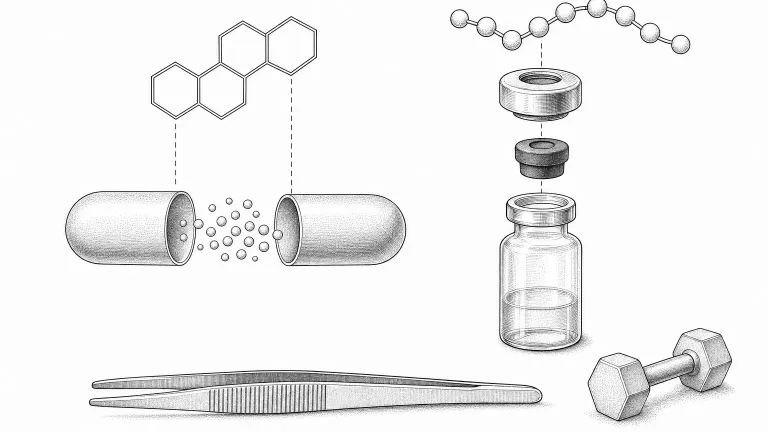
It is not a peptide. Peptides are short chains of amino acids. SLU-PP-332 is a conventional small-molecule drug candidate, even though it is often sold and discussed alongside peptides.
It is sometimes called an “exercise pill” or “exercise mimetic”. Those labels describe its effects in mice, not anything shown in people.[5]
How SLU-PP-332 works
SLU-PP-332 switches on the estrogen-related receptors (ERRα, ERRβ and ERRγ). Despite the name, they are “orphan” receptors, separate from the estrogen receptors. They control genes for mitochondria, fat burning and endurance. SLU-PP-332 is most potent at ERRα.[1]
In mouse muscle, one dose switched on some of the same genes that a treadmill run turns on. In mice whose muscle lacked ERRα, the endurance benefit disappeared, which suggests ERRα drives the effect.[1]
SLU-PP-332 research: what studies have found
In animals
- Endurance: mice given SLU-PP-332 for a week ran about 70% longer and 45% farther than untreated mice. In a separate 15-day experiment, treated mice had more oxidative (endurance-type) fibers and more mitochondria.[1]
- Obesity and metabolic syndrome: in obese mice, SLU-PP-332 increased energy use and fat burning, reduced fat gain and improved insulin sensitivity.[2] According to the University of Florida, obese mice treated twice a day for a month gained 10 times less fat than untreated mice and lost 12% of their body weight, while eating the same amount.[5]
- Heart failure: in mice with a stressed, failing heart, SLU-PP-332 and a related compound improved how well the heart pumped, reduced scarring and improved survival.[3]
- Aging kidneys: in 21-month-old mice, 8 weeks of SLU-PP-332 reversed age-related protein leakage into urine, mitochondrial problems and inflammation in the kidney.[4]
In human cells
In Italy, researchers took muscle biopsies from 20 women having hip replacement surgery. When they treated muscle cells from the inactive women with SLU-PP-332 in a dish, markers of oxidative stress and aging went down and the cells formed more myotubes (early muscle fibers).[9] This is lab work on cells, not treatment of people.
In people
There are no human studies. As of October 2026, no clinical trial of SLU-PP-332 is registered on ClinicalTrials.gov.[14] A 2026 systematic review from Chile, limited to animal and cell studies published from 2020 to 2024, concluded that clinical trials are needed to confirm efficacy and safety in humans.[10]
SLU-PP-332 side effects and safety
Human side effects are unknown because no human has been studied.
- Short mouse studies: 10 days of twice-daily dosing caused no obvious toxicity. Blood counts, electrolytes and a muscle damage marker stayed normal.[1] No long-term toxicity studies have been published.
- Not optimized as a drug: its developers describe SLU-PP-332 as a widely used research tool, and in 2026 reported modified versions with better solubility or metabolic stability.[8] In 2023, they said it would need further changes and more animal safety testing before any human trial.[5]
- Oral use: its developers state that SLU-PP-332 lacks oral bioavailability.[6] Products taken by mouth may deliver little of the compound.
- Product quality: SLU-PP-332 sold online is not made under drug-quality standards, so purity and dose are unknown.
SLU-PP-332 dosage: what has been studied
No human dose exists. These are mouse doses:
| Study | Dose |
|---|---|
| Endurance study | 50 mg/kg twice daily, injected into the abdomen, for 7 days[1] |
| Obesity studies | Twice-daily dosing for about a month[2][5] |
Mouse doses cannot be converted directly into a safe or effective human dose.
SLU-PP-332 vs SLU-PP-915 and other exercise mimetics
- SLU-PP-915 is a chemically different ERR activator from the same researchers.[7] Unlike SLU-PP-332, it works when swallowed. In mice it improved running distance and time about as much as SLU-PP-332.[6] It also has no human data.
- GW1516 (cardarine) works on a different receptor, PPARδ. WADA names it under metabolic modulators.[13]
- MOTS-c is a real peptide that also mimics some exercise effects in mice through a different pathway.
- 5-Amino-1MQ and AOD-9604 are other compounds promoted for fat loss. ACE-031 is promoted for muscle growth. Each works differently.
Is SLU-PP-332 legal or FDA approved?
- Not approved anywhere. SLU-PP-332 is a preclinical compound with no approved medical use and no human trials.[10][14]
- Anti-doping: WADA’s 2026 Prohibited List does not name SLU-PP-332. However, WADA’s S0 section bans at all times any pharmacological substance that is not covered elsewhere on the list and has no government approval for human use, including drugs in preclinical development.[13] WADA has not named SLU-PP-332, but in our reading it would fall under S0 (or possibly S4.4 metabolic modulators). Anti-doping labs in Germany and at UCLA have used human liver preparations to identify its breakdown products, to help detect misuse.[11][12] Athletes should assume it is prohibited.
We did not find trustworthy, non-vendor user reports about SLU-PP-332, so this profile does not include a user-experience section.
This is general information, not legal advice.