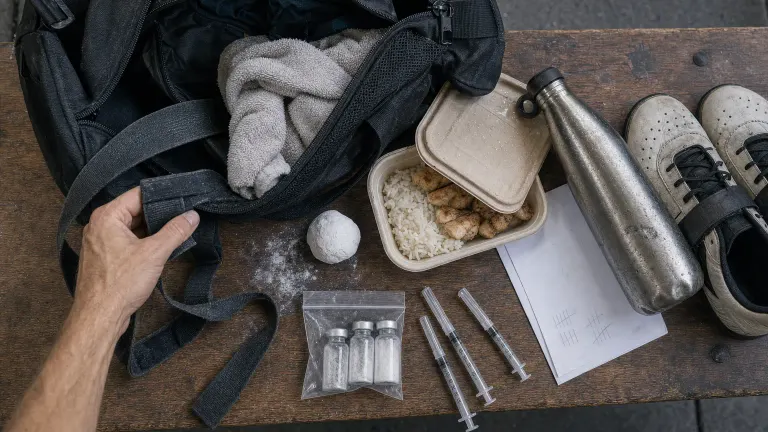
The best peptides for muscle growth, judged by evidence rather than hype, are not injectable drugs at all: in randomized trials, about 15 g a day of collagen peptides plus resistance training added about 1.3 kg more fat-free mass than training alone in older men, and whey protein beat collagen for muscle size in young adults.[2][4] Growth hormone secretagogues such as CJC-1295, ipamorelin and MK-677 raise hormone levels but have not been shown to increase strength, and IGF-1 LR3 and follistatin have no human muscle-building trials.[8][9][10]
“Best” here means best supported by evidence. This guide ranks the options, explains the risks and covers anti-doping rules. For related topics, see our muscle and metabolism peptides hub.
Evidence-graded table
| Peptide or drug | Evidence level | What was shown | FDA status | Our profile |
|---|---|---|---|---|
| Protein supplements with resistance training | Human RCTs | +0.3 kg fat-free mass and +2.5 kg one-rep max across 49 trials[1] | Food (not a drug) | None |
| Collagen peptides with resistance training | Human RCTs (small) | +4.2 vs +2.9 kg fat-free mass in older men; less muscle than whey in young adults[2][4] | Food or dietary supplement | None |
| Growth hormone (somatropin) | Human RCTs | +2.1 kg lean mass, no strength gain in fit young adults[6] | Approved for GH deficiency, not for muscle building[7] | HGH |
| MK-677 (ibutamoren) | Human RCTs (surrogate outcomes) | +1.1 kg fat-free mass in older adults; no strength gain; higher blood sugar[8] | Not approved; FDA safety-risk list[16] | MK-677 |
| CJC-1295 | Small human studies | Raised GH and IGF-1 for days; no muscle outcomes measured[9] | Not approved | CJC-1295 |
| Ipamorelin, GHRP-2, GHRP-6 | Small human studies | Raise GH; no muscle trials in healthy people[10] | Not approved; safety-risk list for compounding[16] | Ipamorelin, GHRP-2, GHRP-6 |
| IGF-1 LR3 | Animal or lab only | No human studies[10] | Not approved (mecasermin is approved only for severe primary IGF-1 deficiency)[11] | IGF-1 LR3 |
| PEG-MGF | Animal or lab only | No human studies[10] | Not approved | PEG-MGF |
| Follistatin | Small human studies (gene therapy in muscular dystrophy) | Mixed walking results in 6 patients[14] | Not approved | None |
| Myostatin antibody (apitegromab) | FDA-approved for a different use | Modest motor gains in spinal muscular atrophy[15] | Approved for SMA only (Sept 2026) | None |
| BPC-157, TB-500 | No evidence for muscle growth | Healing studies in animals only | Not approved | BPC-157, TB-500 |
Trial results come from different groups of people and are not head-to-head comparisons.
Start with what works: training, protein and sleep
Progressive resistance training is the main driver of muscle growth, and protein helps it along. A meta-analysis of 49 randomized trials with 1,863 participants found that protein supplements during training added about 0.3 kg of fat-free mass and 2.5 kg to one-rep max strength. Benefits leveled off above roughly 1.6 g of protein per kg of body weight per day.[1]
Those numbers are modest, and that is the honest baseline. Any peptide marketed for “explosive” muscle gains should be judged against it.
Collagen peptides: the one “peptide” with trials
Collagen peptides are short protein fragments made by breaking down collagen from animal skin or bone. They are sold as food powders, not drugs.
- Older men with sarcopenia (age-related muscle loss): in a 12-week trial of 53 men averaging 72 years, all did supervised strength training three times a week. Those taking 15 g of collagen peptides gained 4.2 kg of fat-free mass versus 2.9 kg on placebo, and gained more quadriceps strength.[2]
- Premenopausal women: in a trial of 77 women, 15 g a day of collagen peptides with training produced larger gains in fat-free mass and hand-grip strength than training with placebo.[3]
- Young untrained adults: when 35 g of whey was compared with leucine-matched collagen, whey increased thigh and arm muscle thickness more, while strength gains were similar.[4]
- Recreational athletes: 30 g a day of collagen did not raise muscle or connective-tissue protein synthesis during a week of hard training.[5]
The takeaway: collagen beats a no-protein placebo, but it is a lower-quality protein than whey for building muscle. It is reasonable as part of total protein intake, not as a shortcut.
Growth hormone and GH secretagogues
Growth hormone itself is the comparison point for every “GH peptide.” A review of 27 study groups of fit adults with an average age of 27 found GH added about 2.1 kg of lean body mass, but strength and exercise capacity did not improve, and swelling and fatigue were more common.[6] Much of the lean-mass gain reflects fluid. Growth hormone is approved for adults with confirmed GH deficiency, which usually requires stimulation testing, not for building muscle.[7]
MK-677 is an oral ghrelin mimetic, a drug that copies the hunger hormone ghrelin and triggers GH release. In a two-year trial of 65 healthy adults aged 60 to 81, it raised GH and IGF-1 to young-adult levels and added 1.1 kg of fat-free mass at one year. Strength and function did not improve, body weight rose 2.7 kg, fasting blood sugar rose and insulin sensitivity fell.[8]
CJC-1295 is a long-acting GH-releasing hormone analog. A single injection raised GH and IGF-1 for days in healthy adults, but the study measured hormone levels, not muscle.[9] A 2026 review sorting GH-axis peptides by evidence found that ipamorelin, the GHRPs, IGF-1 LR3 and PEG-MGF range from limited hormone data to no human studies at all.[10] Compare these options in IGF-1 LR3 vs MGF and peptides vs SARMs.
IGF-1 LR3 and mechano growth factor
IGF-1 LR3 is a lab-modified, longer-acting form of insulin-like growth factor 1. It was designed for cell-culture research. The only approved IGF-1 drug, mecasermin, is used for children with severe primary IGF-1 deficiency, and its label warns that severe low blood sugar, including seizures, has occurred.[11]
Quality is a separate problem. A German anti-doping lab found a version of IGF-1 LR3 carrying a “His-tag,” a purification handle used in lab research, in a black-market injection vial. Its effects in humans are unknown.[12]
Follistatin and myostatin blockers
Myostatin is a protein that limits muscle size. In mice bred without it, individual muscles weigh two to three times more than normal.[13] Follistatin is a natural protein that blocks myostatin.
In humans, follistatin has been tested only as an experimental gene therapy. In a trial in six men with Becker muscular dystrophy, walking distance improved in some patients and not others.[14] In September 2026, FDA approved apitegromab, an antibody that blocks myostatin activation, for spinal muscular atrophy in people already on standard therapy. It improved a motor-function score by 2.2 points over placebo.[15] That is a rare-disease approval, not evidence that “follistatin peptides” sold online build muscle. Our follistatin and myostatin research review covers the full history.
Risks, legal status and anti-doping rules
For athletes, the answer is simple. WADA prohibits growth hormone, GH-releasing factors including CJC-1295 and ipamorelin, IGF-1 and its analogues, mechano growth factors and myostatin inhibitors at all times.[17] USADA says the 2027 List, effective January 1, 2027, names “peptides” in general under the S0 non-approved class.[18] See also our guides to peptides and exercise and best peptides for men.
Questions to discuss with your clinician
- Am I eating enough protein for my training, and could a dietitian help?
- Do I have a medical cause for muscle loss, such as low testosterone, thyroid disease or a GH deficiency, that needs testing?
- If I am considering a GH-axis peptide, how would it affect my blood sugar, and what would we monitor?
- Am I subject to drug testing in my sport or job?
The bottom line
For muscle growth, the evidence favors training, adequate protein and sleep. Collagen peptides can count toward your protein, but whey builds more muscle. GH secretagogues raise hormone levels without proven strength gains, and IGF-1 LR3 and follistatin remain untested in healthy people.