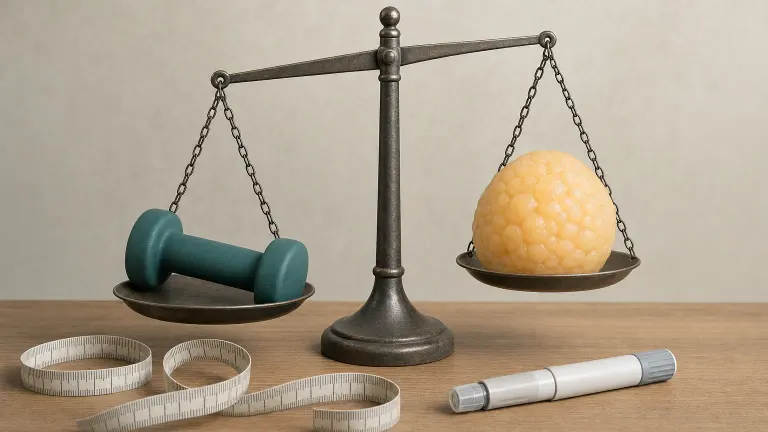
Peptides and exercise work best together in one well-studied case: GLP-1 drugs plus strength training. Lean tissue makes up about 25% to 35% of the weight people lose on semaglutide, tirzepatide or liraglutide, similar to diet alone, while lifestyle programs that included resistance training cut that share to 17.5%.[1] In a randomized trial, combining exercise with liraglutide roughly doubled the drop in body-fat percentage compared with either alone.[3] For “muscle” or “recovery” peptides like BPC-157 or ipamorelin, there’s no good human evidence that they improve training results.
This guide explains what the trials show and how to build an exercise routine around peptide treatment safely. Check with your clinician before starting a new program. For related topics, see the muscle and metabolism peptides hub.
Why exercise matters on GLP-1 drugs
When you lose weight, you lose some muscle and other lean tissue along with fat. A 2026 meta-analysis of 20 randomized trials and 15,782 people found lean mass made up 35.2% of weight lost on semaglutide, 25.4% on tirzepatide, 26.8% on liraglutide and 26.2% with lifestyle programs. Programs that added resistance training had the lowest share, 17.5%.[1]
In a body composition substudy of SURMOUNT-1, tirzepatide cut fat mass by 33.9% and lean mass by 10.9% over 72 weeks; about three-quarters of the weight lost was fat.[2] Lean mass isn’t all muscle, though: scans count water and organs as lean too. Our guide to GLP-1 muscle loss covers the details.
What the exercise trials show
| Study | Who | What they found |
|---|---|---|
| Exercise, liraglutide or both (2021)[3] | 195 adults with obesity after an 8-week diet | After 1 year vs placebo: −4.1 kg with exercise, −6.8 kg with liraglutide, −9.5 kg combined. Body-fat percentage fell 3.9 points combined, about twice either alone |
| Same trial, 1 year after stopping (2024)[4] | 109 participants | Combination group kept off 5.1 kg more than liraglutide alone; regain after stopping liraglutide alone was 6.0 kg larger than after stopping exercise alone |
| Diet plus exercise in older adults (2017)[5] | 160 adults with obesity, 65+ | With 9% weight loss, lean mass fell 2% to 3% with resistance or combined training vs 5% with aerobic training alone; physical function improved most with combined training |
No GLP-1 drug was used in the older-adult trial, but it shows how training type changes what’s lost during weight loss. A trial now under way, LEAN-PREP, is testing home resistance exercise and protein in 232 adults on semaglutide or tirzepatide, with thigh muscle size as its main outcome.[10]
Step-by-step: building your routine
- Talk to your clinician first, especially if you have heart disease, joint problems or diabetes medicines that can cause low blood sugar.
- Strength train at least 2 days a week. US guidelines call for muscle-strengthening activity at least 2 days a week and 150 to 300 minutes of moderate aerobic activity weekly.[6] Work major muscle groups and progress gradually. If you are new to strength training, simple moves such as sit-to-stands from a chair, wall push-ups, step-ups and resistance-band rows are a reasonable start; a physical therapist or qualified trainer can tailor a plan if you have joint problems.
- Add aerobic activity such as brisk walking or cycling for heart health and function.
- Protect your protein intake. A 2025 joint advisory from four US societies recommends assessing muscle before treatment and pairing GLP-1 therapy with resistance training and adequate protein.[7] See our GLP-1 diet guide.
- Plan around side effects. Vomiting or diarrhea can cause dehydration, which the Wegovy label links to kidney problems.[8] Drink fluids and scale back on bad days; our GLP-1 nausea and GLP-1 fatigue guides can help.
- Track strength, not just weight. Note the weights you lift or how far you walk, and recheck every few weeks.
Keeping results after the drug stops
Exercise may matter most once treatment ends. In the follow-up of the Danish liraglutide trial, people who had done supervised exercise during treatment were more likely to keep off at least 10% of their starting weight a year later than those who had taken placebo, and the combination group was about four times as likely as the liraglutide-alone group to do so.[4] The trial was small and only 109 of the original participants returned, so the estimates are imprecise, but the direction is consistent: habits built during treatment outlast the drug. Our guide to stopping a GLP-1 covers what else helps.
What about “muscle” and “recovery” peptides?
Growth hormone-releasing peptides, IGF-1 LR3, BPC-157 and TB-500 are widely marketed to people who train. None is FDA-approved for muscle growth or recovery, and none has controlled human trials showing better training results. Our comparisons of IGF-1 LR3 vs MGF, peptides vs SARMs and peptides vs TRT explain the evidence and the risks.
For athletes: WADA’s 2026 Prohibited List bans BPC-157 as a non-approved substance and growth hormone-releasing peptides, TB-500 and IGF-1 under peptide hormones and growth factors, at all times.[9] GLP-1 drugs aren’t on the list. See peptides on the WADA prohibited list.
Checklist: peptides and exercise
- Clinician has cleared my exercise plan.
- Strength training scheduled at least 2 days a week.
- Aerobic activity most days, built up gradually.
- Protein at each meal, even when appetite is low.
- Fluids planned, especially on days with nausea or diarrhea.
- Tracking strength as well as weight.
- No unapproved “recovery” peptides, especially if I’m a tested athlete.
The bottom line
The best-supported way to combine peptides and exercise is simple: if you’re on a GLP-1 drug, lift weights, stay active, eat enough protein and keep going after the drug stops. That combination protects lean tissue and improves the odds of keeping weight off. Peptides sold specifically to build muscle or speed recovery don’t have the human evidence to back their claims.