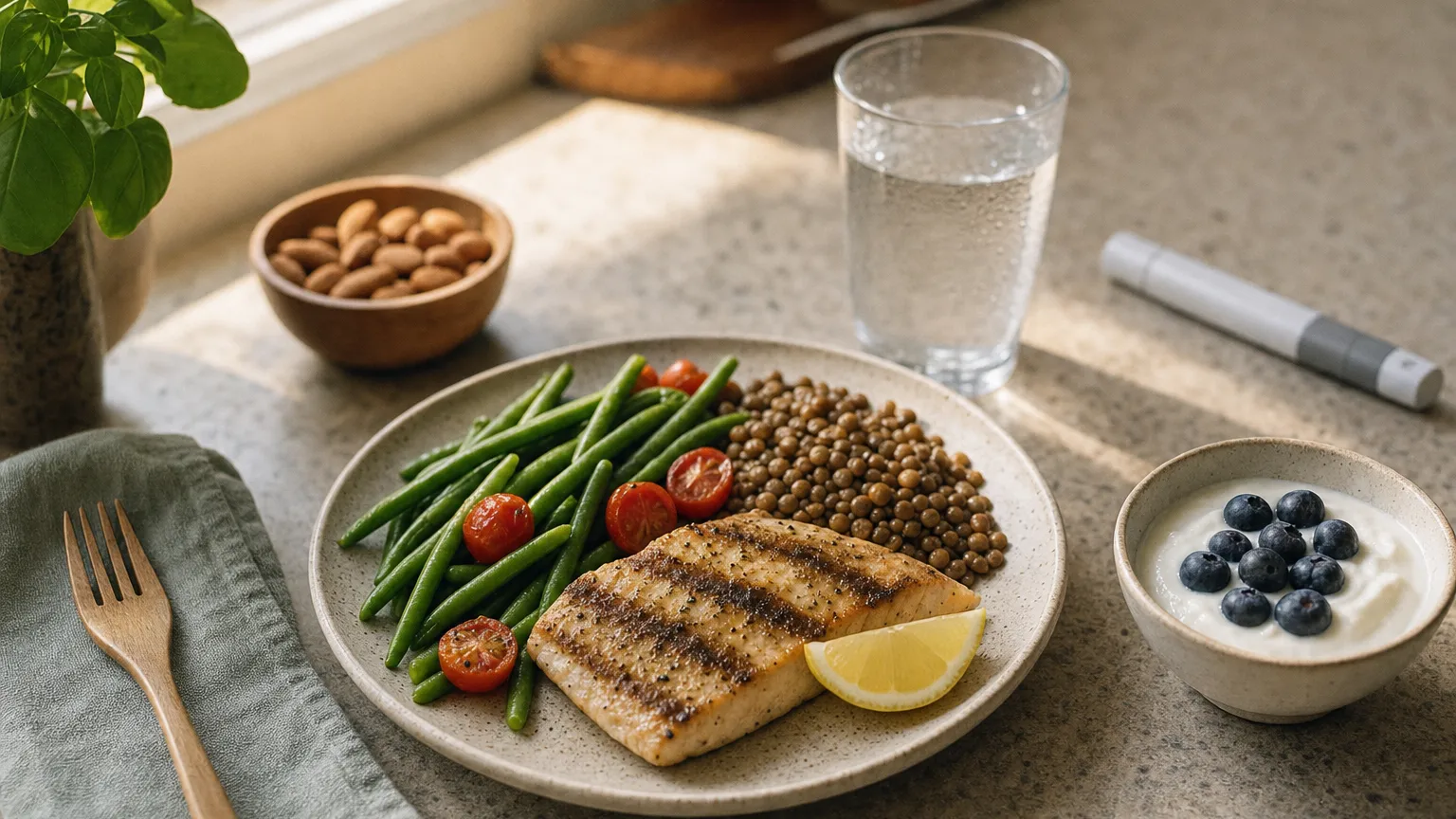
A GLP-1 diet puts protein first, keeps meals small and avoids greasy, heavy foods that worsen nausea. A 2025 joint advisory from four nutrition and obesity societies notes that 1.2-1.6 g of protein per kg of body weight a day has been proposed during active weight loss, or about 80-120 g a day as a simpler target.[1] It also advises fiber from foods, enough fluids, minimal alcohol and strength training at least 3 times a week.[1]
This applies to semaglutide (Ozempic, Wegovy), tirzepatide (Mounjaro, Zepbound), liraglutide (Saxenda) and dulaglutide (Trulicity). For more on how these drugs work, see the GLP-1 basics hub.
Why diet still matters on a GLP-1
Every one of these labels pairs the drug with diet. Wegovy, Zepbound and Saxenda are approved for use with a reduced-calorie diet and more physical activity, and Ozempic, Mounjaro and Trulicity are approved as an addition to diet and exercise.[2][3][4][5][6][7]
The advisory from the American College of Lifestyle Medicine, the American Society for Nutrition, the Obesity Medicine Association and The Obesity Society lists the main problems that food choices can help with:[1]
- Eating much less. Studies it reviewed found calorie intake fell by 16% to 39% on GLP-1s, which can leave gaps in vitamins and minerals.
- Losing muscle. In the STEP 1 semaglutide trial, about 38% of the weight lost was lean mass, which the authors estimate is about 20% muscle.
- Stomach side effects. Nausea, vomiting, diarrhea and constipation are the most common reasons people struggle.
How much protein to eat
Protein helps protect muscle and bone while you lose weight, especially combined with strength training.[1]
| Target | Amount | Notes |
|---|---|---|
| General adult minimum (RDA) | 0.8 g/kg/day | Baseline for all adults[1] |
| Proposed during active weight loss | 1.2-1.6 g/kg/day | Higher target[1] |
| Simpler daily goal | 80-120 g/day | 16-24% of calories on a 2,000-calorie diet[1] |
| Floor | 0.4-0.5 g/kg/day | Intake should not fall below this[1] |
| Upper caution | 2 g/kg/day | Avoid staying at or above this long term[1] |
When appetite is low, the advisory suggests eating protein foods first in a meal.[1] It encourages beans, peas, lentils, whole grains, dairy, seafood, eggs and lean poultry, with red and processed meats in moderation.[1] Smoothies or protein drinks made with fruit and unsweetened milk or yogurt, cottage cheese and soups are often easier to manage than heavy foods like red meat or hard cheese.[1]
What to eat and what to limit
The advisory’s summary table groups foods this way:[1]
| Encourage | Minimize or avoid |
|---|---|
| Fruits (berries, apples, citrus, bananas, grapes, avocado) | Refined carbohydrates (processed grains, flours, added sugars) |
| Vegetables (broccoli, leafy greens, tomatoes, carrots, peas, squash) | Sugar-sweetened drinks |
| Whole grains (oats, quinoa, brown rice, whole-grain bread and pasta) | Red and processed meats |
| Dairy (yogurt, milk, cheese) | Most fast food |
| Lean protein (poultry, fish, seafood) and eggs | Sweets and savory snacks |
| Nuts and seeds; olive, canola or avocado oil | Large meals |
| Ginger or peppermint tea | Long gaps without eating; alcohol |
It also recommends regular, small meals at consistent times, flexibility with food choices and portion-controlled treats rather than strict restriction.[1] Nausea can trigger cravings for white bread, white rice and sweets, so having nutrient-dense options ready helps.[1]
Eating to reduce nausea and other stomach effects
Stomach side effects are common. On Wegovy 2.4 mg, 44% of people had nausea and 24% had vomiting, versus 16% and 6% on placebo.[2] On Zepbound, nausea affected 25% to 29% versus 8% on placebo.[3] On Saxenda, it affected 39.3% versus 13.8%.[4]
Food strategies from the advisory:[1]
- Go smaller and more often. Eat a small breakfast, then small meals every 3-4 hours. Vomiting is more likely with large meals.
- Avoid fatty foods at the start. Avoiding fatty or high-fiber foods during the first few days of treatment can ease symptoms.
- Cut back on high-fat meals for diarrhea. Avoiding large or high-fat meals can help.
- Add fiber slowly for constipation. Gradually increase foods with soluble and insoluble fiber, such as prunes or other dried fruit, and drink enough fluids.
- Limit alcohol. It may worsen nausea and acid reflux on a GLP-1. See our guide to GLP-1s and alcohol.
More tips are in our guide to GLP-1 nausea.
Fluids and hydration
The advisory does not set a daily amount, but it repeatedly stresses adequate fluids, especially when nausea, vomiting or diarrhea occur.[1] This matters for your kidneys. The Wegovy and Zepbound labels warn that dehydration from stomach side effects has led to acute kidney injury, and the Wegovy label advises patients to take precautions to avoid fluid depletion.[2][3]
Vitamins and minerals to watch
Eating far less raises the risk of shortfalls, especially below about 1,200 calories a day for women or 1,800 for men.[1]
- Nutrients of concern: iron, calcium, magnesium, zinc and vitamins A, D, E, K, B1, B12 and C.[1]
- Warning signs: fatigue beyond what is expected, excessive hair loss, flaky or itchy skin, muscle weakness, poor wound healing and unusual bruising.[1] See our guide to GLP-1 hair loss.
- Supplements: vitamin D, calcium, B12 or a multivitamin-mineral can be considered for people at risk.[1] Ask your clinician before starting any.
Exercise alongside the diet
The advisory says GLP-1s should be prescribed with a structured exercise program: strength training at least 3 times a week plus at least 150 minutes of moderate aerobic activity.[1] Combined with enough protein, this helps limit muscle and bone loss.[1]
Drug-specific timing
- Weekly injections (Ozempic, Wegovy, Mounjaro, Zepbound, Trulicity) can be taken with or without meals.[5][3]
- Saxenda is taken once a day at any time, without regard to meals.[4]
- Wegovy tablets need an empty stomach: wait at least 30 minutes after a tablet before eating, drinking or taking other oral medicines.[2]
For dosing schedules, see our guide to the best time to take a GLP-1. Eating habits also matter if you stop treatment; the advisory lists weight maintenance after stopping as an area needing more study.[1] Our guide to stopping a GLP-1 covers what to expect. If weight loss stalls, see not losing weight on a GLP-1.