Dulaglutide is a once-weekly GLP-1 drug from Eli Lilly, sold as Trulicity. It was FDA-approved in 2014 for type 2 diabetes and later to reduce cardiovascular risk.[2] In the REWIND trial, it lowered the rate of heart attack, stroke or cardiovascular death from 13.4% to 12.0%.[3] It is not approved for weight loss.[1]
What is dulaglutide?
Dulaglutide links two GLP-1-like peptides to part of an antibody (an Fc fragment), which makes it large enough to last about 5 days in the body.[1]
FDA approvals
- 2014: blood sugar control in adults with type 2 diabetes.[2]
- 2020: reducing cardiovascular events, based on REWIND; and higher 3.0 mg and 4.5 mg doses.[2]
- 2022: children aged 10 and older with type 2 diabetes.[2][6]
The cardiovascular indication covers adults with established heart disease or multiple risk factors.[1]
Dulaglutide results
- Heart protection (REWIND): in 9,901 people, most without established heart disease, major cardiovascular events fell from 13.4% to 12.0% over 5.4 years.[3]
- Higher doses (AWARD-11): 4.5 mg lowered HbA1c 1.77 points and weight 4.6 kg, versus 1.54 points and 3.0 kg on 1.5 mg.[5]
- Versus liraglutide (AWARD-6): weekly dulaglutide matched daily liraglutide.[4]
- Youths (AWARD-PEDS): 51% reached HbA1c below 7% versus 14% on placebo, without a change in BMI.[6]
Inside the REWIND heart trial
REWIND enrolled 9,901 adults aged 50 or older with type 2 diabetes at 371 sites in 24 countries. They had either a previous cardiovascular event or cardiovascular risk factors. Their average age was 66, 46% were women, and their median HbA1c was 7.2%, so many had fairly well-controlled diabetes. They took dulaglutide 1.5 mg or placebo once a week.[3]
Over a median of 5.4 years, the risk of heart attack, stroke or cardiovascular death was 12% lower on dulaglutide (hazard ratio 0.88). Deaths from any cause were not significantly different: 10.8% versus 12.0%. Stomach and bowel side effects were reported by 47.4% on dulaglutide versus 34.1% on placebo.[3]
Youth trial details
AWARD-PEDS randomized 154 young people aged 10 to 17. After 26 weeks, HbA1c rose 0.6 points on placebo but fell 0.6 points on 0.75 mg and 0.9 points on 1.5 mg.[6]
Head to head with tirzepatide
In SURPASS-CVOT, 13,299 adults with type 2 diabetes and atherosclerotic heart disease took either dulaglutide 1.5 mg or tirzepatide. Heart attack, stroke or cardiovascular death occurred in 13.1% on dulaglutide and 12.2% on tirzepatide. Tirzepatide was shown to be no worse, but not clearly better.[13]
Trulicity vs Ozempic and Mounjaro
| Trulicity (dulaglutide) | Ozempic (semaglutide) | Mounjaro (tirzepatide) | |
|---|---|---|---|
| Receptors | GLP-1[1] | GLP-1 | GIP and GLP-1 |
| Dosing | Weekly | Weekly | Weekly |
| Heart-protection indication | Yes[1] | Yes | Yes (since 2026)[12] |
In their own trials, semaglutide and tirzepatide produced larger HbA1c and weight reductions than dulaglutide. See also the Chinese drug mazdutide, which beat dulaglutide head to head.
Dulaglutide side effects
From the label (placebo-controlled trials):[1]
| Side effect | Placebo | 0.75 mg | 1.5 mg |
|---|---|---|---|
| Nausea | 5.3% | 12.4% | 21.1% |
| Diarrhea | 6.7% | 8.9% | 12.6% |
| Vomiting | 2.3% | 6.0% | 12.7% |
| Abdominal pain | 4.9% | 6.5% | 9.4% |
- Boxed warning: thyroid C-cell tumors in rats.[1]
- Other warnings: pancreatitis, low blood sugar with insulin or sulfonylureas, kidney injury, severe stomach reactions, diabetic retinopathy complications and gallbladder disease.[1]
Dulaglutide dosage
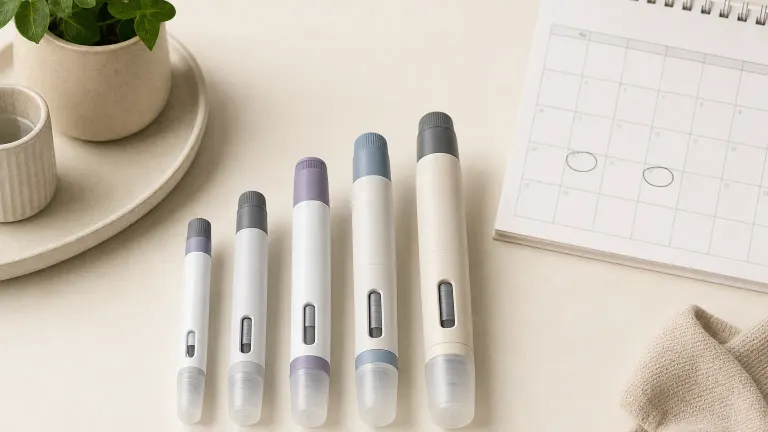
Adults start at 0.75 mg once weekly, may increase to 1.5 mg after 4 weeks, and then by 1.5 mg every 4 weeks up to 4.5 mg. Children start at 0.75 mg with a maximum of 1.5 mg.[1] MedlinePlus notes it can be taken with or without meals.[10]
The label says to inject it once a week at any time of day, in the abdomen, thigh or upper arm, rotating sites each week. If you use insulin too, give them as separate injections and never mix them in one syringe. A missed dose can be taken if at least 3 days (72 hours) remain before the next one.[1] Your prescriber sets the dose and when to increase it.
Who should not use dulaglutide
Trulicity is not for people with a personal or family history of medullary thyroid carcinoma or multiple endocrine neoplasia type 2 (MEN 2), or who have had a serious allergic reaction to dulaglutide or its components. It is not recommended for people with severe gastroparesis, and the label warns about inhaling stomach contents during anesthesia or deep sedation, so tell your care team about any planned procedure.[1]
Drug interactions and pregnancy
- Oral medicines: dulaglutide slows stomach emptying, most after the first dose, which may slow the absorption of other pills. The label advises monitoring drugs that need tight dosing, such as warfarin.[1]
- Insulin and sulfonylureas: their doses may need lowering when Trulicity starts, to avoid low blood sugar.[1]
- Pregnancy: human data are limited. The label says to use it during pregnancy only if the benefit justifies the possible risk to the fetus.[1]
Questions to ask your clinician
- Does my heart risk make dulaglutide a good fit for me?
- Should I move up to 3 mg or 4.5 mg if my HbA1c is still high?
- Would a drug with a larger weight effect suit me better?
- Should my insulin or sulfonylurea dose change?
- Do I need eye checks for diabetic retinopathy?
Dulaglutide around the world
- Japan: a trial compared the 1.5 mg and 0.75 mg doses in Japanese patients.[7]
- China: dulaglutide added to insulin helped 75.9% reach HbA1c below 7% versus 33.8%,[8] and a Chinese biosimilar matched Trulicity’s blood levels.[9]