Cagrilintide is a long-acting version of amylin, a hormone the pancreas releases with insulin to signal fullness. Novo Nordisk combines it with semaglutide in a once-weekly injection called CagriSema.[1][4] In its main phase 3 trial, CagriSema produced 20.4% weight loss over 68 weeks versus 3.0% on placebo,[4] but it lost a head-to-head trial against tirzepatide.[7] Neither cagrilintide nor CagriSema was FDA-approved as of our last review.[7][8]
This profile covers how amylin and cagrilintide work, every major CagriSema trial, how it compares with Zepbound, side effects, doses studied and its regulatory status.
What is cagrilintide?
Amylin is a 37-amino-acid hormone made alongside insulin. It slows stomach emptying, suppresses the hormone glucagon after meals, and signals fullness to the brain.[1] Natural amylin lasts only minutes. Cagrilintide is a modified, long-acting version that works once a week and activates both amylin and calcitonin receptors.[14] The first amylin drug, pramlintide (Symlin), was approved about 20 years after amylin was discovered.[22]
How cagrilintide and CagriSema work
GLP-1 drugs like semaglutide and amylin analogs reduce appetite through partly different pathways in the brain. Combining them in CagriSema aims to produce more weight loss than either alone, and in REDEFINE 1 it did: 20.4% for the combination versus 14.9% for semaglutide and 11.5% for cagrilintide alone.[4][6]
Cagrilintide and CagriSema results
Weight loss
| Trial | Who | CagriSema | Comparison |
|---|---|---|---|
| REDEFINE 1 (68 weeks) | 3,417 adults with obesity | −20.4%[4] | Placebo −3.0% |
| REDEFINE 2 (68 weeks) | 1,206 with obesity and type 2 diabetes | −13.7%[5] | Placebo −3.4% |
| REDEFINE 4 (84 weeks) | 809 adults with obesity | −20.2%[7] | Tirzepatide −23.6% |
| REDEFINE 5 (Japan and Taiwan) | 331 adults | −18.4%[9] | Semaglutide −11.9% |
In REDEFINE 1, Novo’s own analysis of people who stayed on treatment showed 22.7% weight loss, and 40.4% lost at least 25% of their weight. Only 57.3% of CagriSema patients were on the highest dose at the end.[6] The result fell short of the roughly 25% the company had signaled, and Novo’s shares dropped sharply.
REDEFINE 1 and REDEFINE 2 were presented at the American Diabetes Association’s Scientific Sessions in June 2025, at the same time as their journal publication. In REDEFINE 2, which enrolled about 1,200 adults with type 2 diabetes, people who stayed on treatment lost 15.7% of their weight versus 3.1% on placebo. The ADA noted that nearly 90% of US adults with diabetes also have overweight or obesity, which is why a drug that targets both weight and blood sugar matters.[23]
Cagrilintide alone
In a 26-week phase 2 trial, cagrilintide alone produced 6.0% to 10.8% weight loss depending on dose, versus 3.0% on placebo; the top dose beat liraglutide (10.8% vs 9.0%).[2] Phase 3 trials of cagrilintide alone (RENEW) began in late 2025.[18]
Type 2 diabetes
- REIMAGINE 1: CagriSema lowered HbA1c by up to 1.8 points and weight by up to 13.8% in newly treated type 2 diabetes.[10]
- REIMAGINE 2: in 2,713 people, it lowered HbA1c slightly more than semaglutide alone (1.91 vs 1.75 points).[11]
- REIMAGINE 3: added to basal insulin, it lowered HbA1c by more than 2 points with no severe low blood sugar.[12]
- REIMAGINE 4: versus tirzepatide, CagriSema matched it on weight but not on blood sugar.[8]
A heart outcomes trial (REDEFINE 3) in more than 7,000 people with heart disease is ongoing.[13]
CagriSema vs tirzepatide (Zepbound)
In REDEFINE 4, the only head-to-head obesity trial, tirzepatide 15 mg produced 23.6% weight loss versus 20.2% for CagriSema over 84 weeks, and CagriSema failed its goal of proving it was at least as effective.[7] Both are weekly injections; tirzepatide is already FDA-approved. See also semaglutide and the investigational retatrutide.
Cagrilintide with retatrutide or tirzepatide
People search for combining cagrilintide with retatrutide or tirzepatide, usually from online research-chemical sellers. No study has tested these combinations. FDA states that cagrilintide and retatrutide cannot legally be used in compounding because they are not components of FDA-approved drugs.[16] A 2026 JAMA report warned about unapproved weight-loss drugs sold online.[21]
Cagrilintide side effects
- Stomach effects dominate: in REDEFINE 1, 79.6% of people on CagriSema had gastrointestinal side effects versus 39.9% on placebo.[4] In REDEFINE 2, 72.5% versus 34.4%.[5]
- Cagrilintide alone: nausea occurred in 20% to 47% depending on dose, versus 18% on placebo.[2]
- Dose limits: many people could not reach the top dose; 57.3% were on it at week 68 in REDEFINE 1.[6]
- Low blood sugar: no severe episodes in the diabetes trials, including with insulin.[3][12]
- Kidney and liver: no dose adjustment appeared necessary in people with kidney or liver impairment.[15]
Cagrilintide dosage: what has been studied
| Setting | Dose |
|---|---|
| CagriSema (main phase 3 trials) | Cagrilintide 2.4 mg + semaglutide 2.4 mg once weekly, increased gradually[4] |
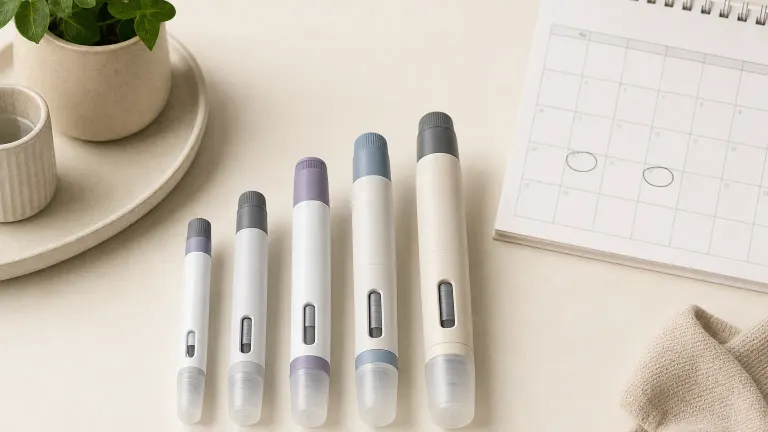
| Lower-dose CagriSema (diabetes) | 1.0 mg + 1.0 mg once weekly[10] |
| Cagrilintide alone (phase 2) | 0.3 to 4.5 mg once weekly[2] |
No dose is approved. For syringe-unit math, see our peptide calculator.
Other amylin drugs
- Pramlintide (Symlin): the first amylin drug, approved in 2005 for diabetes and now discontinued in the US. See our pramlintide profile.
- Petrelintide (Zealand Pharma): a human amylin analog that produced up to 10.7% weight loss at 42 weeks in a phase 2 trial.[19]
- Amycretin (zenagamtide, Novo Nordisk): a single molecule acting on both GLP-1 and amylin receptors that produced 24.3% weight loss at 36 weeks in an early trial.[20]
Cagrilintide research around the world
- Denmark: Novo Nordisk’s home country and the base of most trials.
- Japan and Taiwan: REDEFINE 5 tested CagriSema in East Asian adults.[9]
- China: Shanghai researchers mapped how cagrilintide activates its receptors,[14] and Chinese chemists developed a new dual amylin-calcitonin drug candidate.[25]
- Germany: anti-doping researchers developed methods to detect cagrilintide and pramlintide.[24]
Is cagrilintide FDA approved or legal?
- Not FDA-approved. CagriSema was submitted to FDA in December 2025, and Novo expected a decision in late 2026.[7][8]
- Cannot be compounded: FDA says cagrilintide cannot legally be used in compounding.[16] It is not on FDA’s list of substances under evaluation for compounding.[17]
- Online products sold as “research peptides” are unapproved, and their contents are unverified.[16][21]
This is general information, not legal advice.