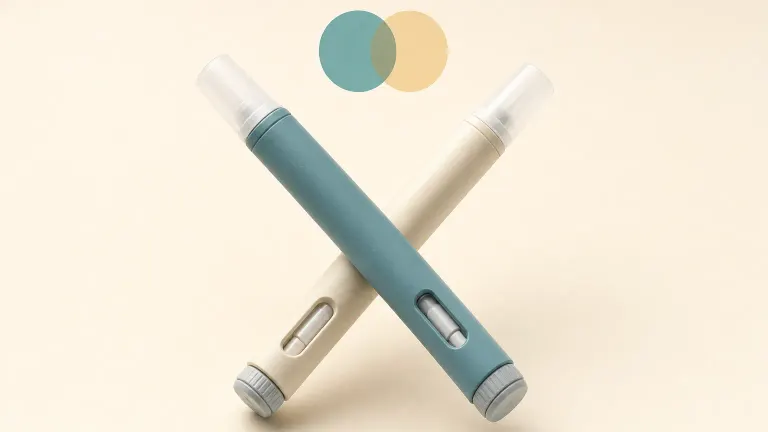
Mazdutide is a once-weekly injection that activates both the GLP-1 and glucagon receptors. China approved it in June 2025 as Xinermei, the world’s first dual GLP-1/glucagon drug for weight loss, and added type 2 diabetes in September 2025.[5][6][7] In the GLORY-1 trial, weight fell 14.0% on the 6 mg dose over 48 weeks.[1] It is not FDA-approved.[5]
What is mazdutide?
Mazdutide was discovered by Eli Lilly and licensed to China’s Innovent Biologics, which ran most of its trials.[6] Its glucagon action may increase energy use and help burn fat in the liver.[6]
In China it is approved, alongside diet and exercise, for long-term weight management in adults with a BMI of 28 or more, or a BMI of 24 or more plus at least one weight-related health problem. It is also being studied for fatty liver disease, obstructive sleep apnea and alcohol use disorder.[5]
Mazdutide results
Weight loss
| Trial | Who | Mazdutide | Placebo |
|---|---|---|---|
| GLORY-1 (48 weeks) | 610 Chinese adults | −11.0% (4 mg), −14.0% (6 mg)[1] | +0.3% |
| GLORY-2 (60 weeks) | 461 Chinese adults with obesity | −16.65% (9 mg)[2] | −1.50% |
| US phase 2 (32 weeks) | 179 US adults | up to −18.1% (16 mg)[9] | −0.9% |
GLORY-1 in detail. The 610 adults started at an average of 87.2 kg (BMI 31.1). By week 32, the trial’s main time point, 73.9% on 4 mg and 82.0% on 6 mg had lost at least 5% of their weight, versus 10.5% on placebo. By week 48, 35.7% and 49.5% had lost at least 15%, versus 2.0%.[1]
The 9 mg dose. GLORY-2 enrolled younger adults (average age 33.9) with a higher starting BMI of 34.3, and 16.1% had type 2 diabetes. At 60 weeks, 84.3% on mazdutide had lost at least 5% of their weight, versus 33.1% on placebo.[2] An earlier 24-week phase 2 trial of 9 mg in 80 Chinese adults with a BMI of 30 or more found 12.78% weight loss versus a 1.80% gain on placebo, and 81.7% lost at least 5%.[10]
US dose range. Lilly’s US trial compared 3 to 6 mg, 10 mg and 16 mg. At 32 weeks, weight fell 7.3%, 15.6% and 18.1%, and people kept losing weight through week 48.[9]
In GLORY-1, people with high baseline liver fat saw it fall by about two-thirds to four-fifths.[6] A 9 mg dose application was accepted for review in China in November 2025.[11]
Type 2 diabetes
- DREAMS-1 (24 weeks): in 320 adults whose diabetes was managed with diet and exercise alone, HbA1c fell 1.57 to 2.15 points versus 0.14 on placebo, and weight fell 5.6% to 7.8% versus 1.3%.[3]
- DREAMS-2 (28 weeks): in 731 adults already taking diabetes pills, mazdutide beat dulaglutide 1.5 mg on both blood sugar and weight. HbA1c fell 0.24 to 0.30 points more, and weight 3.8% to 5.8% more.[4]
- DREAMS-3: Chinese media reported it beat semaglutide 1 mg on a combined blood sugar and weight goal; this has not yet been peer reviewed.[12] The registered design compared mazdutide 6 mg with semaglutide 1 mg in 349 adults with early type 2 diabetes and obesity over 32 weeks. Its main goal was reaching both an HbA1c below 7% and at least 10% weight loss.[18]
Ongoing mazdutide trials
Innovent and Lilly are now testing mazdutide well beyond weight loss. Registered trials include:
- GLORY-3: 9 mg versus semaglutide 2.4 mg in 479 Chinese adults with overweight or obesity and fatty liver disease. It measures weight and MRI liver fat at 48 weeks, with main results due after December 2026.[19]
- Sleep apnea (GLORY-OSA): 9 mg versus placebo in about 260 adults with moderate to severe sleep apnea and a BMI of 28 or more. The main goal is the change in breathing pauses per hour of sleep at 48 weeks.[20]
- Teenagers (GLORY-YOUNG): about 180 adolescents aged 12 to 17 who did not lose 5 kg with at least 12 weeks of diet and exercise. The main goal is BMI change at 32 weeks.[21]
- MASH: a 60-week phase 2 trial in about 165 adults with fatty liver inflammation, judged by liver biopsy.[22]
- Alcohol use disorder: Lilly completed a 308-person phase 2 trial in 2026. We found no posted or published results as of October 2026.[23]
Mazdutide vs survodutide and tirzepatide
Survodutide and pemvidutide work the same way but are not yet approved anywhere. Tirzepatide pairs GLP-1 with GIP instead of glucagon. No head-to-head trials have compared them.
Mazdutide side effects
- Stomach effects: on 9 mg, vomiting affected 53.1%, nausea 46.9% and diarrhea 39.4%, versus 1% to 7% on placebo.[2]
- Stopping treatment: in GLORY-1, few stopped because of side effects (0.5% to 1.5%).[1] In GLORY-2, 2.9% stopped the 9 mg dose versus none on placebo.[2] In the US trial, 20% stopped at the highest 16 mg dose, mainly because of stomach problems.[9]
- Severity: most stomach effects were mild to moderate. In the 9 mg phase 2 trial, nausea affected 50.0%, diarrhea 38.3% and vomiting 36.7%.[10]
- Versus dulaglutide: stomach side effects were more common on mazdutide than on dulaglutide in DREAMS-2.[4]
- Heart rate rose by about 5 to 9 beats per minute in an early phase 2 trial.[8]
Mazdutide dosage
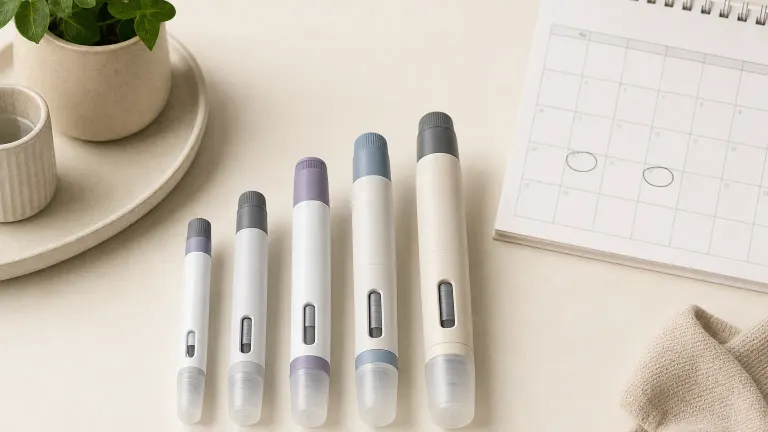
Approved Chinese doses are 4 mg and 6 mg once weekly; a 9 mg dose was studied and submitted for review.[1][2][11] In Lilly’s US trial, people in the lowest-dose group stayed on 3 mg from week 4 to week 32 before stepping up to 6 mg.[9] Only a clinician can set a dose, and outside China there is no approved product.
Questions to ask a clinician
The main obesity trials enrolled adults, and the trial in teenagers is still running.[1][21] Because mazdutide has no US prescribing information, there is no FDA list of who should avoid it. If you are considering it, useful questions include:
- Would an approved option such as semaglutide or tirzepatide suit me better?
- How would nausea, vomiting or diarrhea be managed while the dose goes up?
- Could it affect my other medicines, my heart rate or a planned pregnancy?
Mazdutide in China
Chinese specialists have called it a major new tool for weight management clinics.[13] Beijing News reported the first national prescription was written in July 2025 for a patient with a BMI near 28 and fatty liver.[14] A published case report described a 15-year-old who lost 16.8 kg over 36 weeks.[15]
Is mazdutide legal in the US?
- Not FDA-approved, and not on FDA’s list of substances compounding pharmacies may use.[17]
- Sport: WADA bans drugs not approved by any regulator; because mazdutide is approved in China, how this applies should be confirmed with an anti-doping agency.[16]
This is general information, not legal advice.