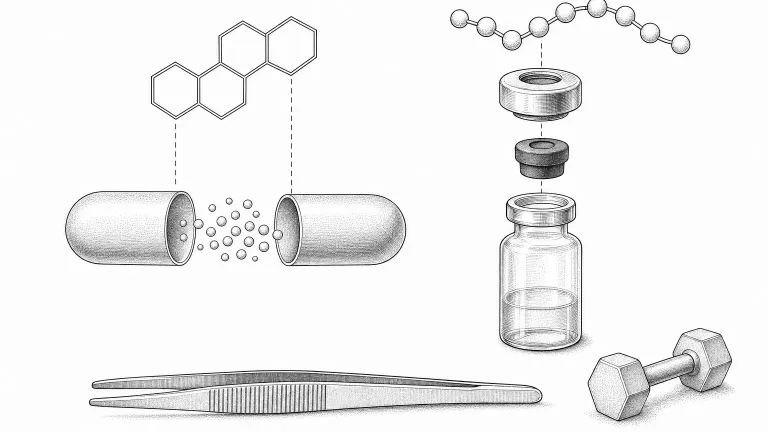
An L-carnitine injection contains levocarnitine, a natural molecule that carries fats into mitochondria so they can be burned for energy.[1] It is not a peptide; it is an amino acid derivative. As Carnitor and its generics, it is FDA-approved for carnitine deficiency and for people with kidney failure on dialysis.[1] Clinics also sell it for weight loss and energy, but supplement trials show only about 1 kg of extra weight loss,[5] and injections for fat loss have not been well studied.
This profile covers what L-carnitine is, approved uses, what research shows for weight loss and exercise, dosage, side effects, the TMAO question, and the rules for athletes.
What is L-carnitine?
Levocarnitine is a small, water-soluble molecule (molecular weight 161).[1] Muscles and the heart rely on fatty acids for energy, and carnitine moves those fatty acids into the mitochondria where they are burned.[1] The body makes some carnitine, and meat and dairy supply more.[1]
FDA-approved forms:
- Carnitor tablets (1985) and oral solution: primary systemic carnitine deficiency, and secondary deficiency caused by inborn errors of metabolism.[3][2]
- Carnitor injection (1992): given into a vein for secondary deficiency from inborn errors of metabolism, and to prevent and treat carnitine deficiency in people with end-stage kidney disease (ESRD) on dialysis.[4][1]
Dialysis removes carnitine, and people on dialysis often have low levels.[1] The label notes that the injection raises blood carnitine in these patients, but its effects on symptoms and clinical outcomes have not been established.[1]
L-carnitine sits in our performance, metabolic and weight categories.
L-carnitine for weight loss: what research shows
- Talenezhad 2020: 37 randomized trials with 2,292 adults. Carnitine lowered body weight by 1.21 kg, BMI by 0.24 and fat mass by 2.08 kg versus control, with no change in waist size or body fat percentage. The benefit seemed to level off at about 2,000 mg a day.[5]
- Pooyandjoo 2016: 9 trials with 911 adults. Weight loss was 1.33 kg more than control, and the effect shrank the longer people took it.[6]
These trials tested carnitine supplements. We did not find good randomized trials of L-carnitine injections for weight loss.
L-carnitine for exercise performance
The idea is that more carnitine in muscle means more fat burning. But getting it into muscle is hard:
- IV infusion alone did not work: in 8 healthy men, a 5-hour IV carnitine infusion raised muscle carnitine only when insulin was also raised to high levels. The authors noted earlier studies had failed to raise muscle carnitine with diet or IV carnitine alone.[7]
- Oral carnitine plus carbohydrate: in a 24-week trial, 14 healthy men took 2 g of L-carnitine L-tartrate with 80 g of carbohydrate twice a day, or carbohydrate alone. Muscle carnitine rose 21%, muscle glycogen use fell during easy cycling, and work output in a performance test rose 11% in the carnitine group.[8]
- Russian sports nutrition study: among 30 junior swimmers, a group of 10 took 600 mg a day for 4 weeks, compared with coenzyme Q10 and diet-only groups. Researchers reported changes in immune markers but did not measure performance.[12]
For other compounds promoted to mimic or boost exercise, see AICAR, SLU-PP-332 and MOTS-c.
L-carnitine injection dosage
Label doses for the injection, given into a vein:[1]
| Use | Dose |
|---|---|
| Metabolic disorders | 50 mg/kg as a slow 2 to 3 minute injection or infusion, every 3 to 4 hours and never less often than every 6 hours; highest dose given 300 mg/kg |
| ESRD on hemodialysis | 10 to 20 mg/kg dry body weight into the venous line after each dialysis, adjusted by trough levels |
Each vial holds 1 g in 5 mL (200 mg/mL).[1] For tablets, the adult label dose is 990 mg two or three times a day.[2] After an IV dose, the terminal half-life is about 17.4 hours; only about 15% of an oral dose is absorbed.[1] Weight-loss clinic doses are not on any label. To convert milligrams into syringe volume, use our peptide calculator.
L-carnitine side effects
The label lists transient nausea and vomiting, body odor and gastritis.[1] In two placebo-controlled dialysis trials, some events were more common with carnitine at one or more doses, though results did not rise steadily with dose:[1]
| Event | Placebo (n=63) | 10 mg/kg (n=34) | 20 mg/kg (n=62) | 40 mg/kg (n=34) |
|---|---|---|---|---|
| Headache | 16% | 12% | 37% | 3% |
| Hypertension | 14% | 18% | 21% | 21% |
| Diarrhea | 19% | 9% | 10% | 35% |
| Hypercalcemia | 3% | 15% | 8% | 6% |
| Tingling (paresthesia) | 3% | 3% | 3% | 12% |
- Serious allergic reactions: anaphylaxis, throat swelling and bronchospasm, mostly in dialysis patients, sometimes within minutes of an IV dose.
- Seizures: reported with oral and IV use, with more frequent or severe seizures in some people who already had them.
- Warfarin: INR can rise, so it should be monitored.
- Kidney failure and high oral doses: TMA and TMAO can build up.
L-carnitine and TMAO
Gut bacteria convert carnitine into trimethylamine, which the liver turns into TMAO. A 2013 Nature Medicine study found that carnitine raised TMAO and sped up artery disease in mice. Meat-eaters made more TMAO from carnitine than vegans or vegetarians, and among 2,595 people having heart evaluations, higher blood carnitine predicted both existing heart disease and future heart attack, stroke or death, but only in people who also had high TMAO.[10] A 2019 Moscow study found higher TMAO in people with coronary artery disease, who also ate red meat more often.[11]
These human findings are associations, not proof that carnitine supplements or injections cause heart disease.
Is L-carnitine injection legal?
- Prescription drug: levocarnitine injection is FDA-approved and sold by prescription.[4][1]
- Off-label use: using it for weight loss or energy is off-label.[1]
- Sport: WADA does not list L-carnitine as a substance. Method M2.2 bans IV infusions and/or injections of more than 100 mL in total per 12-hour period, except those legitimately received during hospital treatment, surgery or clinical diagnostic tests.[13] A small injection is within that limit; a large IV drip may not be.
This is general information, not legal advice.