AICAR (acadesine, or AICA riboside) is an experimental compound that switches on AMPK, the cell’s energy sensor that exercise also activates.[10] It is a nucleoside, not a peptide. In a famous 2008 study, sedentary mice given AICAR ran 44% farther, earning it the nickname “exercise in a pill.”[1] In people, it was tested as a heart-protecting drug during bypass surgery and failed a large trial in 2012.[5] It is not approved anywhere, and WADA bans it.[11]
This profile covers what AICAR is, what animal and human research shows, doses studied, side effects, how it compares with SLU-PP-332 and MOTS-c, and its legal and anti-doping status.
What is AICAR?
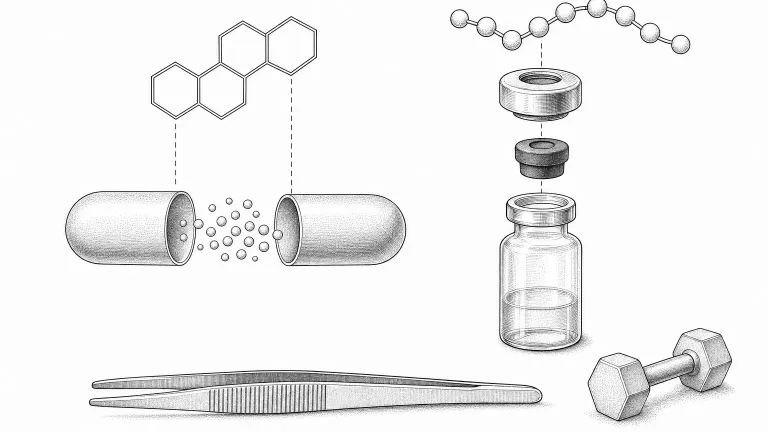
AICAR is a small molecule made of a base attached to a sugar (ribose), a type of molecule called a nucleoside. Once inside a cell it is converted to ZMP, which imitates AMP and activates AMPK.[10] Because it is also a natural step in the body’s production of purines, small amounts are always present in urine.[10][13]
It is also not as specific as its reputation suggests. A 2021 Croatian review found that many effects once credited to AMPK actually happen without it, and urged caution in reading AICAR studies.[10] A 2018 Russian study in mouse stem cells found that AICAR activated AMPK but sped up cell division instead of pausing it, a reminder that its effects vary by cell type.[17]
AICAR fits in our performance and metabolic categories.
AICAR research: what studies have found
The “exercise in a pill” mouse study
In 2008, Ronald Evans’s lab at the Salk Institute injected mice with AICAR (500 mg/kg a day) for 4 weeks. Without any training, treated mice ran about 23% longer and 44% farther than untreated mice on a treadmill, and genes for burning fat in muscle were switched on.[1] The same paper showed the PPAR-delta drug GW1516 boosted endurance only when combined with training.[1] These results were in mice, not people.
Human studies
No human study has tested whether AICAR improves exercise performance. What exists:
- Heart bypass surgery (1990s): a pooled analysis of 5 trials with 4,043 patients found acadesine infusions cut perioperative heart attacks by 27% and cardiac deaths in the first 4 days by 50%.[4]
- RED-CABG (2012): a larger confirmatory trial was stopped after 3,080 patients for futility. The main outcome (death, stroke, or severe heart dysfunction needing mechanical support within 28 days) occurred in 5.1% on acadesine and 5.0% on placebo.[5]
- Healthy men (2007): an AICAR infusion doubled glucose uptake into muscle, but whole-body glucose disposal rose only 7%.[6]
- Type 2 diabetes (2008): in 10 men, an infusion lowered blood sugar by cutting the liver’s glucose output and reduced fat release into the blood.[7]
- 2011 Dutch study: in healthy volunteers, AICAR did not raise glucose uptake during an insulin clamp but did raise heart rate and lower blood pressure.[8]
- Leukemia (2013): a Phase 1/2 study in 24 patients with relapsed or refractory chronic lymphocytic leukemia tested single doses of 50 to 315 mg/kg and set 210 mg/kg as the maximum tolerated dose.[9]
AICAR dosage: what has been studied
There is no approved or tested dose for performance. Doses used in research:
| Study | Dose and route |
|---|---|
| Mouse endurance study | 500 mg/kg a day by injection into the abdomen, 4 weeks[1] |
| Heart surgery trials | 0.1 mg/kg per minute by IV infusion for 7 hours[4] |
| Type 2 diabetes study | 0.75 mg/kg per minute by IV infusion[7] |
| Leukemia study | 50 to 315 mg/kg as a 4-hour IV infusion; 210 mg/kg was the maximum tolerated dose[9] |
Swallowing it does not work well: in healthy men, less than 5% of an oral dose reached the blood, and after IV dosing it was cleared with a half-life of about 1.4 hours.[2] Mouse doses cannot be converted directly into safe human doses.
AICAR side effects and safety
From human trials:
- High uric acid: seen in the heart surgery trials and common in the leukemia study, where it was prevented with allopurinol. AICAR breaks down into uric acid.[4][9][3]
- Low blood pressure and faster heart rate: infusion-related low blood pressure in the leukemia study, and a rise in heart rate with lower blood pressure in healthy volunteers.[9][8]
- Low blood sugar risk: AICAR lowered blood glucose in people with diabetes.[7]
- Blood counts and kidneys: temporary anemia or low platelets and kidney impairment in the leukemia study.[9]
A 1991 study in healthy men found single doses up to 100 mg/kg were well tolerated.[2] Long-term safety in people has never been studied, and products sold online are not made to drug standards. In one doping case, the vial was labeled not for human consumption.[16]
AICAR vs SLU-PP-332 and MOTS-c
| AICAR | SLU-PP-332 | MOTS-c | |
|---|---|---|---|
| Type | Nucleoside[10] | Small synthetic molecule | 16-amino-acid peptide |
| Main target | AMPK[10] | Estrogen-related receptors | AMPK |
| Human data | IV trials in surgery, diabetes and leukemia[5][9] | None | No published human trials |
| WADA 2026 | Named, S4.4.1[11] | Not named | Named, S4.4.1[11] |
SLU-PP-332 is another “exercise mimetic” tested only in animals. MOTS-c is a mitochondrial peptide that WADA lists alongside AICAR as an AMPK activator.[11]
Is AICAR legal?
- Not approved: acadesine was never approved, and its main Phase 3 trial was stopped.[5] It does not appear on FDA’s list of substances nominated for pharmacy compounding.[18]
- Banned in sport: WADA’s 2026 list names AICAR under S4.4.1 (AMPK activators), prohibited at all times.[11] WADA added it in 2009, after reports of confiscated illicit AICAR products.[12]
- Detection: because the body makes AICAR, labs set reference ranges. A US study of 12,377 samples suggested sending any urine above 2,000 to 2,500 ng/mL for carbon isotope testing to prove an outside source.[14] A ratio with a related molecule, SAICAr, may help catch use for longer.[15]
- Doping cases: in 2017, USADA gave a track and field athlete from Morocco a 4-year ban based on non-analytical evidence that he had possessed and used AICAR; a vial labeled AICAR was tested, and he admitted using it.[16]
This is general information, not legal advice.