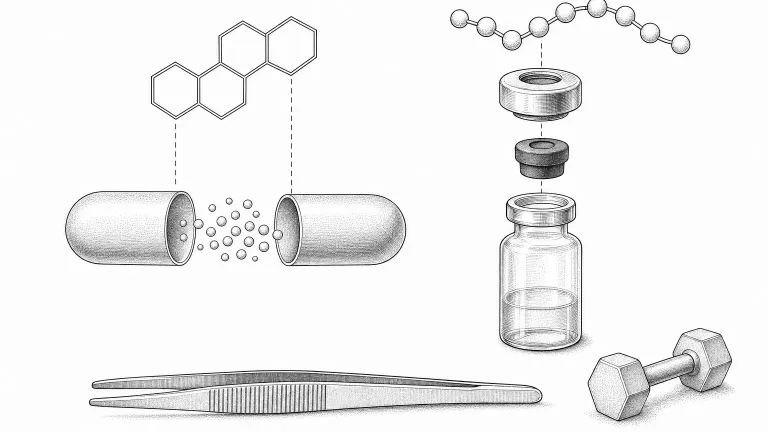
BAM-15 (BAM15) is an experimental mitochondrial uncoupler, a small molecule that makes cells burn more fuel to produce the same energy. In obese mice it reduced body fat and improved insulin sensitivity without changing how much they ate.[2] It is not a peptide, it has never been tested in people, and it is not approved for any use.[11]
This profile covers what BAM-15 is, how it works, the mouse research, why the history of the older uncoupler DNP matters, safety unknowns, and its legal and anti-doping status.
What is BAM-15?
BAM-15 was found in 2013 by researchers at the University of Virginia and Virginia Tech, led by Kyle Hoehn and Webster Santos, who screened a chemical library for new mitochondrial uncouplers.[1] Its chemical name is a fluorophenyl-substituted oxadiazolopyrazine.
It is not a peptide. Peptides are short chains of amino acids. BAM-15 is a small synthetic drug-like molecule, even though it is often sold next to peptides.
The researchers were looking for an uncoupler without the off-target effects of older ones. Classic uncouplers such as FCCP and 2,4-dinitrophenol (DNP) also act on the cell’s outer membrane, which causes toxicity and a narrow gap between effective and harmful doses.[1]
How BAM-15 works
Mitochondria normally pump protons across their inner membrane and then use the flow of protons back to make ATP, the cell’s energy currency. An uncoupler gives protons a shortcut back that bypasses ATP production.[1]
The cell then has to burn more fat and sugar to make the same amount of ATP. That raises energy use and can reduce fat stores. Unlike FCCP, BAM-15 did not depolarize the outer (plasma) membrane of cells and was less toxic to them in the lab.[1]
BAM-15 research: what studies have found
Mouse obesity studies
- Reversing diet-induced obesity (2020): an Australian and US team led by Kyle Hoehn fattened mice on a high-fat, high-sugar Western diet for 4 weeks and then mixed BAM-15 into that diet for a further 5 weeks. At the end of the 9-week study the treated mice weighed about 15% less than untreated obese mice, almost all of it fat, while eating the same calories. Lean mass, body temperature and blood markers of toxicity did not change.[2]
- Insulin and liver: the same study found better insulin sensitivity in several tissues, less liver fat and lower inflammation.[2]
- Preventing weight gain (2020): a separate US team at Pennington Biomedical Research Center found that mice given BAM-15 resisted weight gain on a high-fat diet and had better blood sugar control.[3]
- Older obese mice (2022): in 80-week-old obese mice, 10 weeks of BAM-15 in food lowered body weight from 54.0 g to 42.3 g. Muscle mass, grip strength and activity all increased.[4]
- Head-to-head in diabetic mice (2024): in female db/db mice with severe metabolic disease, BAM-15 and calorie restriction improved body weight and fatty liver more than semaglutide, rosiglitazone or another uncoupler, niclosamide ethanolamine.[5]
- Against other uncouplers (2025): in a comparison of 15 different uncouplers, BAM-15 had the best overall effects on body weight, blood sugar and fatty liver in diabetic mice.[6]
A Chinese review from 2023 also noted possible uses in fatty liver disease, sepsis and heart disease, all based on animal and cell studies.[7]
In people
There are no human studies. As of October 2026, no clinical trial of BAM-15 is registered on ClinicalTrials.gov.[11]
Why DNP’s history matters
BAM-15 belongs to the same drug class as 2,4-dinitrophenol (DNP), which shows how dangerous uncouplers can be in people.
- A 1930s diet drug: DNP caused real weight loss in humans, but the gap between effective and toxic doses is narrow, and it was banned for human use by FDA in 1938.[2] UK health authorities likewise date its being deemed unfit for human consumption to 1938.[9]
- Deaths: DNP poisoning causes high fever, a racing heart, heavy sweating and fast breathing, and can lead to death. By 2011, 62 deaths linked to DNP had been published in the medical literature.[8]
- Still sold online: in the UK, the National Poisons Information Service received 21 enquiries about DNP poisoning from January 2012 to mid-August 2013, and four of those patients died despite treatment. Long-term users have developed cataracts.[9]
BAM-15 was designed to avoid DNP’s off-target effects, and in mice it did not raise body temperature.[1][2] But results in mice may not hold in people, and the drug class carries a known risk of dangerous overheating.
BAM-15 side effects and safety
Human side effects are unknown because no person has been studied.
- Mouse findings: in the 2020 obesity study, BAM-15 did not change food intake, lean mass, body temperature, or standard blood chemistry and blood count tests.[2]
- Short-acting: BAM-15 has a half-life of about 1.7 hours in mice and poor water solubility. The developers mixed it into food to keep levels steady and called the short half-life a limitation.[2]
- Mostly in the liver: it is distributed mainly to the liver.[2]
- No long-term data: we found no published long-term toxicity studies.
- Product quality: BAM-15 sold online is not made under drug-quality standards, so the dose and purity are unknown. With an uncoupler, a dosing error could be dangerous.
BAM-15 dosage: what has been studied
No human dose exists. These are mouse regimens:
| Study | Dose |
|---|---|
| Obesity reversal | 0.1% BAM-15 by weight in a Western diet for 5 weeks[2] |
| Older obese mice | 0.1% BAM-15 by weight in a high-fat diet for 10 weeks[4] |
| Diabetic mice | 0.15% to 0.2% BAM-15 by weight in chow for 4 weeks[6] |
BAM-15 was 67% orally bioavailable in mice.[2] Mouse doses cannot be converted into a safe or effective human dose.
BAM-15 vs SLU-PP-332 and 5-Amino-1MQ
- SLU-PP-332 is another small molecule promoted as an “exercise mimetic”. It switches on estrogen-related receptors rather than uncoupling mitochondria, and it also has no human data.
- 5-Amino-1MQ blocks the NNMT enzyme in fat cells. It too has only animal data.
- MOTS-c is a true peptide made by mitochondria that has been studied for metabolism.
For drugs with human trial data, see our overview of metabolic peptides.
Is BAM-15 legal or FDA approved?
- Not approved anywhere. BAM-15 is a preclinical compound with no approved medical use and no registered human trials.[11]
- Banned in sport. WADA’s 2026 Prohibited List names BAM15, by its chemical name, as an example of an AMP-activated protein kinase (AMPK) activator in section S4.4.1 (metabolic modulators). That class is prohibited at all times, in and out of competition, and counts as non-specified substances.[10]
We did not find trustworthy, non-vendor user reports about BAM-15, so this profile does not include a user-experience section.
This is general information, not legal or medical advice.