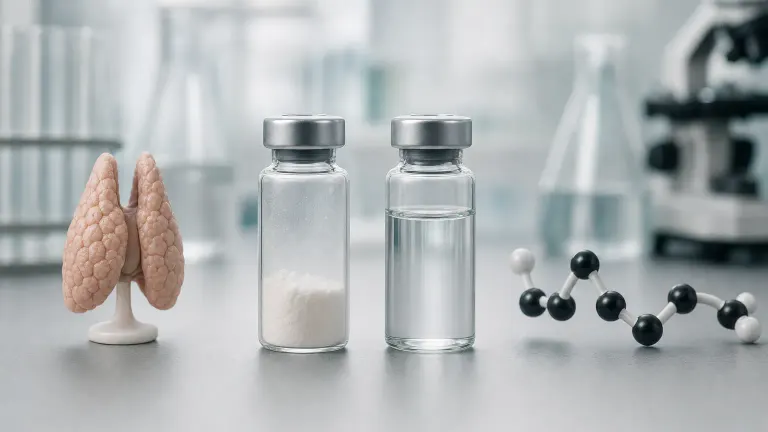
Thymulin is a natural hormone made by the thymus, a small gland behind the breastbone where T cells, a key type of immune cell, mature.[6] French researchers Jean-François Bach and Mireille Dardenne first characterized it in the 1970s as serum thymic factor, or FTS (facteur thymique sérique).[2] It is a 9-amino-acid peptide that only works when it carries a zinc atom.[4][5] Small French trials in the 1980s gave mixed results, and most later research is in animals or cells.[10][11][8] It is not approved as a medicine in the US.[1]
What is thymulin?
Thymulin is produced only by epithelial cells of the thymus, according to reviews co-written by Dardenne.[6] Its peptide chain is pGlu-Ala-Lys-Ser-Gln-Gly-Gly-Ser-Asn, as given in a 1979 paper that reported making it synthetically.[3]
The zinc part matters. In 1982, Dardenne and Bach showed that FTS lost its activity in a lab test when metal was stripped away and regained it when zinc was added back, with one zinc per peptide working best. They proposed the name thymulin (FTS-Zn) for the active, zinc-bound form.[4] Bach and Dardenne described it as a hormone that helps T cells mature and adjusts the activity of different T-cell groups.[5]
Thymulin also talks to the hormone system. Prolactin, growth hormone and thyroid hormones raise its release, and in rat pituitary tissue thymulin itself stimulated the release of hormones such as LH and ACTH. Those pituitary findings come from animal studies.[6][7]
Thymulin benefits: what the research shows
Human trials from the 1980s
A synthetic version called nonathymulin was tested in a handful of small clinical studies:
- Immunodeficient children (1982): three children with immune defects were given synthetic FTS by vein. Doctors reported fewer and milder infections, better immune tests, and IgA antibodies appearing in two children who had none. In two children, the gains faded when treatment paused and came back when it restarted.[9]
- Rheumatoid arthritis (1987): two randomized, double-blind, placebo-controlled trials compared 1, 5 and 10 mg a day. The 5 mg dose worked best: 56% of patients improved on an overall assessment, compared with 17% on placebo.[10]
- Multiple sclerosis (1989): 40 patients got nonathymulin or placebo under the skin for 6 months. There was no difference in disability or walking scores, and the authors concluded it did not work for MS.[11]
Zinc, thymulin and aging
Because thymulin needs zinc, its blood activity drops when zinc is low. In a 1988 US study, mild zinc deficiency lowered serum thymulin activity, and zinc supplements restored it.[12] In 13 zinc-deficient older adults, zinc supplements raised thymulin activity and improved skin-test immune responses.[13] Zinc also restored low thymulin in people with Crohn’s disease, but only at 200 mg a day of zinc sulfate.[22] These studies gave zinc, not thymulin.
Thymulin levels fall in old mice, rats and dogs, and some hormones partly restored them in those animals.[6] Researchers have also tested thymulin gene therapy, but only in mice and rats.[6][8]
Inflammation and pain (animal studies)
In rats, thymulin and a synthetic analog (called PAT) reduced inflammation in the brain.[6] In rat nerve-injury models, PAT reduced pain responses as much as or more than single doses of morphine or meloxicam.[15] These are animal results and have not been tested in people.
Thymulin for hair loss
Thymulin is marketed in topical hair products. The main lab evidence is a 2012 study led by a German hair research group, which kept human scalp hair follicles alive in culture for a short period. Thymulin increased hair growth and kept follicles in the growth phase (anagen) longer. Thymosin beta-4, the peptide behind TB-500, had the opposite effect on the growth phase.[14][24]
This was a short lab experiment on donated tissue, not a treatment study.[14] The only human data we found is a 2017 open-label study of a zinc-thymulin scalp spray in 18 adults with pattern hair loss. It had no placebo group, and its sole author ran the clinic selling the spray and disclosed a financial interest and a patent filing. He reported no local irritation or systemic side effects, and more fine and intermediate hairs at 6 months.[24] That is too weak to show the spray works. For peptides with more skin and hair data, see our skin and hair peptides page.
Thymulin dosage
There is no approved thymulin dose for any use. The only dosing data in people come from the 1980s trials: 1, 5 or 10 mg a day in rheumatoid arthritis, with 5 mg working best, and injections under the skin in the MS trial.[10][11] Those were synthetic products given in clinical trials, and they do not tell us what is safe or effective in today’s online products. We do not give a dosing schedule. If you are working with a prescribed peptide, our peptide calculator explains vial and syringe math.
Thymulin side effects
- In trials: the rheumatoid arthritis trials reported minimal side effects, and the MS trial recorded no significant side effects.[10][11] These trials were small, so rare or long-term risks are unknown.
- Unknown risks: New Zealand’s regulator wrote in 2025 that thymulin’s clinical risks are unknown.[16]
- Product quality: thymulin sold online is not an approved medicine, so purity, dose and sterility are not checked by a regulator.[1]
Thymulin vs thymalin vs thymosin alpha-1
| Thymulin | Thymalin | Thymosin alpha-1 | |
|---|---|---|---|
| What it is | Natural 9-amino-acid thymic hormone that needs zinc[5] | Calf thymus peptide extract[20] | 28-amino-acid thymic peptide[19] |
| Approved where | Nowhere we found[1] | Russia, prescription[20] | Sold as Zadaxin in other countries; not approved in the US[21] |
| Main human evidence | Small 1980s French trials[10] | Russian prescription use[20] | Randomized trials, mostly outside the US[21] |
Despite the similar names, thymalin is a Russian extract, not thymulin. Thymosin alpha-1 has a larger body of human trials. Thymulin is also sometimes grouped with Khavinson’s peptides, but it was discovered separately in France; see our guide to Khavinson peptide bioregulators.
Is thymulin legal?
- US: not FDA-approved. Thymulin acetate appears in Category 3 of FDA’s 503A nominations list, bulk drug substances nominated without adequate support, as of May 14, 2026.[1] In our reading, that means 503A pharmacies cannot use it for compounding.
- New Zealand: in June 2025, Medsafe recommended making thymic peptide hormones, including thymulin, prescription medicines as a group. It said thymulin was not scheduled in New Zealand or Australia at the time.[16] Its paper said thymulin’s functions seem to have been studied only in animals, although the small 1980s trials above did test it in people.[16][10]
- Sports: thymulin is not named on WADA’s 2026 list. In our reading, as a substance not approved for human use anywhere, it could fall under S0 (non-approved substances). Athletes should check with their anti-doping organization.[18]
This is general information, not legal advice.
What users report
For other compounds studied for immunity and aging, see our immune peptides and longevity peptides pages.