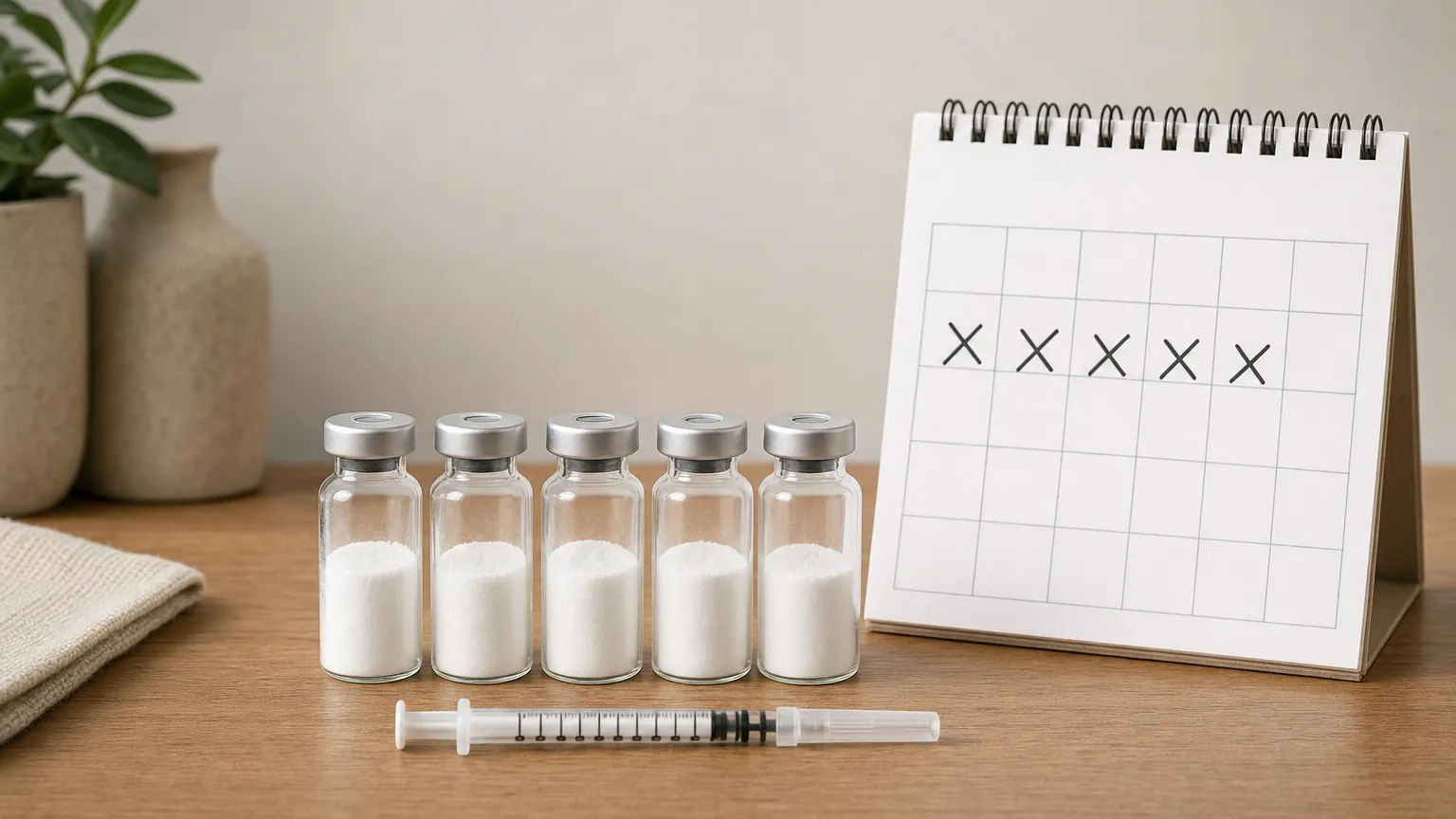
Quick answer: the standard thymalin dosage comes from its Russian label: adults receive 5 to 20 mg by injection into a muscle once a day for 3 to 10 days, 30 to 100 mg per course, with a repeat course after 1 to 6 months if needed.[1] Children aged 6 months to 14 years receive 1 to 5 mg a day by age. In published studies, the most clearly reported dose was 10 mg daily for 5 days.[2][3]
Thymalin is a peptide extract of calf thymus, registered in Russia as a prescription medicine for weakened immunity.[1] This guide covers the label doses, what studies used, side effects and US status. For background, see our thymalin profile and the longevity peptides hub.
What thymalin is
The thymus is a gland behind the breastbone where T cells, a key type of immune cell, mature. Thymalin was made by mild acid extraction of small peptides from calf thymus and was put into medical practice as an “immunocorrector”.[6]
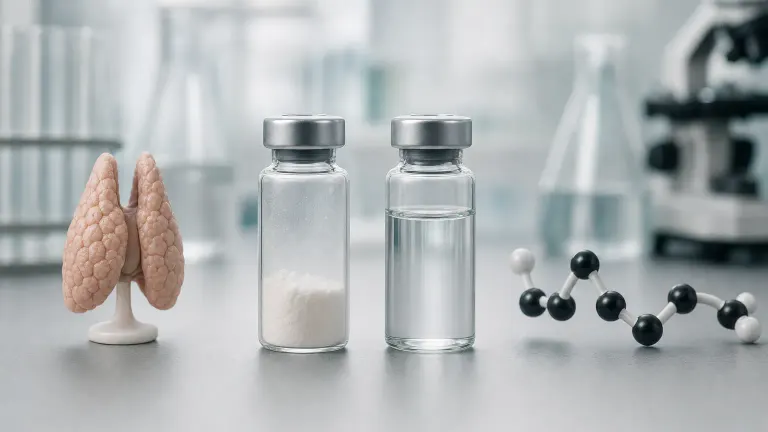
The current Russian product is a freeze-dried powder. Each vial holds 10 mg of thymus extract from calves and young cattle under one year old, plus 20 mg of glycine, and is dissolved before injection into a muscle.[1] Its registration holder is Samson-Med, and its current registration certificate is dated June 21, 2024.[1] Khavinson’s group reports that two dipeptides, Lys-Glu (KE) and Glu-Trp (EW), are active substances of the extract.[7]
Because thymalin is a mixture rather than a single molecule, its dose is given as milligrams of extract, not as a specific peptide.
Thymalin dosage on the Russian label
The label states that a doctor chooses the best dose. It lists these daily doses, all given into a muscle:[1]
| Who | Daily dose | Course |
|---|---|---|
| Adults | 5 to 20 mg | 3 to 10 days; 30 to 100 mg in total |
| Children 6 to 12 months | 1 mg | 3 to 10 days |
| Children 1 to 3 years | 1.5 to 2 mg | 3 to 10 days |
| Children 4 to 6 years | 2 to 3 mg | 3 to 10 days |
| Children 7 to 14 years | 3 to 5 mg | 3 to 10 days |
| Prevention, adults | 5 to 10 mg | 3 to 5 days |
| Prevention, children | 1 to 5 mg | 3 to 5 days |
- Course length depends on how severe the immune problem is.[1]
- Repeat course: if needed, 1 to 6 months later.[1]
- Missing data: the label has no dosing information for people with kidney or liver problems, or for older adults.[1]
What the label is for
The label lists immune deficiency in adults and in children from 6 months to 14 years, with severe infections that cause pus or sepsis, lasting thymus problems (after radiation sickness, thymus tumors or thymus removal), acute and chronic viral and bacterial infections, poor tissue healing, and suppressed immunity or blood-cell production after chemotherapy or radiation.[1] Anti-aging is not a labeled use.
Doses used in published studies
Most thymalin research is Russian, and many older papers have no English abstract, so doses are often not reported in a form we can verify. These are the human studies where we could confirm the regimen or design:
| Study | Who | Thymalin dose |
|---|---|---|
| St. Petersburg COVID-19 trial, 2020[2] | 92 hospital patients (42 thymalin, 50 control) | 10 mg into a muscle, once daily for 5 days, with standard care |
| Moscow military hospital, HIV[3] | Servicemen with HIV infection | 10 mg into a muscle for 5 days, alongside antiviral treatment |
| Elderly mortality study[4] | 266 older adults, 6 to 8 years of follow-up | Given during the first 2 to 3 years; dose not stated in the abstract |
| Chita COVID-19 study, 2022[5] | Middle-aged and older adults with severe COVID-19 | Not stated in the abstract |
What the studies reported
- COVID-19 (St. Petersburg): in a single-center, open-label trial randomized using the envelope method, adding thymalin was linked to faster falls in the inflammation markers IL-6 and CRP and the clotting marker D-dimer, and improved T-cell measures. No one died in either group; CT scans worsened in 2 thymalin patients and 5 controls.[2]
- Elderly adults: the developers reported 2.0- to 2.1-fold lower death rates with thymalin compared with controls, but the abstract does not describe how people were assigned, group sizes or death counts.[4]
- Severe COVID-19 (Chita): hospital mortality was reported as lower with thymalin than with standard care, but the English and Russian abstracts give different figures and neither states patient numbers.[5]
Timing, frequency and “protocols”
The label describes short daily courses, not continuous use. There is no published human evidence for:
- Injecting thymalin under the skin rather than into a muscle.
- Taking it every day for months.
- Yearly “longevity” cycles in healthy people. The elderly study gave thymalin over 2 to 3 years, but its abstract does not report the schedule.[4]
- Combining it with other peptides such as epitalon, apart from the developers’ own elderly study, which also tested thymalin with the pineal extract epithalamin.[4]
A Russian review by the developers summarizes their long-term clinical use of thymalin and related peptides in people of different ages, but it is not a dosing trial.[8] For the wider group of Russian peptides, see our guide to Khavinson peptide bioregulators.
Side effects and who should avoid it
- Side effects: the label lists allergic reactions as possible.[1]
- Do not use: in pregnancy, while breastfeeding, or if allergic to any ingredient.[1]
- Use with caution: in people with a history of allergies.[1]
- Relative cautions: for thymus extracts from cattle, the label lists the days around menstruation and some hormone conditions, such as pituitary adenoma and acromegaly. It says side effects may be more frequent with severe hormone disorders and in the second half of the menstrual cycle, and advises against alcohol during treatment.[1]
The COVID-19 paper did not report side effects in detail.[2] There are no large modern safety trials.
Is thymalin legal in the US?
Thymalin is not FDA-approved. It does not appear on any of FDA’s 503A bulk substance lists as of May 14, 2026; the similarly named thymulin acetate is a different peptide.[9] In our reading, that leaves no route for US pharmacies to compound it. Products sold online under the name thymalin are not regulated as medicines in the US, so their content and sterility are not checked by FDA.
To understand how thymalin differs from similar-sounding peptides, see thymalin vs thymosin alpha 1 and thymalin vs thymulin. For other immune-focused options, see our best peptides for immune support and peptides for long COVID guides.
Questions to ask a clinician
- Is there a diagnosed immune problem that this medicine is meant to treat?
- Which dose and course length do you recommend, and why?
- Is the product the registered Russian medicine, and how was it sourced?
- Do I have allergies or hormone conditions that make it unsuitable?
- Is there an approved treatment with stronger evidence for my condition?
For help reading vial strengths on any prescription, see our peptide calculator. This is general information, not medical advice.