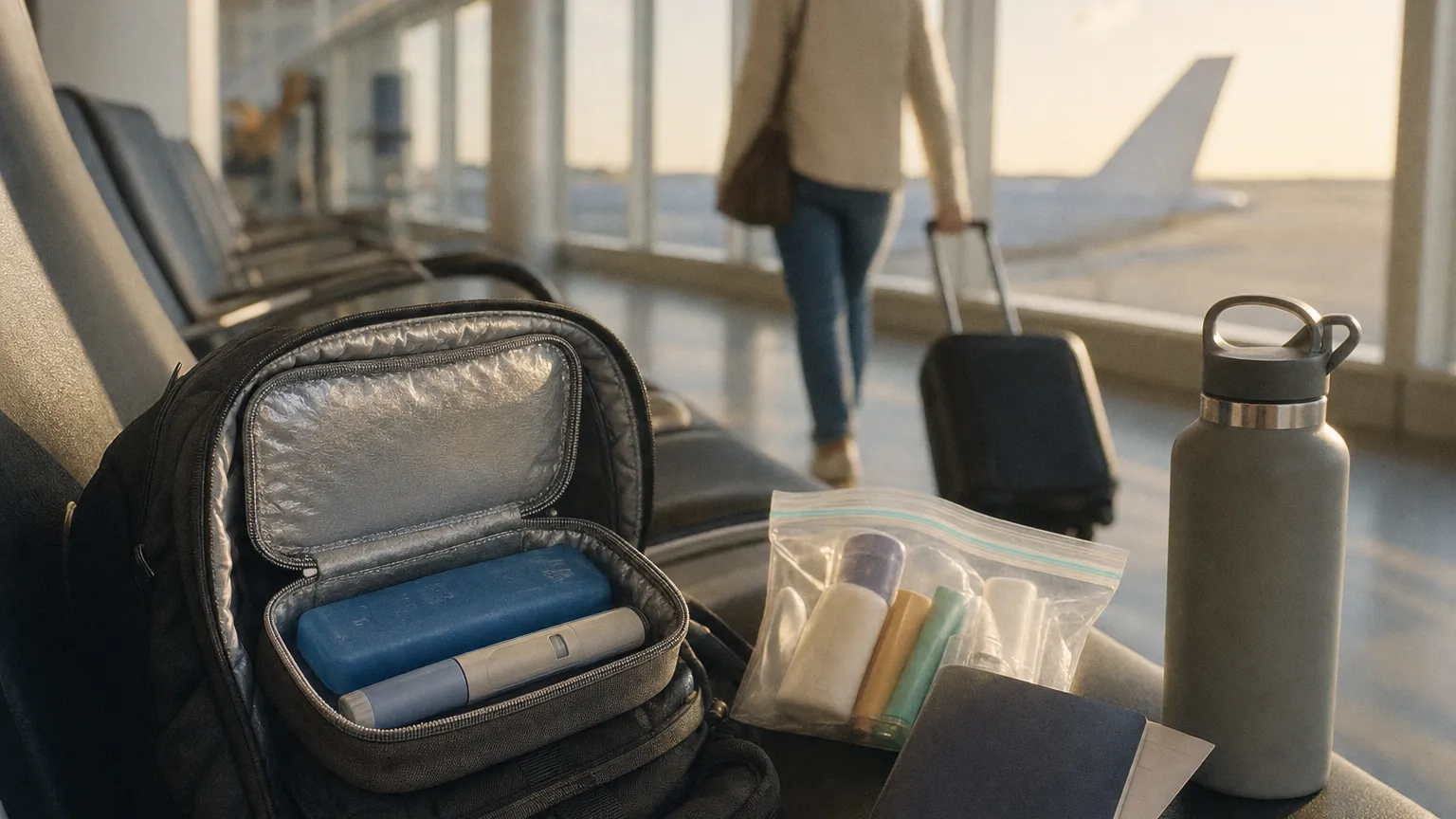
Traveling with GLP-1 medications is allowed in your carry-on: TSA permits injectable medicine and unused needles once you declare them at the checkpoint, with no 3.4-ounce limit for medically necessary liquids.[1][3] Most pens can also leave the fridge for a while. Mounjaro and Zepbound single-dose pens last up to 21 days at or below 86°F (30°C), and an in-use Ozempic pen lasts 56 days.[8][9][6]
This guide covers airport screening, keeping pens cool, dosing across time zones and paperwork for international trips. For general storage at home, see our GLP-1 storage guide, and for the bigger picture see the GLP-1 basics hub.
TSA rules for GLP-1 pens and needles
TSA treats GLP-1 pens like other injectable medicines:
- Pens and needles are allowed. Unused syringes are allowed in carry-on and checked bags when they are with injectable medication. You must declare them to the officer at the checkpoint.[1]
- The liquids limit does not apply. You may bring medically necessary liquids above 3.4 ounces (100 mL) in reasonable amounts for your trip.[3][2]
- Screen them separately. Tell the officer about your medication before screening starts, then place it in its own bin along with cooling packs and needles.[2]
- Labels help. TSA recommends, but does not require, that medication be labeled.[1] Keeping pens in the pharmacy-labeled carton is the simplest way to do this.
- Cooling packs are fine. Ice packs, freezer packs and gel packs used for medicine may be frozen, partly frozen or melted at the checkpoint.[2]
You can tell the officer out loud, show a TSA notification card or show medical paperwork.[2] If a liquid triggers an alarm and the alarm can’t be cleared, the item may not be allowed through, so leave time for extra screening.[2]
Carry-on, not checked
Keep your medicine with you. The CDC Yellow Book says all medications should go in hand luggage rather than checked bags, and that you should pack enough for the whole trip plus several extra days in case of delays.[4] There’s another reason too: the labels say not to use a GLP-1 pen that has been frozen, and you can’t control the temperature of a cargo hold.[6][8]
How long GLP-1 pens last without a fridge
The labels set the limits. All of them say to keep the medicine away from heat and light, and none allow freezing.
| Medicine | Before first use | Out of the fridge |
|---|---|---|
| Ozempic pen | Refrigerate | 56 days at 59-86°F (15-30°C) after first use[6] |
| Wegovy single-dose pen | Refrigerate | Up to 28 days at 46-86°F (8-30°C), cap on[7] |
| Wegovy FlexTouch pen | Refrigerate | 56 days at 59-86°F (15-30°C) after first use[7] |
| Mounjaro or Zepbound single-dose pen or vial | Refrigerate | Up to 21 days total, not above 86°F (30°C)[8][9] |
| Mounjaro or Zepbound KwikPen or multi-dose vial | Refrigerate | 30 days at up to 86°F (30°C)[8][9] |
| Saxenda pen | Refrigerate | 30 days at 59-86°F (15-30°C) after first use[10] |
| Trulicity pen | Refrigerate | Up to 14 days total, not above 86°F (30°C)[11] |
The once-daily liraglutide pen (Saxenda) and the weekly dulaglutide pen (Trulicity) have the shortest room-temperature windows. Unopened Ozempic and Saxenda pens should stay cold until first use.[6][10]
Practical cooling tips
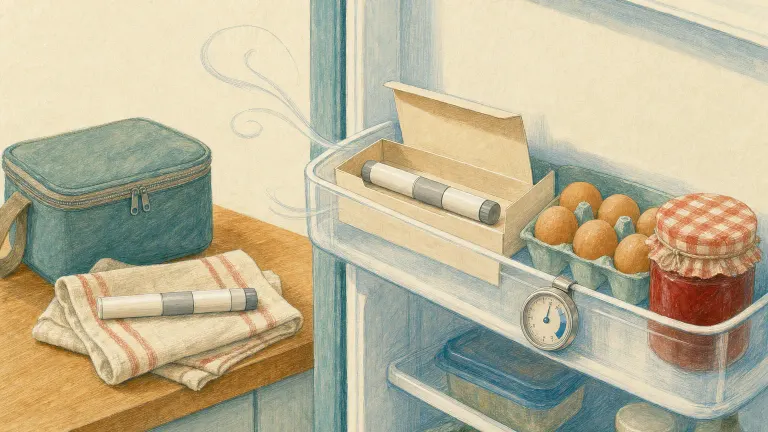
- Use an insulated pouch with a cold pack. Don’t let the pen touch the ice pack directly, because the labels say not to use a pen that has frozen.[6]
- Keep pens out of hot cars, sunny windows and beach bags. The labels limit storage to 86°F (30°C) and ask you to protect pens from heat and light.[8][7]
- Write down the date a pen first leaves the fridge, so you know when its room-temperature time runs out.
- Keep pens in their original carton where the label says to. Ozempic, Wegovy, Mounjaro and Zepbound all say this.[6][7][8]
Time zones and your dose day
Weekly GLP-1s can be taken at any time of day, so a few hours of time difference rarely matters.[6][8] If a trip makes your usual day awkward, the labels let you move it as long as doses stay far enough apart:
| Medicine | Changing the dose day | Missed dose rule |
|---|---|---|
| Ozempic | Allowed if doses are at least 2 days (48 hours) apart[6] | Take within 5 days; otherwise skip[6] |
| Wegovy injection | Allowed if the last dose was 2 or more days before[7] | Take it if the next dose is more than 2 days away; otherwise skip[7] |
| Mounjaro, Zepbound | Allowed if doses are at least 3 days (72 hours) apart[8][9] | Take within 4 days; otherwise skip[8][9] |
| Trulicity | Allowed if the last dose was 3 or more days before[11] | Take it if the next dose is at least 3 days away; otherwise skip[11] |
| Saxenda (daily) | Any time of day[10] | Skip it and take the next scheduled dose; no extra dose[10] |
Two cautions apply. If you miss 2 or more Wegovy doses in a row, the label says to restart at a lower dose.[7] If more than 3 days pass without Saxenda, the label says to restart at 0.6 mg.[10] Both steps lower the risk of stomach side effects, so talk to your prescriber before a long trip if you might run out. More detail is in our guides to a missed GLP-1 dose and the best time to take a GLP-1.
International travel and paperwork
The CDC Yellow Book suggests these steps for travelers with ongoing prescriptions:[4]
- 3-4 weeks before: get a letter from your clinician on office letterhead. It should list your conditions, your medicines with generic names and doses (semaglutide or tirzepatide, not only the brand), any allergies and the supplies you need, plus the clinician’s contact details.
- Check the destination: contact the destination country’s US embassy or consulate to ask about medication restrictions.
- 1-2 days before: pack enough for the trip plus several extra days in your carry-on.
Carry copies of your prescriptions too. If your pen stops working or gets lost abroad, generic names help a local pharmacist find the same drug, since brand names vary between countries.[4]
Needles and sharps on the road
Used pen needles need a safe place to go. FDA advises carrying a small, travel-size sharps disposal container in case other options aren’t available.[5] TSA allows used syringes when they are in a sharps container or similar hard-surface container.[12] Use a new needle for each injection with pens that take screw-on needles, such as Ozempic.[6] If you want a refresher on technique while away from home, see our guide to GLP-1 injection sites.
Quick packing checklist
- Pens or vials in their cartons, plus spare doses for delays[4]
- Pen needles, alcohol swabs and a travel sharps container[5]
- Insulated pouch and cold packs[2]
- Prescription copies and a clinician letter for international trips[4]
- A note of each pen’s first day out of the fridge
For drug-specific details, see our semaglutide and tirzepatide profiles.