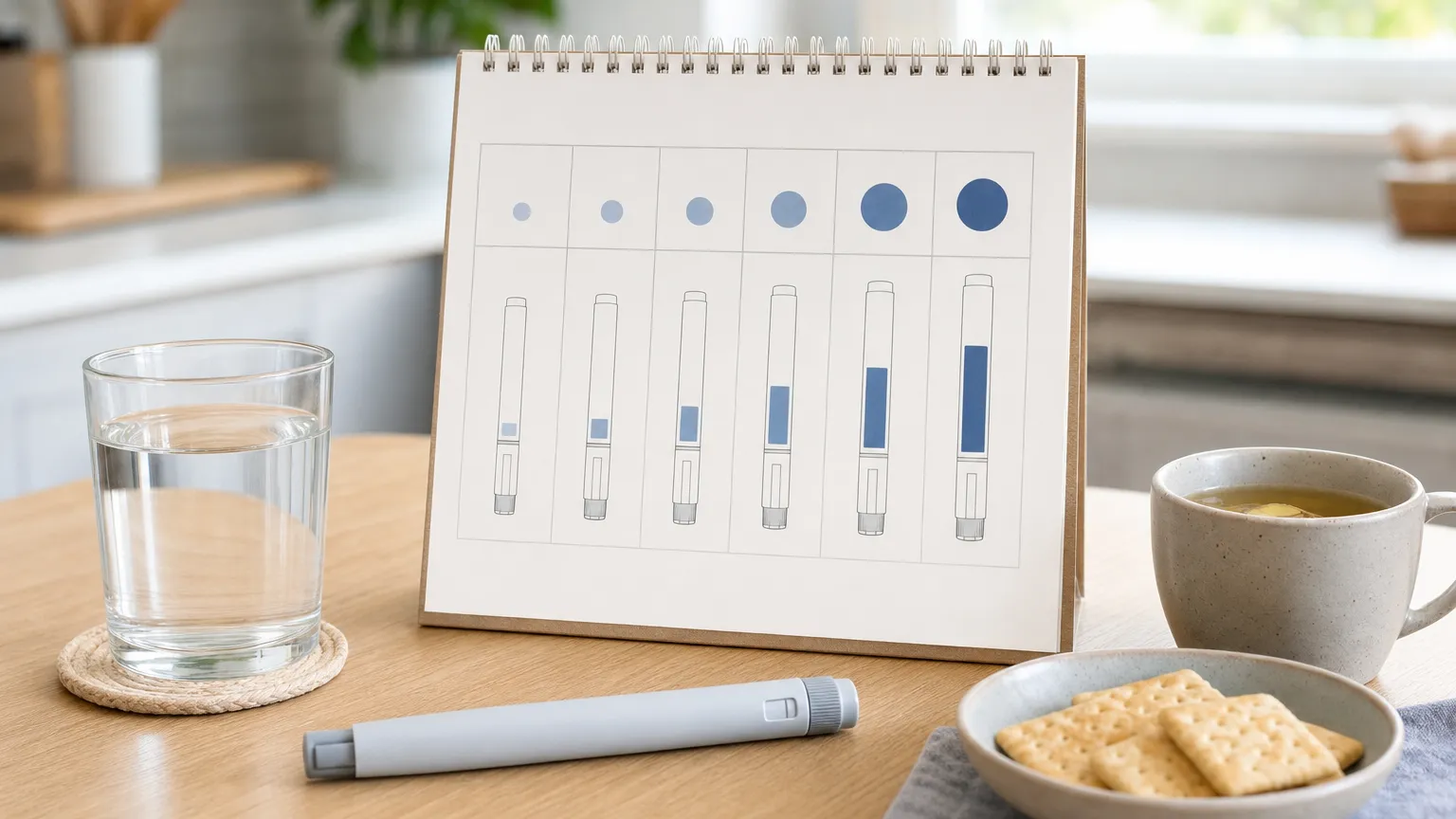
Quick answer: the most common tirzepatide side effects are stomach-related. In the Zepbound weight-loss trials, nausea affected 25% to 29% of people, diarrhea 19% to 23%, vomiting 8% to 13% and constipation 11% to 17%, compared with 2% to 8% on placebo.[1] These problems are mostly mild to moderate, show up mainly in the first weeks and after each dose increase, and then tend to fade.[1][4]
Tirzepatide is sold as Zepbound for weight loss and sleep apnea, and as Mounjaro for type 2 diabetes. It is the same drug in both, so the same side effects apply. For background, see our tirzepatide profile and the GLP-1 side effects hub.
Tirzepatide side effects by dose (Zepbound)
These are the reactions that occurred in at least 2% of people on Zepbound and more often than on placebo, pooled from two 72-week trials of about 2,500 adults on the drug.[1]
| Side effect | Placebo | 5 mg | 10 mg | 15 mg |
|---|---|---|---|---|
| Nausea | 8% | 25% | 29% | 28% |
| Diarrhea | 8% | 19% | 21% | 23% |
| Vomiting | 2% | 8% | 11% | 13% |
| Constipation | 5% | 17% | 14% | 11% |
| Abdominal pain | 5% | 9% | 9% | 10% |
| Indigestion (dyspepsia) | 4% | 9% | 9% | 10% |
| Injection site reactions | 2% | 6% | 8% | 8% |
| Fatigue | 3% | 5% | 6% | 7% |
| Allergic-type reactions | 3% | 5% | 5% | 5% |
| Burping | 1% | 4% | 5% | 5% |
| Hair loss | 1% | 5% | 4% | 5% |
| Reflux (GERD) | 2% | 4% | 4% | 5% |
| Dizziness | 2% | 4% | 5% | 4% |
Overall, 56% of people on each Zepbound dose had at least one stomach side effect, compared with 30% on placebo.[1] Notice that constipation was most common at the lowest dose, while vomiting and diarrhea rose with dose.
Mounjaro side effects in type 2 diabetes
The Mounjaro label comes from diabetes trials, where rates were lower. Nausea affected 12%, 15% and 18% of people on 5, 10 and 15 mg (4% on placebo), and diarrhea 12% to 17% (9% on placebo).[2] Decreased appetite (5% to 11%), vomiting (5% to 9%), constipation (6% to 7%), indigestion and abdominal pain were the other common reactions.[2]
The trials differ in length, population and placebo rates, so the two labels are not a head-to-head comparison. Our Zepbound vs Mounjaro guide explains how the two brands differ.
When side effects start: a rough timeline
Both labels say most nausea, vomiting and diarrhea happened during dose escalation and decreased over time.[1][2] In the SURMOUNT-1 trial, the main weight-loss study, stomach side effects were mostly mild to moderate and occurred primarily while the dose was being raised.[3]
- Weeks 1 to 4 (2.5 mg): a starter dose meant to let your body adjust. It is not a treatment dose.[1]
- Each step up: the dose rises by 2.5 mg after at least 4 weeks. Nausea or diarrhea often returns for a few days after each increase.[1] In an analysis of the SURMOUNT-1 to -4 trials, people who needed anti-diarrhea or anti-nausea medicine most often started it during dose escalation.[4]
- First few months: most people who quit because of side effects did so in this window, mainly because of stomach problems.[1]
- Maintenance: once the dose is stable, stomach side effects usually ease.
Feeling sick does not mean the drug is working better. In the SURMOUNT analysis, weight loss was similar whether or not people had nausea, vomiting or diarrhea.[4]
Side effects when increasing the dose
The label escalation schedule exists to limit stomach side effects: start at 2.5 mg for 4 weeks, then increase in 2.5 mg steps, no faster than every 4 weeks.[1] The maximum is 15 mg once weekly. If a maintenance dose is not tolerated, the Zepbound label says your prescriber can consider a lower maintenance dose.[1] See our tirzepatide dosage chart for the full schedule.
Stopping because of side effects was slightly more common at higher doses: 4.8%, 6.3% and 6.7% on 5, 10 and 15 mg, versus 3.4% on placebo.[1] For stomach side effects alone, the figures were 1.9%, 3.3% and 4.3%, versus 0.5%.[1]
Less common tirzepatide side effects
- Hair loss. Linked to weight loss and much more common in women: 7.1% of women versus 0.5% of men on Zepbound.[1] See GLP-1 hair loss.
- Injection site and allergic reactions. Mostly skin reactions such as rash or itching, and more frequent in people who developed antibodies to the drug.[1]
- Faster heart rate. An average rise of 1 to 3 beats per minute on Zepbound.[1]
- Low blood pressure. 1.6% versus 0.1% on placebo, more often in people taking blood pressure medicines.[1]
- Skin sensitivity (dysesthesia). Rare, at 0.2% to 0.4%.[1] See Mounjaro skin sensitivity.
- Burping. 4% to 5%, sometimes described as sulfur burps. See Mounjaro sulfur burps.
Serious side effects: when to call a clinician
These are rare, but the labels list them as warnings:[1][2]
- Pancreatitis: severe belly pain that won’t go away, sometimes spreading to the back, with or without vomiting. In the Zepbound weight trials it was confirmed in 0.2% of people on the drug and 0.2% on placebo.[1] A 2026 meta-analysis of 19 trials found it rare (0.22%) with no clear difference between 5, 10 and 15 mg.[5]
- Gallbladder disease: pain under the right ribs, fever or yellow skin. Gallbladder inflammation occurred in 0.7% on Zepbound versus 0.2% on placebo.[1] See GLP-1 gallbladder problems.
- Dehydration and kidney injury: vomiting or diarrhea that stops you keeping fluids down.[1]
- Severe stomach problems: reported in 1.7% to 3.1% on Zepbound versus 1% on placebo. Tirzepatide is not recommended with severe gastroparesis.[1]
- Low blood sugar: mainly with insulin or a sulfonylurea. In one Zepbound trial, 10.3% of people also taking a sulfonylurea had low blood sugar, versus 2.1% of those who were not.[1]
- Thyroid warning: tirzepatide caused thyroid C-cell tumors in rats. Whether it does in humans is unknown, and it should not be used with a personal or family history of medullary thyroid cancer or MEN 2.[1]
- Before surgery: tell your care team. Rare cases of food in the stomach during anesthesia have been reported. See GLP-1 before surgery.
Zepbound’s label used to carry a warning about suicidal thoughts. FDA asked for it to be removed in January 2026 after a review found no increased risk.[6] Mood changes are still worth reporting.
Managing common side effects
- Eat smaller meals and stop when you feel full.
- Limit greasy, fried and very sweet foods, especially around injection day. Our GLP-1 nausea guide has more tips.
- Drink fluids steadily through the day. The patient guide stresses this to lower the chance of dehydration.[1]
- Ask whether staying longer on a dose before stepping up makes sense for you.
Questions to ask your clinician
- Which dose should I stay on if side effects return after an increase?
- What should I take, or avoid, for nausea, diarrhea or constipation?
- Do my insulin, sulfonylurea or blood pressure medicines need adjusting?
- What birth control should I use while my dose is changing?
- Which symptoms mean I should stop and call you?
This guide is general information. A licensed clinician should set and adjust your dose.