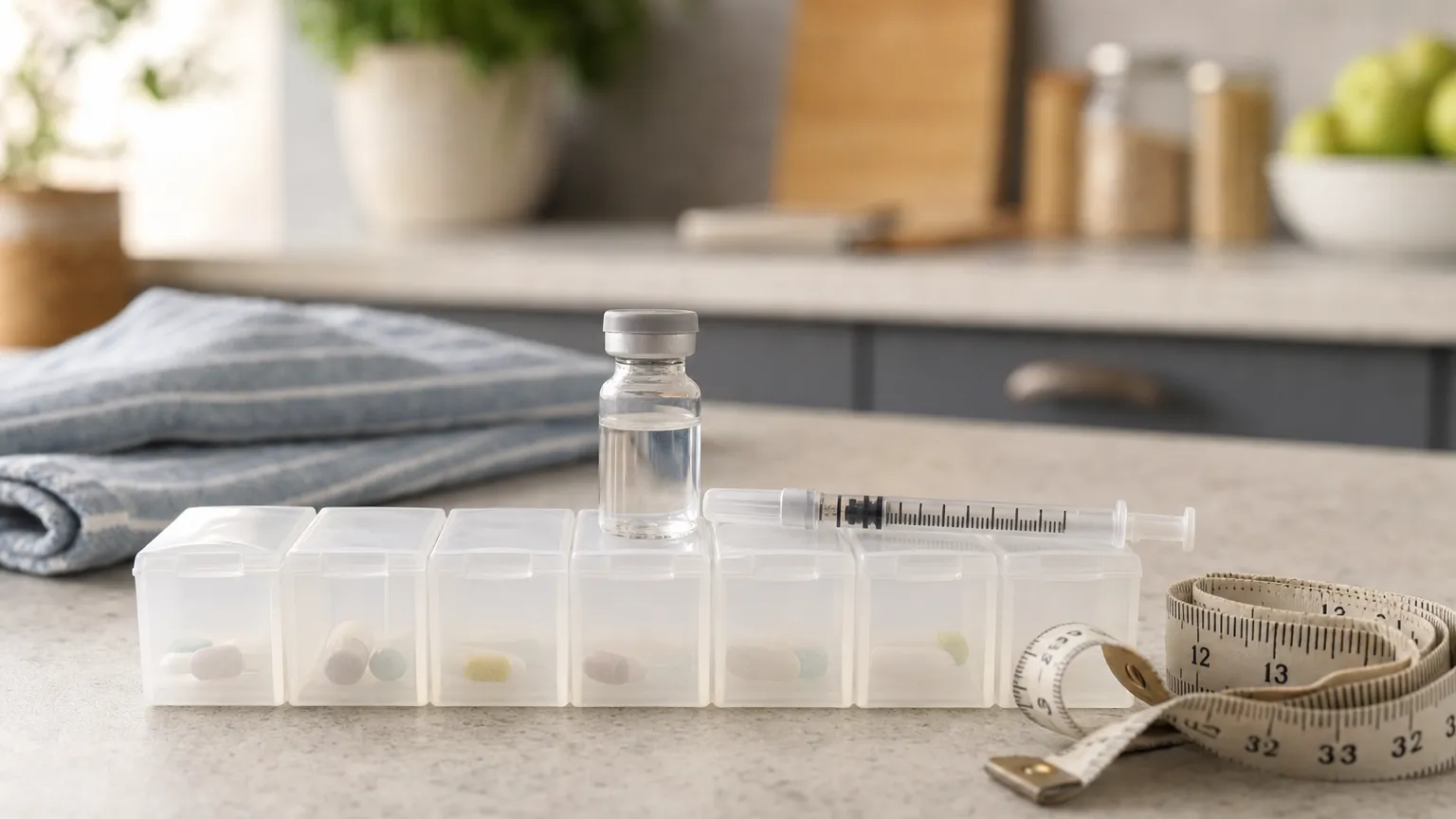
Quick answer: the label tesamorelin dosage is 1.4 mg once a day for Egrifta SV or 1.28 mg once a day for Egrifta WR, injected under the skin of the abdomen.[2][1] Both doses give about the same blood levels as the 2 mg daily dose of the original Egrifta used in the phase 3 trials, which is why the numbers look different.[1][4] There is no dose escalation: you start and stay on the same daily dose.
Tesamorelin is FDA-approved only to reduce excess abdominal fat in adults with HIV who have lipodystrophy, and the labels say it is not for weight loss.[1] This guide covers the label doses, how each product is mixed and stored, missed doses, the monitoring the labels call for, and the doses used in research. For background, see our tesamorelin profile and the growth hormone peptides hub.
Tesamorelin dosage chart
| Product | Vial strength | Daily dose | Volume per dose | How long a vial lasts |
|---|---|---|---|---|
| Egrifta SV | 2 mg | 1.4 mg | 0.35 mL | One dose; discard the rest |
| Egrifta WR | 11.6 mg | 1.28 mg | 0.16 mL | 7 daily doses |
| Original Egrifta (used in phase 3 trials) | 1 mg | 2 mg | Two vials | One dose |
Sources: Egrifta SV label,[2] Egrifta WR label[1] and the first phase 3 trial.[4]
The labels state plainly that Egrifta SV and Egrifta WR are not substitutable. The dose, the number of vials needed, the mixing steps and the storage rules all differ, so a switch needs a new prescription, not a guess at the equivalent volume.[1][2]
Why 1.4 mg and 1.28 mg match the old 2 mg dose
Tesamorelin is poorly absorbed from under the skin. The label puts the absolute bioavailability of a 2 mg dose at less than 4%.[1] Newer formulations deliver the drug more efficiently, so a smaller amount reaches similar blood levels:
- The Egrifta SV label bases its 1.4 mg dose on studies showing similar peak and total exposure to the original 2 mg dose.[2]
- The Egrifta WR label does the same for its 1.28 mg dose.[1]
- Neither newer product was retested in a full efficacy trial. Their effectiveness and safety rest on the original trials plus these exposure comparisons, and the WR label says side effects are expected to be similar.[1]
The drug itself is short-lived. Its half-life was about 8 minutes after Egrifta SV and 11 minutes after Egrifta WR, with peak levels reached about 9 minutes (0.15 hours) after injection.[2][1] Once-daily dosing works because the effect runs through the body’s own growth hormone and IGF-1, not through tesamorelin staying in the blood.
How to mix and inject each product
Your clinic or pharmacist should show you the steps before the first dose, and each box includes Instructions for Use.
Egrifta SV (2 mg vial):[2]
- Mix one vial with 0.5 mL of the sterile water supplied, rolling it gently for 30 seconds. Do not shake it.
- Draw up 0.35 mL (1.4 mg) and inject it right away.
- Throw away the leftover solution. Do not refrigerate or freeze mixed solution.
- Store unopened vials at room temperature in the original box to protect them from light.
Egrifta WR (11.6 mg vial):[1]
- Mix one vial with 1.3 mL of the bacteriostatic water supplied, swirling rather than shaking.
- Each daily dose is 0.16 mL (1.28 mg), and one vial covers 7 days.
- Keep the mixed vial at room temperature, 68°F to 77°F, and discard it 7 days after mixing. Do not freeze it.
For both: use the solution only if it is clear and colorless with no particles.[1] Inject into the abdomen and rotate to a different area each time, avoiding scar tissue, bruises and the navel.[1] MedlinePlus adds that the site should be below the navel and should not be a spot with hard bumps from earlier injections.[3] For general technique, see how to inject peptides under the skin and how to dispose of needles.
Never share syringes or needles, even if the needle is changed, because that can spread infection.[2]
Timing and missed doses
The labels do not name a time of day. MedlinePlus advises injecting at around the same time every day.[3]
If you miss a dose, MedlinePlus says to inject it as soon as you remember. If it is almost time for the next dose, skip the missed one and continue the usual schedule. Do not take a double dose to catch up.[3]
Monitoring while on tesamorelin
The dose does not change, but the labels ask prescribers to watch for these effects:[1]
- IGF-1: tesamorelin raises IGF-1, a growth factor. At 26 weeks in the trials, 47% of patients had IGF-1 above 2 standard deviation scores and 36% above 3. The label suggests considering stopping in people with persistently high levels, especially if the fat response is not strong.
- Blood sugar: check glucose before starting and periodically after. In the trials, HbA1c of 6.5% or more developed in 5% of people on tesamorelin versus 1% on placebo. People with diabetes also need eye checks for retinopathy.
- Fluid retention: swelling, joint pain and carpal tunnel symptoms can occur. They are usually temporary or go away after stopping.
- Injection-site reactions: these affected 25% of people on tesamorelin versus 14% on placebo in the first 26 weeks. Rotating sites helps.
There is no dose adjustment table for kidney or liver disease, because the drug’s handling in those groups, in older adults and in children has not been studied.[1] Tesamorelin should not be used in pregnancy, with active cancer, or after pituitary surgery, pituitary damage or head radiation.[1] For a full list, see our tesamorelin side effects section and our guide to peptide injection-site reactions.
Doses used in research
| Study | Who | Dose | What happened |
|---|---|---|---|
| Dose-ranging trial, 12 weeks | 61 adults with HIV and belly fat | 1 mg or 2 mg daily | IGF-1 rose 48% and 65%; trunk fat fell significantly only on 2 mg[5] |
| Phase 3 trial, 26 weeks | 412 adults with HIV and belly fat | 2 mg daily | Visceral fat fell 15.2% vs a 5.0% rise on placebo[4] |
| Type 2 diabetes trial, 12 weeks | 53 adults with type 2 diabetes | 1 mg or 2 mg daily | No change in insulin response or blood sugar control[7] |
| Cognition trial, 20 weeks | 152 adults aged 55 to 87 | 1 mg nightly | Better executive function scores; mild side effects in 68% vs 36%[6] |
| Fatty liver trial, 12 months | 61 adults with HIV and fatty liver | 2 mg daily | Liver fat fell 37% relative to placebo[8] |
In the cognition trial, participants injected about 30 minutes before bedtime.[6] That timing was a study choice, not a label instruction. For what these trials found in more detail, see tesamorelin results.
How tesamorelin dosing compares with related peptides
Because Egrifta has an FDA label, tesamorelin has an official dose, a fixed schedule and defined monitoring. Most other growth hormone peptides sold for anti-aging or body composition do not. See tesamorelin vs sermorelin for how the two hormone analogs differ, and tesamorelin with ipamorelin for why that popular pairing has no dosing data.
Questions to ask your clinician
- Am I being prescribed Egrifta SV or Egrifta WR, and how many units or milliliters is my dose?
- How often will you check my IGF-1 and blood sugar?
- How long should I stay on it, and how will we know whether it is working?
- What should I do about swelling, joint pain or numbness in my hands?
- Do any of my other medicines, such as steroids, hormones or seizure drugs, need monitoring?
The last question matters because growth hormone can change how the liver clears some medicines, and people on steroid replacement may need a dose increase.[1]