Quick answer: the best retatrutide fatty liver data come from a phase 2 substudy of 98 adults with metabolic dysfunction-associated steatotic liver disease (MASLD). After 24 weeks, liver fat fell by 81.4% on 8 mg and 82.4% on 12 mg, versus a 0.3% rise on placebo, and 86% of people on 12 mg reached a normal liver fat level.[1] It is a small, early study that measured fat, not liver scarring, and retatrutide is not FDA-approved for any condition.
This page explains what the study measured, what it found, and what it cannot tell you yet. For the drug’s background and status, see the retatrutide profile.
What MASLD is, and why liver fat matters
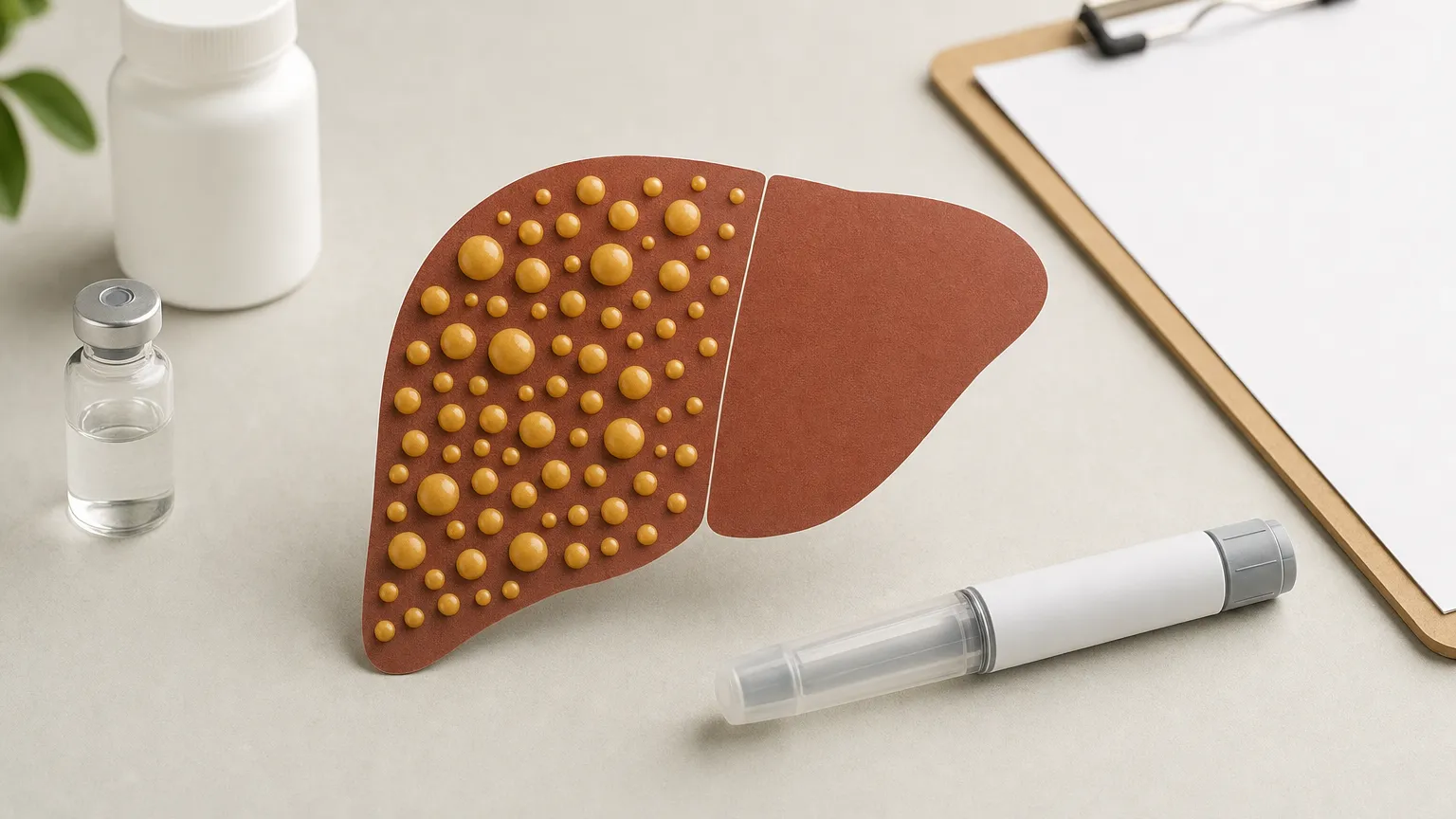
MASLD is the newer name for what was called non-alcoholic fatty liver disease. It means fat has built up in the liver in someone with metabolic risk factors such as obesity, high blood sugar or high triglycerides. In some people the fat leads to inflammation (MASH, formerly NASH) and then scarring (fibrosis), which can progress to cirrhosis.
Liver fat is an early measure. A drop in liver fat is encouraging, but it is not the same as showing less scarring or fewer serious liver problems. Keep that difference in mind as you read the results below.
The retatrutide MASLD trial: who was in it
The liver study was a substudy inside the 48-week phase 2 obesity trial, which enrolled 338 adults with obesity, or overweight plus a weight-related condition.[2] Participants who also had MASLD with liver fat of 10% or more on an MRI scan could join the substudy.[1]
- Size: 98 participants, randomly assigned to weekly retatrutide (1, 4, 8 or 12 mg) or placebo.[1]
- Starting point: average liver fat was about 19%, well above the 5% threshold usually treated as normal.[1]
- Measurement: liver fat by MRI, plus blood markers of liver injury and insulin resistance.[1]
- Excluded: people with type 2 diabetes.[1]
Results: liver fat by dose
The main goal was the relative change in liver fat at 24 weeks.[1]
| Dose | Liver fat change at 24 weeks | Reached normal liver fat (under 5%) at 24 weeks | Liver fat change at 48 weeks |
|---|---|---|---|
| 1 mg | −42.9% | 27% | −51.3% |
| 4 mg | −57.0% | 52% | −59.0% |
| 8 mg | −81.4% | 79% | −81.7% |
| 12 mg | −82.4% | 86% | −86.0% |
| Placebo | +0.3% | 0% | −4.6% |
Source: Sanyal et al., Nature Medicine 2024.[1]
Every dose beat placebo at both time points. At 48 weeks, 89% of people on 8 mg and 93% on 12 mg had normal liver fat, though only about half the participants had a 48-week scan, so those later figures are less certain.[1]
How fast liver fat falls
Most of the drop happened in the first 24 weeks. The authors described a “floor effect”: once people had lost roughly 20% of their body weight, liver fat had fallen by about 75% and could not go much lower. Belly fat kept shrinking after that point.[1]
The substudy group also lost weight steadily: 17.6% on 12 mg at 24 weeks and 25.9% at 48 weeks, versus 0.1% on placebo.[1]
Why retatrutide may affect the liver
The liver changes tracked closely with weight loss. The correlation between percentage weight loss and liver fat reduction was strong, and liver fat also fell in step with visceral (deep belly) fat.[1]
Other changes pointed the same way:
- Insulin resistance: fasting insulin fell by up to 70.9% at 48 weeks on doses of 4 mg or more.[1]
- Visceral fat: fell by up to 48.3% at 48 weeks, while it rose 2.5% on placebo.[1]
- Blood fats: triglycerides fell by more than 40% on 8 mg and 12 mg.[1]
Retatrutide also activates the glucagon receptor, and the authors suggest glucagon activity may help the liver burn fat directly. The trial cannot separate that effect from weight loss, so treat it as a hypothesis.[1] Our guide to how retatrutide works explains the three receptors.
What about inflammation and scarring?
This is the main gap. The study did not take liver biopsies, which are needed to grade MASH and fibrosis directly.[1]
What it did measure were blood markers:[1]
- K-18, a marker of liver cell death, fell significantly on 8 mg and 12 mg at 48 weeks.
- Pro-C3, a marker linked to active scarring, fell significantly with several doses.
- ALT, AST, FIB-4 and ELF, the liver enzymes and fibrosis scores clinicians commonly use, did not change consistently versus placebo. Most participants started with normal or only mildly raised values.
The authors listed further limits: the small sample, a mostly white US population, no people with diabetes, no enrichment for MASH or significant fibrosis, and many missing 48-week scans. They called the results hypothesis-generating, not definitive.[1]
Liver safety in the trials
The researchers reported no signals of drug-induced liver injury through 48 weeks, in the MASLD group or across the whole obesity trial.[1] Side effects in the substudy were mainly short-lived, mild-to-moderate stomach problems, more frequent on 8 mg and 12 mg. One participant had a serious episode of gallbladder inflammation that was treated with surgery to remove the gallbladder.[1]
Lilly has completed a single-dose study comparing people with impaired liver function to healthy volunteers, but no results had been posted as of October 2026.[5]
What is still unknown, and the phase 3 liver trial
Lilly is now testing whether retatrutide prevents serious liver events. SYNERGY-Outcomes is a phase 3 trial planned for about 4,500 adults with MASLD at higher risk of liver complications, selected using liver stiffness scans and a blood fibrosis score.[3]
- Main measure: time to a first major adverse liver outcome. Progression to cirrhosis and liver fat are also tracked.[3]
- Design: separate retatrutide and tirzepatide groups, each compared with placebo.[3]
- Timing: estimated primary completion in August 2030.[3]
Lilly’s 2026 releases list MASLD among retatrutide’s ongoing phase 3 programs.[4] Separately, an analysis of the phase 2 trials found falls in cholesterol-carrying particles and in the inflammation marker hsCRP, which may matter because people with MASLD often have high heart risk.[6]
For the wider evidence on liver treatments, see our guide to peptides for fatty liver.
Questions to ask a clinician
- How much fat and scarring does my liver have, and how would we measure it?
- Which approved treatments, including weight loss, fit my liver results?
- Would I qualify for a liver trial such as SYNERGY-Outcomes?
- Which other conditions, such as diabetes or high cholesterol, should we treat at the same time?
For the weight results behind these numbers, see retatrutide weight loss results. For safety across trials, see is retatrutide safe? and retatrutide side effects.