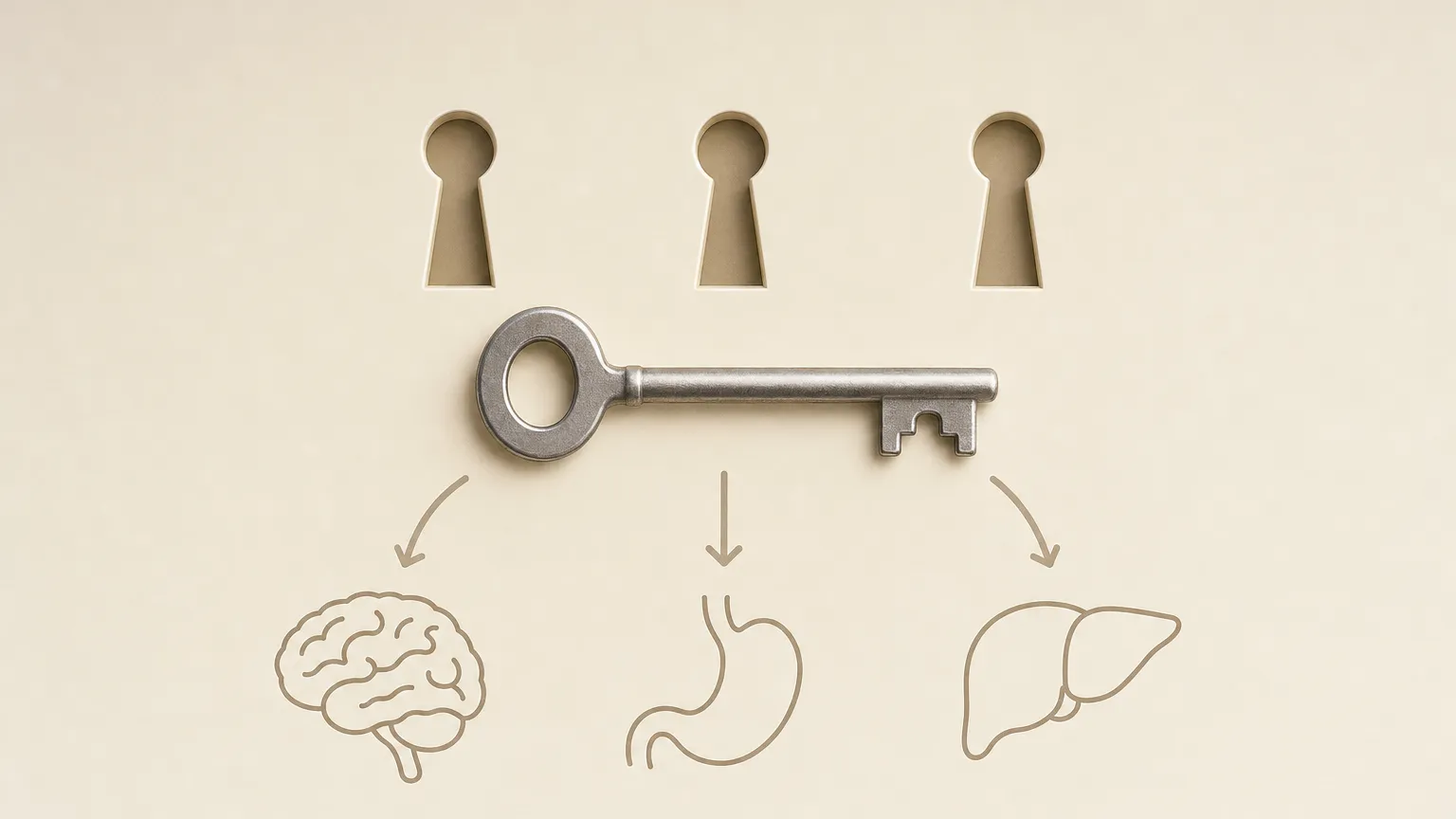
How does retatrutide work? Retatrutide is a single peptide that activates three hormone receptors at once: GLP-1, GIP and glucagon. In laboratory studies, the GLP-1 and GIP actions reduced how much animals ate, and the glucagon action added an increase in calories burned.[1] That combination is why it is called a “triple agonist”, and why some people nickname it “GLP-3”.
Retatrutide is an investigational Eli Lilly drug and is not FDA-approved. For trial results and status, see the retatrutide profile.
Is retatrutide a “GLP-3”?
No. There is no hormone called GLP-3. The nickname is shorthand for a third generation of these drugs:
| Drug | Receptors activated | Status |
|---|---|---|
| Semaglutide (Wegovy, Ozempic) | GLP-1 | Approved |
| Tirzepatide (Zepbound, Mounjaro) | GIP and GLP-1 | Approved |
| Retatrutide | GIP, GLP-1 and glucagon | Investigational |
Sources: Wegovy label,[7] Zepbound label,[6] retatrutide discovery paper.[1]
The accurate name is a “GIP, GLP-1 and glucagon receptor triple agonist”. Calling it GLP-3 can mislead people into thinking it is simply a stronger GLP-1 drug. The glucagon part works differently.
The three receptors, one at a time
Retatrutide does not contain three drugs. It is one molecule, first known by the code LY3437943, designed to fit all three receptors.[1]
GLP-1: appetite and fullness
GLP-1 is a gut hormone released after eating. The Wegovy label describes it as a physiological regulator of appetite and calorie intake, and notes that GLP-1 receptors sit in brain areas involved in appetite.[7] Drugs that activate it reduce hunger, increase fullness and boost insulin release after meals.
GIP: a second incretin
GIP is another gut hormone that helps release insulin after meals. The tirzepatide label says GIP and GLP-1 receptors are both found in brain areas that regulate appetite, and that nonclinical studies suggest adding GIP may further help regulate food intake.[6]
Glucagon: the new piece
Glucagon is a hormone made by the pancreas. It is best known for raising blood sugar between meals by telling the liver to release glucose, but it also affects how the body uses energy and handles fat in the liver.
In Lilly’s discovery work in obese mice, retatrutide’s glucagon activity added an increase in energy expenditure on top of the reduced food intake driven by GIP and GLP-1, and the combination produced more weight loss.[1] Whether the same holds in people is still being studied. Lilly has completed a human study measuring calorie intake and energy use on retatrutide, but its results had not been posted as of October 2026.[9]
How strongly it hits each receptor
Retatrutide is not equally strong at all three. In laboratory tests, it showed balanced activity at the glucagon and GLP-1 receptors, but more activity at the GIP receptor.[1]
That balance matters because glucagon alone raises blood sugar. Pairing it with GLP-1 and GIP, which lower blood sugar, is meant to capture glucagon’s energy and liver effects without the blood sugar rise. In the 12-week phase 1b study in people with type 2 diabetes, the three highest doses lowered daily blood glucose and HbA1c compared with placebo.[2] In the larger phase 3 TRANSCEND-T2D-1 trial, HbA1c fell by 1.69 to 1.94 percentage points over 40 weeks, versus 0.81 on placebo, and no severe low blood sugar was reported.[10]
What the mechanism looks like in people
The trial results fit what the mechanism predicts:
- Weight: in TRIUMPH-1, average weight loss over 80 weeks reached 25.0% on 12 mg, versus 3.9% on placebo.[5]
- Liver fat: in a substudy of people with fatty liver disease, liver fat fell by 82.4% on 12 mg after 24 weeks, and 86% of that group reached normal liver fat. The reductions were linked to weight loss, belly-fat loss and better insulin sensitivity and fat metabolism.[4]
- Heart rate: in the phase 2 obesity trial, heart rate rose with dose, peaked at 24 weeks and then declined.[3]
- Side effects: the most common were gastrointestinal, as with GLP-1 drugs.[3][5]
Trials cannot cleanly separate how much each receptor contributes in humans, so statements that glucagon “burns fat” in people go beyond the evidence so far.
Why it is injected once a week
Retatrutide has a half-life of about 6 days, measured in the phase 1b study.[2] In an earlier single-dose study, weight reduction persisted up to day 43 after one injection.[1] In phase 3, people started at 2 mg weekly and increased every four weeks to 4, 9 or 12 mg, a gradual climb meant to limit stomach side effects.[8] See the retatrutide dosage guide for each trial’s doses.
What is still unknown about the mechanism
Several questions remain open as of October 2026:
- Energy use in people. The mouse finding that glucagon raises calorie burning has not yet been confirmed in published human data; the dedicated study is complete but unreported.[9]
- Skin sensations. In TRIUMPH-1, 5.1% to 12.5% of people on retatrutide reported dysesthesia, an abnormal tingling or burning feeling on the skin, versus 0.9% on placebo.[8] Why a triple agonist causes this has not been explained.
- Long-term heart and kidney effects. A roughly 5-year trial in about 10,000 adults with heart or kidney disease, TRIUMPH-Outcomes, is testing whether retatrutide reduces heart attacks, strokes, heart failure events and kidney decline. Its main results are not expected before 2029.[11]
For the safety picture as a whole, see is retatrutide safe?.
Retatrutide vs tirzepatide and semaglutide: does the extra receptor matter?
In separate trials, retatrutide produced more weight loss than tirzepatide or semaglutide did in their main trials Whether the glucagon action explains that gap has not been tested directly, and different trials enrolled different people for different lengths of time. The answer will come from direct comparisons. See retatrutide vs tirzepatide and retatrutide vs semaglutide, and our general explainer on how GLP-1 drugs work.
Questions to ask a clinician
- Would a single, dual or triple agonist make more sense for my health history?
- How does my heart rate or liver health factor into which drug is right?
- Is there a retatrutide trial I could join?