Quick answer: under U.S. peptide import laws, most people cannot legally import unapproved peptides, even for personal use. FDA says that “in most circumstances” importing drugs for personal use is illegal, and its personal importation policy only describes narrow cases, with a supply limit of about three months, where staff may choose not to act.[1] Shipments of peptides like BPC-157 or retatrutide are routinely detained, refused or seized, and in 2026 CBP reported seizing about 5,000 peptide shipments at a single port.[6]
This guide covers the legal basis, the personal importation policy, import alerts, mail facility enforcement, and what travelers can bring. Related reading: online peptide sales legal risks, research use only peptides, and the FDA & Regulation hub.
The legal basis: FD&C Act section 801
Section 801(a) of the Federal Food, Drug, and Cosmetic Act lets FDA refuse admission to any imported drug that appears to be adulterated, misbranded, or an unapproved new drug.[2] Most peptides sold online fall into the last group: they have no FDA approval, so they are unapproved new drugs when sold for human use.
The process works like this:
- CBP (Customs and Border Protection) controls the border and refers FDA-regulated products to FDA.
- FDA decides whether the product is admissible.
- If FDA detains it, the owner gets a notice and a chance to respond. If the response does not resolve the issue, the product is refused.[7]
The personal importation policy and its limits
FDA’s personal importation policy is guidance to its staff, not a legal right. For unapproved drugs used for a serious condition, FDA may use discretion only when all of these apply:[1]
- effective treatment may not be available in the U.S.;
- the product is not commercialized or promoted to U.S. residents;
- it does not pose an unreasonable risk;
- you affirm in writing that it is for personal use;
- the quantity is generally no more than a three-month supply;
- you provide your U.S. doctor’s name and address, or show you are continuing treatment begun abroad.
FDA also says it may refuse personal imports that are on an import alert, look commercial, pose a serious health risk, or appear to be health fraud.[1]
Import alerts that cover peptides
An import alert tells FDA field staff they may detain products without examining them (called DWPE, detention without physical examination). Two matter most for peptides.
| Import alert | What it covers | Why it matters for peptides |
|---|---|---|
| 66-41 | Unapproved new drugs promoted in the U.S. | Covers listed firms and products marketed to U.S. buyers; FDA notes commercial or promotional shipments are generally not eligible for personal importation discretion[3] |
| 66-80 | GLP-1 active ingredients from makers not on FDA’s “green list” | Semaglutide and tirzepatide ingredients from unlisted manufacturers can be detained at the border[4][5] |
FDA launched the green list on September 5, 2025, saying shortages had led compounders to use overseas ingredients of questionable quality.[4] FDA says it does not stop legal imports from compliant makers.[5] In May 2026, FDA warned a Chinese manufacturer that had sourced semaglutide ingredient from a facility not on the green list, and it put the firm on Import Alert 66-40 and removed it from the green list.[10]
For context on why the compounding side matters, see 503A vs 503B compounding and the FDA peptide compounding crackdown.
Mail facilities and CBP seizures
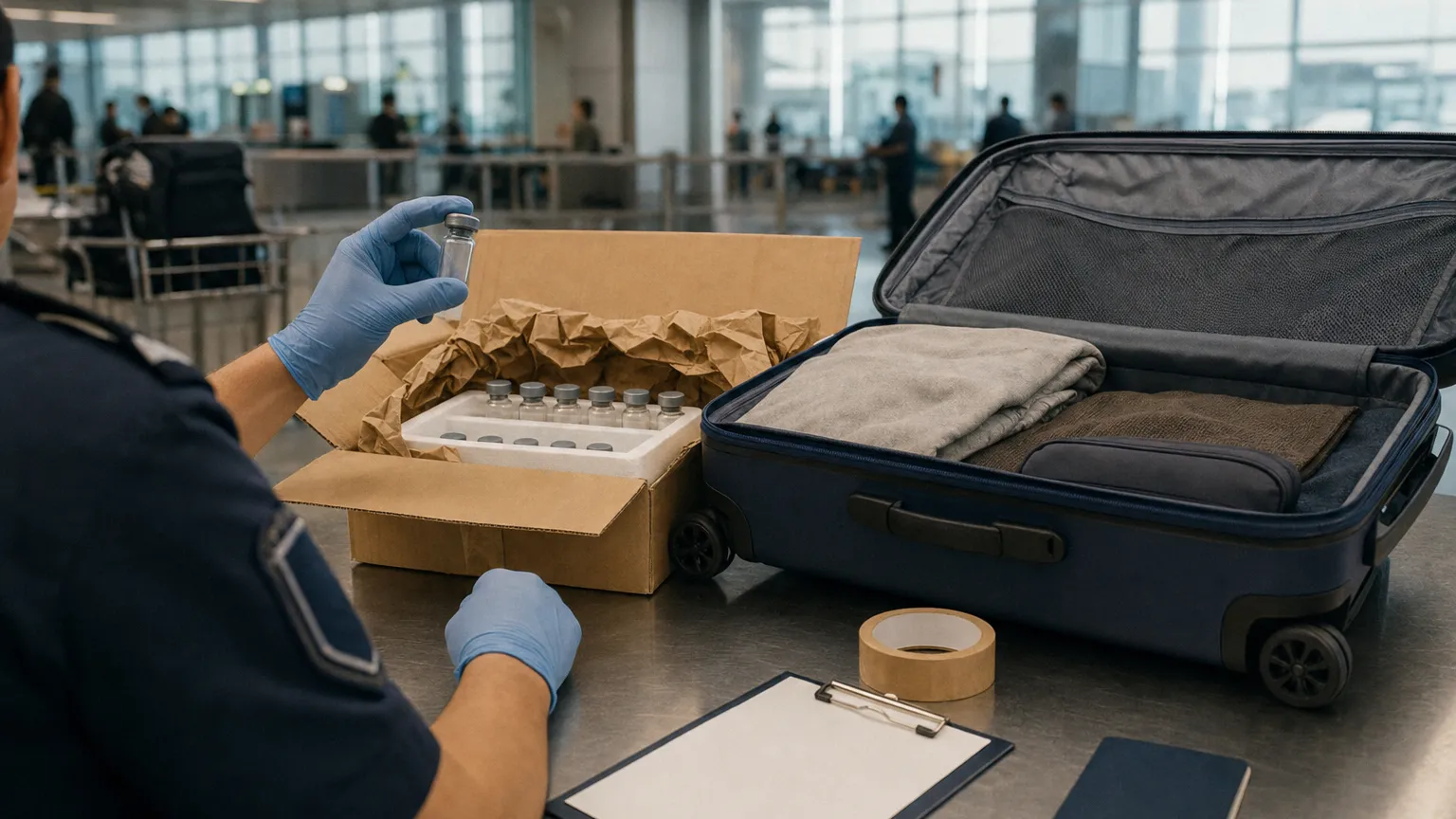
Most consumer peptide orders arrive by international mail or express courier. At international mail facilities, USPS hands packages to CBP, which refers drug parcels to FDA investigators for examination.[7]
If a parcel is detained, FDA issues a Notice of FDA Action. Since 2015, FDA has had authority to destroy refused drugs valued at $2,500 or less, after giving the owner written notice and a chance to present testimony. The rule implemented section 708 of the 2012 FDA Safety and Innovation Act (FDASIA).[8]
Recent seizures show what CBP looks for:
- Cincinnati, March 2026. CBP reported that from December 2025 to March 25, 2026 it found over 300 master cartons from a shipper in China, each hiding about 15 unmanifested parcels, for about 5,000 peptide shipments. Products included retatrutide, semaglutide, tirzepatide, MOTS-c, Semax and cagrilintide.[6]
- “Research” labeling does not help. FDA has warned sellers that labeled GLP-1 peptides “for research purposes” or “not for human consumption.”[11]
Controlled substances and growth hormone
Most peptides are not scheduled under the Controlled Substances Act, so the DEA is usually not the main agency. Two exceptions are worth knowing:
- Controlled substances, such as anabolic steroids, carry extra DEA requirements on top of FDA rules, and CBP says travelers must comply with them.[9]
- Human growth hormone has its own criminal provision: distributing or possessing hGH with intent to distribute for uses other than an approved, prescribed indication is a federal crime under 21 U.S.C. 333(e).[12]
See DEA peptide classification for more.
Traveling with prescribed peptides
Bringing your own prescribed, FDA-approved medicine, such as a GLP-1 pen, is a different situation. CBP advises:[9]
- carry only medicine prescribed to you or legally obtained in the U.S.;
- keep it in the original container, or carry a prescription or doctor’s letter;
- bring generally no more than a 90-day supply;
- declare all medicines when you enter.
CBP also warns that in most cases it is illegal for U.S. citizens to buy drugs abroad and bring them home for personal use.[9] Our guide to traveling with GLP-1 medications covers storage and airport screening.
Other countries
Rules abroad differ, and a peptide that is legal to buy in one country can still be refused at the U.S. border. See peptide legality by country and peptide regulation in the EU, UK and Australia.
This is general information, not legal advice.