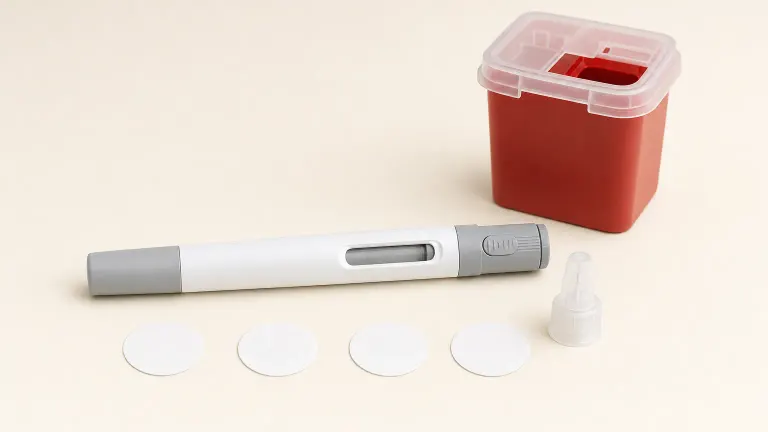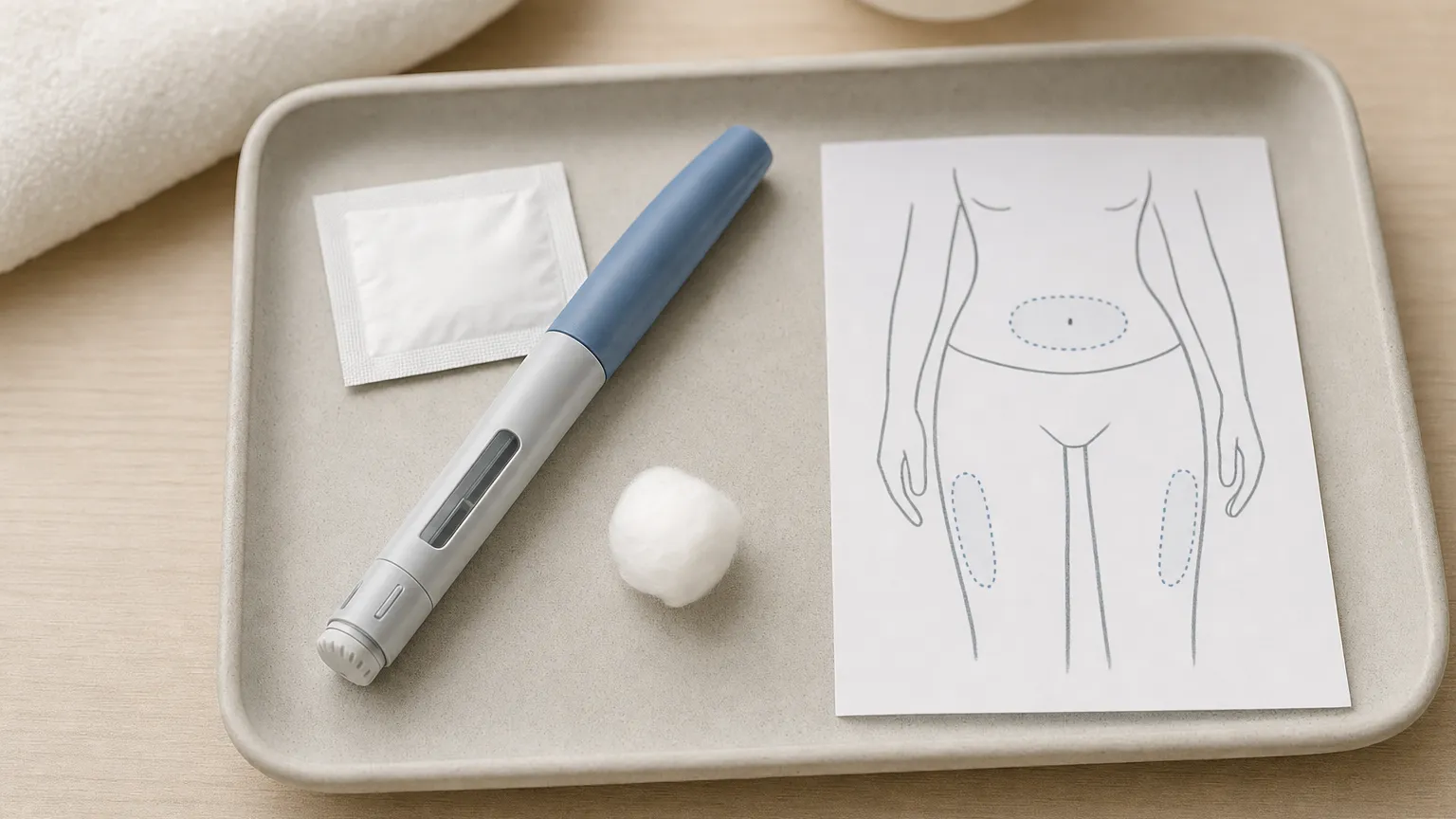
How to inject tirzepatide: once a week, at any time of day, under the skin of your stomach or thigh (or the back of your upper arm if someone else injects it), using the steps for your device.[1][2] With the Zepbound or Mounjaro single-dose pen, that means four steps: choose a site, pull off the base cap, place the pen flat and unlock it, then press and hold for up to 10 seconds until the second click.[1]
Tirzepatide is sold as Zepbound for weight reduction and sleep apnea, and as Mounjaro for type 2 diabetes. Both come as a single-dose pen, single-dose vials, multi-dose vials and a four-dose KwikPen, each with its own Instructions for Use (IFU).[1][2] This guide summarizes those leaflets. It does not replace hands-on training, which the label says you should get before your first dose and again whenever your device changes.[1]
Before you start
- Check the medicine. It should be clear and colorless to slightly yellow. Do not use it if it is frozen, cloudy, discolored or has particles, or if it is expired.[1]
- Check the dose. Make sure the label matches your prescription. Your clinician sets the dose; see our tirzepatide dosage chart for the label schedule.
- Wash your hands with soap and water.
- Timing. Inject once weekly, at any time of day, with or without meals.[1]
- No need to warm it. The pen leaflet says you don’t need to let the pen reach room temperature first.[1]
Where to inject tirzepatide
You or someone else can inject into the stomach (abdomen) or thigh. Only another person should inject into the back of your upper arm.[1] The KwikPen leaflet adds that stomach injections should be at least 2 inches from the belly button.[1]
- Rotate every week. You can use the same body area, but pick a different spot within it.[1]
- Avoid problem skin. The vial leaflet says not to inject where skin has pits, is thickened, has lumps, or is tender, bruised, scaly, hard, scarred or damaged. Rotating lowers the risk of lipodystrophy (pitted or thickened skin) and localized cutaneous amyloidosis (lumps under the skin).[1]
- Keep other injections separate. Do not mix tirzepatide with other medicines or use the same spot as another injectable. With Mounjaro and insulin, give separate injections. They can go in the same body region, but not right next to each other.[1][2]
Our guide to GLP-1 injection sites compares the areas in more detail.
Single-dose pen: four steps
This is the familiar autoinjector with a hidden, built-in needle.[1]
- Choose your injection site and clean hands. Leave the gray base cap on until you’re ready.
- Pull off the gray base cap while the pen is still locked. Throw the cap away; don’t put it back on, and don’t touch the needle. A drop of liquid on the needle tip is normal.
- Place the clear base flat on your skin, then unlock by turning the lock ring.
- Press and hold the purple button for up to 10 seconds. The first click means the injection started. The second click means it’s done, and the gray plunger becomes visible.
Some people hear a soft click just before the second loud click; that’s normal. Don’t lift the pen until the second loud click. If you can’t see the gray plunger afterward, the leaflet says to call Lilly at 1-800-545-5979 and store the pen safely.[1]
Vials: drawing up and injecting
Vials need a separate syringe and needle, such as a 1 mL syringe that can measure 0.5 mL or 0.6 mL.[1] Use a new syringe and needle every time.
- Remove the plastic cap (on a new vial) and wipe the rubber stopper with an alcohol swab.
- Attach the needle if it isn’t pre-attached, and pull off the needle shield.
- Pull back the plunger to draw in air equal to your dose: 0.5 mL for a single-dose vial or 0.6 mL for a multi-dose vial.
- Push the needle through the stopper and inject the air into the vial.
- Turn the vial and syringe upside down, keep the needle tip in the liquid, and pull back past your dose line. Tap out air bubbles, then push up to exactly 0.5 mL or 0.6 mL.
- Withdraw the syringe, insert the needle into your skin as your clinician showed you, and push the plunger down.
- Leave the needle in for at least 5 seconds so the full dose goes in, then pull it out. Do not recap the needle.[1]
A single-dose vial is thrown away after one use, even if liquid remains. A multi-dose vial holds four weekly doses.[1]
KwikPen: prime, dial, inject
The KwikPen needs a new pen needle each week, plus a priming step before every injection. You dial the knob to the prime position (2 clicks), tap out air, and release a drop into the air. Then turn the knob all the way until the dose icon appears, inject, and hold for a slow count of 5.[1] The label says people with visual impairment should not self-inject with the KwikPen unless their clinician decides they can. For Mounjaro, children should not self-inject with it either.[1][2]
After the injection
- Bleeding: press the site lightly with gauze or a cotton ball. Don’t rub.[1]
- Sharps: put the used pen, needle or syringe in an FDA-cleared sharps container right away. If you don’t have one, the leaflet allows a heavy-duty plastic household container with a tight, puncture-resistant lid that stays upright and is labeled as hazardous waste.[1]
- Never put loose needles in household trash or recycling, or flush them. FDA says this puts waste workers and family members at risk.[3]
See how to dispose of needles for local disposal options.
Missed doses and changing your injection day
If you miss a dose, take it as soon as possible within 4 days (96 hours). If more than 4 days have passed, skip it and take the next dose on your usual day.[1][2] You can move your weekly injection day, as long as doses are at least 3 days (72 hours) apart. Our missed GLP-1 dose guide covers longer gaps, which your clinician may handle by restarting at a lower dose.
Injection site reactions
Redness, itching, bruising, pain or rash at the injection site are among the side effects seen with tirzepatide.[1]
| Trial pool | Tirzepatide | Placebo |
|---|---|---|
| Zepbound weight trials (5, 10, 15 mg) | 6%, 8%, 8% | 2% |
| Mounjaro diabetes trials (all doses) | 3.2% | 0.4% |
Sources: Zepbound[1] and Mounjaro[2] prescribing information. Reactions were more common in people who developed antibodies to tirzepatide.[1][2]
The Medication Guide says to stop the drug and get medical help right away for signs of a serious allergic reaction. These include swelling of the face, lips, tongue or throat, problems breathing or swallowing, severe rash or itching, fainting, or a very rapid heartbeat.[1] Our guide to injection site reactions explains what is normal.
Storage at a glance
| Device | Room temperature limit (up to 86°F) |
|---|---|
| Single-dose pen or vial | Up to 21 days in total |
| Multi-dose vial or KwikPen | 30 days; discard 30 days after first use or after 4 doses |
All forms are otherwise kept in the refrigerator at 36°F to 46°F and never frozen.[1] More tips are in GLP-1 storage.
Questions to ask your clinician or pharmacist
- Can you watch me do my first injection with my exact device?
- If I use vials, which syringe and needle size should I buy?
- Should I pinch the skin, and which sites work best for me?
- What should I do if I think I didn’t get a full dose?
For more on how tirzepatide works and its side effects, see the tirzepatide profile and Zepbound vs Mounjaro.