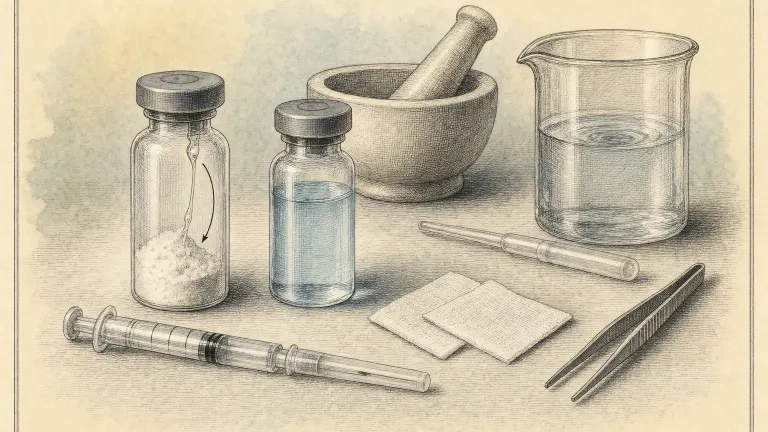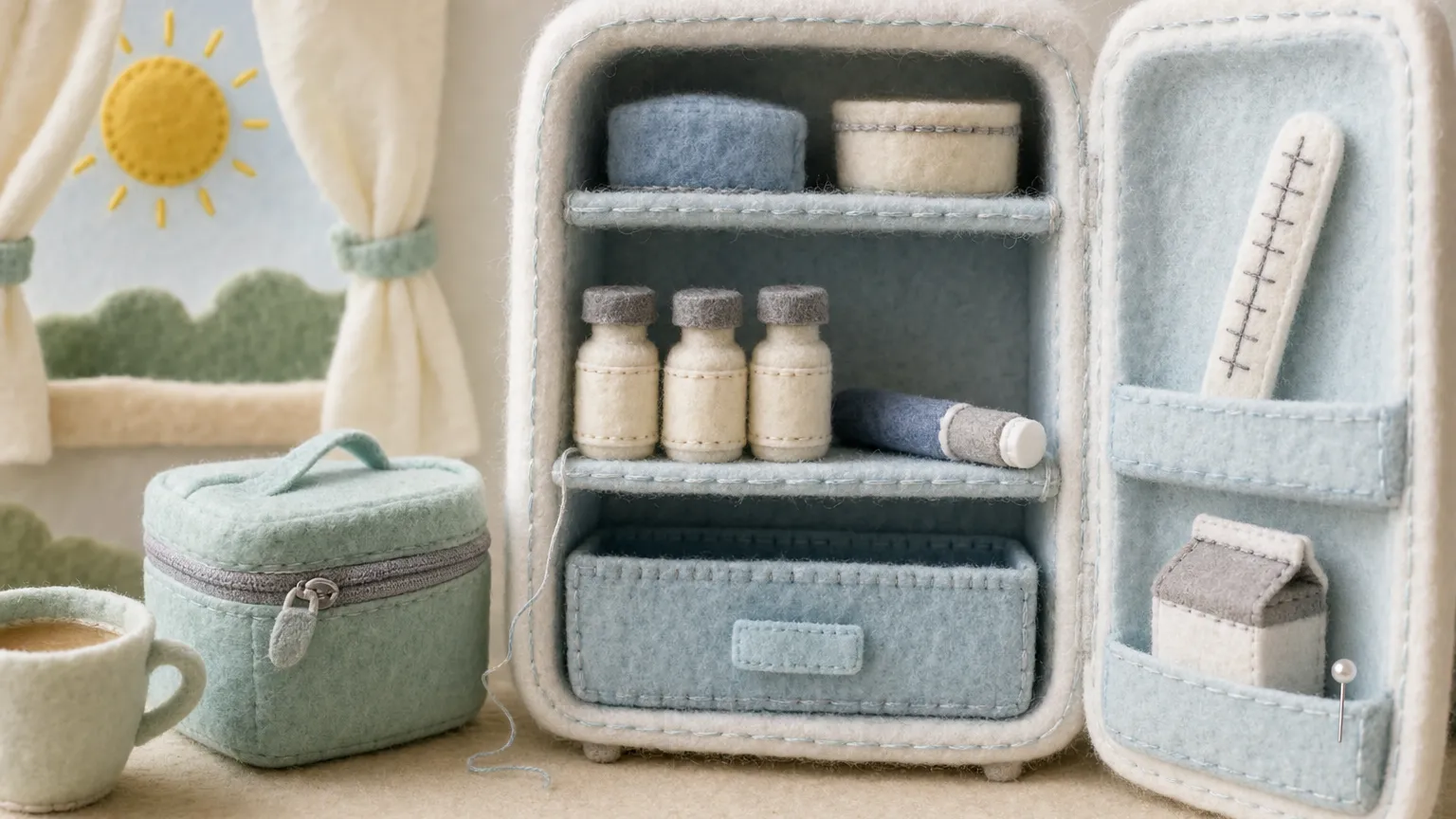
How to store peptides comes down to limiting the things that break them down: water, heat, light, freezing and rough handling. Freeze-dried (lyophilized) powders are the most stable form because many degradation reactions need water.[1] Once mixed or opened, the clock starts, and approved labels set limits ranging from 7 days at room temperature for mixed tesamorelin to 56 days for an in-use semaglutide pen.[8][7]
This page explains the science of peptide stability and turns it into practical storage rules. It’s part of our peptide basics hub.
Bottom line
| Factor | What it does | Practical rule |
|---|---|---|
| Water | Drives chemical reactions such as deamidation and hydrolysis[1] | Keep powders dry and sealed until use |
| Heat | Speeds up most degradation reactions[1] | Store as labeled; avoid hot cars and windowsills |
| Freezing | Ice surfaces can unfold and damage peptides[4] | Don’t freeze liquids unless the label says so |
| Light | Can trigger oxidation of sensitive amino acids[5] | Keep in the original box or a dark place |
| Shaking | Air-liquid surfaces promote clumping[6] | Swirl, don’t shake |
How peptides break down
Peptides degrade in two broad ways:[1]
- Chemical instability changes the molecule itself. Common reactions include deamidation (an asparagine or glutamine side chain changes, especially in water), oxidation (methionine, cysteine and tryptophan are vulnerable), and hydrolysis (the chain is cut).
- Physical instability changes the shape or state without breaking bonds: unfolding, sticking to container surfaces, and aggregation, where molecules clump together.
Aggregation matters for safety as well as strength. Clumped peptides and related impurities can raise the risk of immune reactions, a concern FDA has raised about compounded peptides.[13]
A 2023 review of peptides in liquid formulas found that the most practical ways to slow breakdown are choosing the right pH and buffer, with other options including excluding air, adding stabilizers like polyols, and chemical modifications such as PEGylation.[2] These are choices made by manufacturers, not something you can do at home, which is why the specific product’s label matters.
Why freeze-drying works
Freeze-drying removes water from a frozen product under vacuum, leaving a dry powder or “cake.” Because so many degradation reactions need water, drying slows them dramatically. Solid formulations are often required to keep peptides and proteins stable during storage and transport.[3]
Approved labels reflect this. Novarel (hCG) powder is stored at room temperature before mixing.[9] Egrifta WR (tesamorelin) powder is also kept at room temperature, in its carton to protect it from light.[8] Our lyophilized vs premixed peptides comparison covers the trade-offs in detail.
Temperature, freezing and light
Heat. Higher temperatures speed up most chemical reactions, including peptide degradation.[1] A short warm spell may not ruin a product, but repeated heat exposure adds up.
Freezing. It seems logical that colder is always better, but freezing liquids can backfire. In lab tests on model proteins, freeze-thaw damage was linked to the large ice-liquid surfaces that form during freezing, and the speed of freezing and thawing changed how much damage occurred.[4] Labels for products such as Ozempic and Egrifta WR say not to freeze.[7][8]
What about dry powders in the freezer? Sellers of research peptides often recommend it. Cold storage of a dry, sealed powder is less risky than freezing a liquid, because there is little water to form ice. Moisture is the bigger concern: a cold vial opened in a warm room can collect condensation, so let it reach room temperature first. For research products, though, we found no published data showing how long they last at any temperature.
Light. Light can trigger oxidation of sensitive amino acids such as tryptophan, tyrosine and cysteine, which can change a protein’s structure. That is why many labels say to keep products in their carton.[5]
Practical storage by product type
These examples come from FDA-approved labels. Each applies only to that product.
| Product | Before mixing or first use | After mixing or first use |
|---|---|---|
| Egrifta WR (tesamorelin powder) | Room temperature, in carton | Room temperature; discard after 7 days; do not freeze[8] |
| Novarel (hCG powder) | Room temperature | Refrigerate (2 to 8°C); use within 30 days[9] |
| Ozempic (semaglutide pen) | Refrigerate; do not freeze | Room temperature (15 to 30°C) or fridge for 56 days[7] |
General habits that protect any peptide:
- Keep the product in its original carton until use.
- Mix with the diluent the label specifies. Bacteriostatic water contains benzyl alcohol as a preservative for multiple-dose use.[10] Our how to reconstitute peptides guide covers the steps.
- Swirl gently to dissolve. In stress tests on an antibody solution, shaking and stirring both caused clumping, and air space in the vial made shaking worse. The Egrifta WR label says to swirl rather than shake.[6][8]
- Write the mixing date on the vial and discard on schedule, even if liquid remains. For compounded GLP-1 vials, FDA advises discarding 28 days after first use.[11]
- When traveling, use an insulated bag and keep products out of hot cars and direct sun. Our GLP-1 storage guide covers pens in detail.
Signs a peptide may have degraded
Labels tell you what visible problems mean. Egrifta WR’s instructions say not to use powder that is discolored or has particles, and to use mixed solution only if it’s clear and colorless.[8] Ozempic must not be used if it has been frozen.[7]
But a clear solution doesn’t prove the peptide is intact. Oxidation and deamidation usually cause no visible change.[1]
What’s established vs unknown
Established:
- Dry powders are more stable than solutions.[1][3]
- Heat, light, freeze-thaw cycles and agitation can degrade peptides.[4][5][6]
- Storage times on approved labels come from testing of that specific product.[7]
Unknown:
- How long any unapproved or research peptide stays potent after mixing.
- Whether label times for one peptide can be applied to another. They can’t be assumed to transfer.
The bigger problem with unregulated products
Storage can only preserve what’s in the vial to begin with. In a 2024 study of semaglutide bought online without a prescription, products contained more drug than labeled, purity fell well below claims, and every sample tested positive for bacterial endotoxin.[12] FDA warns that unapproved products may be contaminated or contain the wrong ingredient.[11] For the legal and quality differences, see compounded vs research-grade peptides.
If you’re unsure how to store a prescribed peptide, ask your pharmacist. They can confirm the storage and discard rules for your exact product.