Quick answer: peptide quality standards for medicines come from pharmacopeias and regulators: the U.S. Pharmacopeia (USP), the European Pharmacopoeia (Ph. Eur.), ICH guidelines, and since June 1, 2026, a dedicated EMA guideline on synthetic peptides.[1] For injectables, those standards require identity and impurity testing, a sterility test (USP <71>) and a bacterial endotoxins test (USP <85>). Under the Ph. Eur. approach, peptide impurities above 0.1% must be reported, above 0.5% identified and above 1.0% qualified for safety.[2] Gray-market “research peptides” are not made or tested to these standards, and lab studies of such products have found wrong amounts, low purity and endotoxin.
For the bigger regulatory picture, see our FDA and regulation hub.
Who sets peptide quality standards
| Standard setter | What it covers for peptides | Legal force |
|---|---|---|
| USP (United States Pharmacopeia) | Monographs for specific peptides plus general chapters such as <71> sterility and <85> endotoxins | Enforceable in the U.S. through the FD&C Act for drugs that claim USP compliance or have a USP monograph |
| Ph. Eur. (European Pharmacopoeia) | Monographs and general monograph 2034, “Substances for pharmaceutical use,” which has a separate impurity table for synthetic peptides | Legally binding in member states of the Council of Europe convention |
| ICH | Harmonized guidelines on impurities (Q3A) and biotech specifications (Q6B) | Adopted by FDA, EMA and other regulators as guidance |
| EMA | Guideline on the development and manufacture of synthetic peptides (EMA/CHMP/CVMP/QWP/367182/2025) | Applies to EU marketing and clinical trial applications from June 1, 2026[1] |
A gap explains why peptides needed their own guideline. ICH Q3A, the main impurity guideline for new drug substances, expressly excludes peptides, oligonucleotides and biological products.[3] ICH Q6B covers biotechnological and biological products, which are generally made in living cells, so it does not neatly fit short synthetic peptides either.[4] EMA’s guideline addresses synthetic peptides that are fully or partially outside those ICH documents.[1]
Purity, identity and content: HPLC and mass spectrometry
Pharmaceutical peptide testing usually combines several methods:
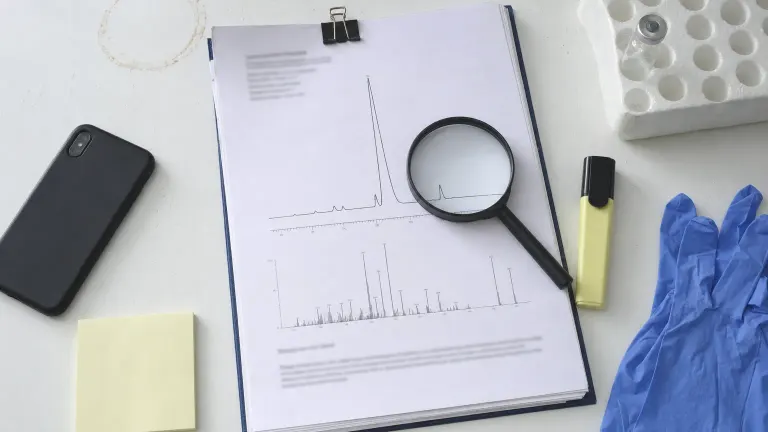
- HPLC (high-performance liquid chromatography) separates the main peptide from related impurities, such as sequences missing one amino acid, oxidized forms or incompletely deprotected fragments, and reports each as a percentage of the total peak area.
- Mass spectrometry (MS) confirms the peptide has the expected molecular weight and helps identify impurities. High-resolution LC-MS can show a single extra amino acid.
- Peptide content (assay) measures how much actual peptide is in the vial. A powder can be “99% pure” by HPLC and still contain a large share of water, salts or counter-ions such as trifluoroacetate.
- Amino acid analysis, water content and counter-ion tests round out a full specification.
The impurity thresholds in Ph. Eur. general monograph 2034 for synthetic peptides, cited by EMA’s 2025 guideline, are 0.1% reporting, 0.5% identification and 1.0% qualification.[2] For comparison, ICH Q3A’s thresholds for small-molecule drugs at a maximum daily dose of 2 g or less are tighter: 0.05%, 0.10% and 0.15% (or 1.0 mg per day).[3]
Sterility and endotoxin testing: USP chapters 71 and 85
Anything injected must be sterile and low in endotoxin.
- USP <71> Sterility Tests describes membrane filtration and direct inoculation methods to check that a batch is free of viable microorganisms. It is harmonized in part with the European and Japanese pharmacopeias.[5]
- USP <85> Bacterial Endotoxins Test measures endotoxin, a fragment of the outer membrane of certain bacteria that can cause fever and, in large amounts, shock. Endotoxin survives many sterilization steps, so a product can be sterile and still contain it. USP’s companion chapter <1085> gives guidance on running the test; the first harmonized version of <85> appeared in 2002.[6]
Sterility and endotoxin tests are among the most important differences between a pharmaceutical or properly compounded injectable and a “research chemical” vial. Our guide to 503A vs 503B compounding explains when compounders must meet these standards.
Certificates of analysis and their limits
A certificate of analysis (COA) is a document a manufacturer issues for a batch, listing tests and results. COAs from research-peptide sellers often show a single HPLC purity figure and a mass spectrum. Their limits:
- No sterility or endotoxin data. Most research COAs do not report USP <71> or <85> results at all.
- HPLC can miss things. A 2020 study used NMR to find undeclared mannitol making up 20% and 43% by weight of two commercially sourced custom peptides, a contaminant UV-based HPLC did not flag.[9] The authors concluded that trust should not replace verification, even for research chemicals.
- The COA may not match the vial. A COA describes one tested batch, if it is genuine. Nothing ties it to the product shipped without an independent chain of custody.
- Purity is not content. A “99%” figure says nothing about how many milligrams are in the vial.
What lab studies of gray-market peptides found
Independent testing has repeatedly found quality failures:
- Semaglutide from illegal online pharmacies (2024). Researchers bought vials from sites selling without a prescription. All three delivered vials were judged probable substandard or falsified products. Semaglutide content exceeded the label by 28.56% to 38.69%, measured purity was only 7.7% to 14.37% against a claimed 99%, and endotoxin was detected in every sample (2.1645 to 8.9511 EU/mg). The three branded pens ordered were never delivered.[8]
- Growth hormone secretagogues (2018). German and Norwegian anti-doping labs identified modified versions of GHRP-6, GHRP-2 and ipamorelin carrying an extra glycine, plus a growth hormone variant with an extra amino acid, in black-market products.[10]
- GHRH analogue (2014). A Belgian lab found a growth hormone-releasing hormone analogue with incomplete C-terminal amidation in a confiscated product, which the authors said showed poor pharmaceutical quality.[11]
FDA has raised similar concerns about peptides in compounding. In its safety review of BPC-157, FDA cited peptide-related impurity and characterization complexities and possible immunogenicity risk for some routes.[7]
What this means for patients
- Approved peptide drugs are made to registered specifications and tested batch by batch.
- Compounded peptides must meet USP and state standards, and 503B outsourcing facilities follow current good manufacturing practice.
- Research-use-only peptides carry no enforceable quality standard for human use.
For more context, see our FDA warning letters on peptides, online peptide sales legal risks and how to reconstitute peptides guides.
This is general information, not legal advice. Pharmacopeial texts are revised regularly; check the current official edition for exact requirements.