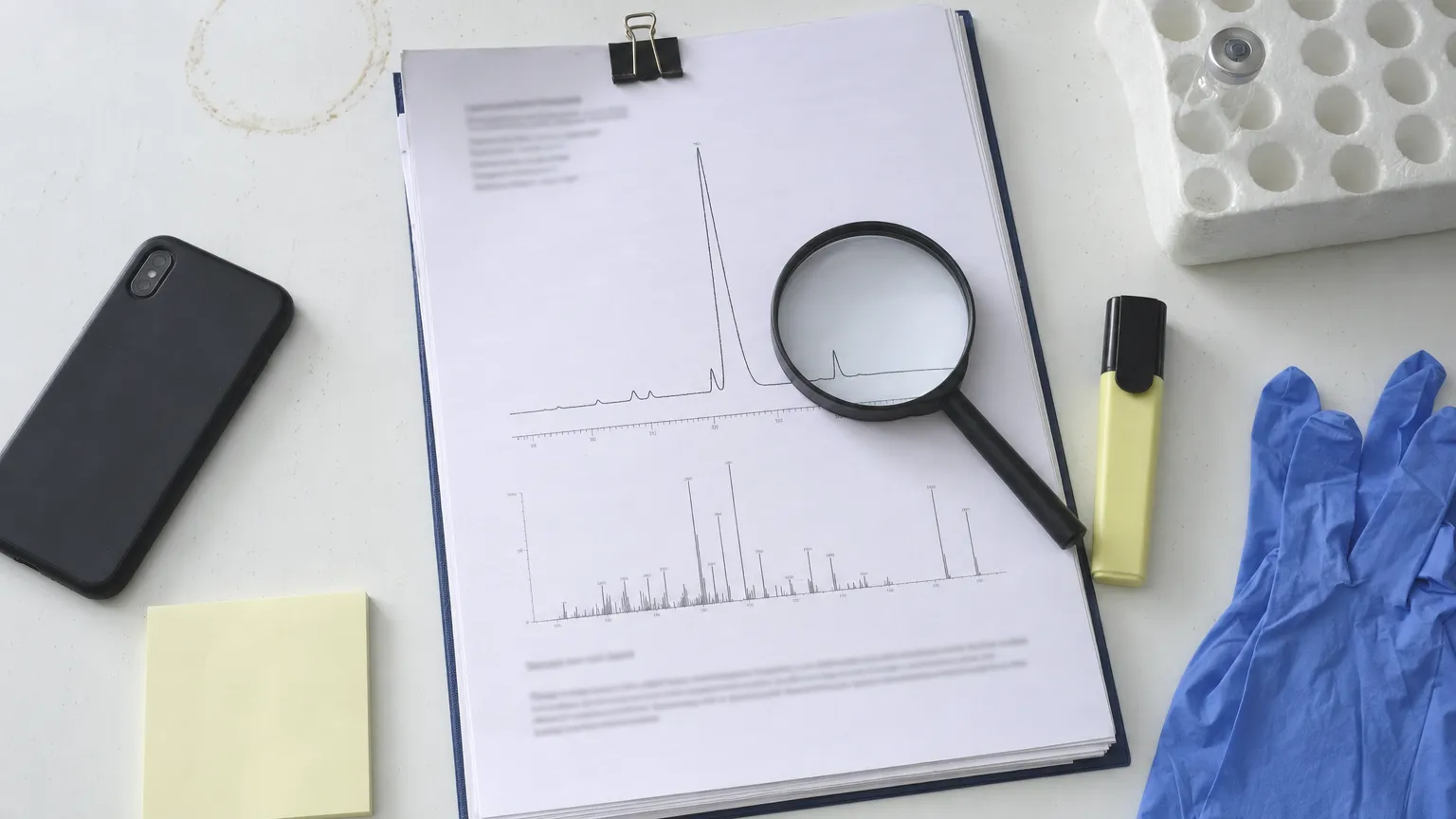
Quick answer: here is how to read a peptide COA (certificate of analysis): check five things in order: (1) the batch or lot number matches your vial; (2) identity is confirmed by mass spectrometry; (3) purity is reported by HPLC, with impurities listed; (4) peptide content, sterility and endotoxin results are present for anything injectable; and (5) an independent, accredited lab signed it.[3][4][5] A single “99% purity” line with no lab details is a red flag, not proof of quality.
This guide is educational. A COA is not a license to self-administer an unapproved product. FDA has flagged quality and safety concerns for several peptides sold this way.[9] For the wider standards, see peptide quality standards and our FDA and regulation hub.
What a COA is, and what it is not
A COA is a batch report: it lists the tests a manufacturer or lab ran on one lot and the results. It is only as trustworthy as the lab behind it and the link between that lot and the vial in your hand.
- Approved drugs are tested against a registered specification and inspected by regulators. Patients rarely see a COA because the release testing is built into approval.
- Compounded drugs must meet USP and state requirements; see 503A vs 503B compounding.
- “Research use only” products have no enforceable quality standard for human use. FDA’s research-use-only labeling applies to lab products not intended for use in people.[10] See compounded vs research-grade peptides.
The fields on a peptide COA, explained
| Field | What it tells you | What to look for |
|---|---|---|
| Product name, sequence, molecular formula | What the lab tested | Sequence and formula match the named peptide |
| Lot/batch number and test date | Which batch | Matches your vial label; recent date |
| Appearance | Physical form | e.g., white to off-white powder |
| Identity (mass spectrometry, MS) | Molecular weight matches the expected value | Observed mass vs theoretical mass, with the spectrum attached |
| Purity (HPLC) | Main peptide as % of UV-detected peaks | The chromatogram, method and wavelength; impurities listed |
| Peptide content (assay) | How much real peptide is in the powder by weight | A value in % or mg, separate from purity |
| Water content and counter-ion | Non-peptide mass (moisture, acetate or trifluoroacetate salts) | Reported, since they lower the actual peptide amount |
| Endotoxin (USP <85>) | Fever-causing bacterial fragments[4] | A result in EU/mg against a limit |
| Sterility (USP <71>) | Whether live microbes are present[3] | “Passes” with method noted, for injectables |
| Lab name, accreditation, signature | Who stands behind the results | Independent lab, ISO/IEC 17025 accreditation, named analyst[5] |
How to read a peptide COA, step by step
- Match the batch. The lot number and product name on the COA must match the vial. A generic COA with no lot number tells you nothing about your vial.
- Check identity by MS. The observed molecular weight should match the theoretical weight for that sequence. Look for the actual spectrum, not just a “conforms” statement.
- Read the HPLC chromatogram. You want one dominant peak and a list of any smaller ones. The purity figure is the main peak’s share of the total peak area.
- Find the impurity profile. Pharmaceutical standards do not stop at one purity number. Under the European approach for synthetic peptides, impurities above 0.1% must be reported, above 0.5% identified and above 1.0% qualified for safety.[1][2]
- Look for peptide content. Purity is not quantity. Water, salts and counter-ions such as trifluoroacetate can make up a large share of a powder that is “99% pure” by HPLC.
- Check endotoxin and sterility for anything meant to be injected. Endotoxin survives many sterilization steps, so sterile is not the same as endotoxin-free.[4][3]
- Verify the lab. Look up the lab’s name and accreditation. ISO/IEC 17025 sets requirements for the competence, impartiality and consistent operation of testing labs.[5] Contact the lab to confirm the report number is genuine.
What HPLC and MS can miss
- Non-UV-absorbing contaminants. A 2020 study found undeclared mannitol making up 20% and 43% by weight of two custom synthetic peptides, which UV-based HPLC did not flag. NMR revealed it.[6]
- Close relatives of the peptide. Anti-doping labs found black-market versions of GHRP-6, GHRP-2 and ipamorelin carrying an extra glycine, plus a growth hormone variant with an extra amino acid.[8] Only careful MS analysis catches these.
- Wrong amount. In a 2024 study, semaglutide vials bought online without a prescription had content 28.56% to 38.69% above the label, measured purity of 7.7% to 14.37% against a claimed 99%, and endotoxin in every sample.[7]
Red flags checklist
- No lot number, or a lot number that does not match your vial
- Only a purity percentage, with no chromatogram or MS spectrum
- Purity reported but no peptide content
- No endotoxin or sterility results for an injectable
- Testing done in-house by the seller, with no independent lab
- Lab name missing, unverifiable, or with no accreditation number
- Identical COA reused across many batches or products
- Images that look edited, or dates that do not make sense
- “Research use only” or “not for human consumption” on a product marketed for injection
COAs you may see from different sources
- A pharmacy dispensing an approved drug usually will not hand you a COA; the manufacturer’s batch release under its FDA approval stands in for it. Ask the pharmacist about the lot and expiry if you have concerns.
- A compounding pharmacy may be able to share testing information for the ingredients it used or, for outsourcing facilities, for finished batches. It is reasonable to ask whether sterility and endotoxin testing were done.
- A research-chemical seller typically posts a single-page report with an HPLC trace and a mass spectrum. Treat it as a claim to verify, using the steps above.
Whatever the source, the same questions apply: which batch, which tests, which lab, and does it match what you have.
Why third-party testing has limits too
Independent testing is better than a seller’s own report, but it only covers the sample sent to the lab. Without a chain of custody, nothing proves the tested sample came from the batch you received. Third-party testing also does not make a product approved, legal for human use, or correctly dosed. Our guides to research use only peptides and FDA warning letters on peptides cover the legal side.