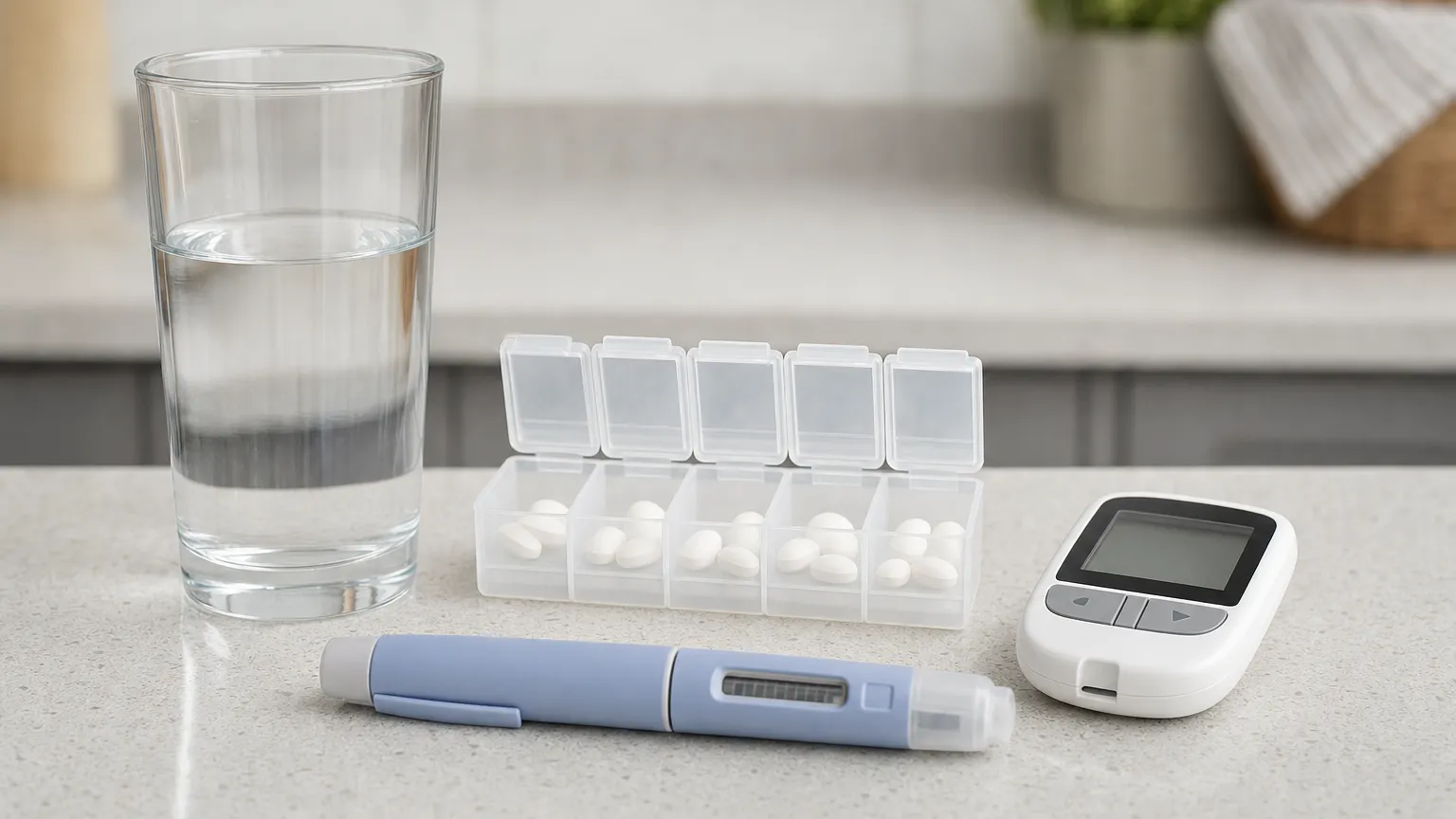
Quick answer: yes, Mounjaro and metformin can be taken together, and they often are. Mounjaro (tirzepatide) was studied as an add-on to metformin in its main diabetes trials; in SURPASS-2, adding it to metformin lowered HbA1c by 2.0 to 2.3 percentage points over 40 weeks.[1][3] The main things to watch are overlapping stomach side effects, low blood sugar if you also use insulin or a sulfonylurea, and staying hydrated.[1][4]
For background on the drug, see our tirzepatide profile. If you have weight-loss rather than diabetes questions, see how to get Mounjaro without diabetes.
How Mounjaro and metformin work together
They lower blood sugar in different ways. Metformin is a daily tablet taken with meals; immediate-release tablets usually start at 500 mg twice a day or 850 mg once a day, and extended-release at 500 mg once daily with the evening meal.[2] Mounjaro is a weekly injection that acts on both GIP and GLP-1 receptors. It boosts insulin release and lowers glucagon when blood sugar is high, slows stomach emptying and decreases food intake.[1]
Because the two act differently, their effects can add up. That is why several of the Mounjaro diabetes trials tested it on top of metformin.
What the trials found with metformin
| Trial | Who | Background treatment | Length | Comparison |
|---|---|---|---|---|
| SURPASS-2 | 1,879 adults | Metformin alone | 40 weeks | Semaglutide 1 mg |
| SURPASS-3 | 1,444 adults | Metformin, with or without an SGLT2 inhibitor | 52 weeks | Insulin degludec |
| SURPASS-4 | 2,002 adults with high heart risk | Metformin (95%), sulfonylureas and/or SGLT2 inhibitors | 104 weeks | Insulin glargine |
Source: Mounjaro prescribing information.[1]
SURPASS-2 is the clearest test of Mounjaro plus metformin. People already taking a stable metformin dose added Mounjaro 5, 10 or 15 mg, or semaglutide 1 mg.[1][3]
- HbA1c: fell by 2.0, 2.2 and 2.3 points on Mounjaro 5, 10 and 15 mg, versus 1.9 on semaglutide (from a baseline of 8.3%).[1]
- Reaching an HbA1c under 7%: 82% to 86% on Mounjaro versus 79% on semaglutide.[1]
- Body weight: fell by 7.6, 9.3 and 11.2 kg on Mounjaro, versus 5.7 kg on semaglutide.[1]
All Mounjaro doses were superior to semaglutide 1 mg for HbA1c.[3] For the bigger drug comparison, see semaglutide vs tirzepatide.
In the later heart outcomes trial, which compared Mounjaro with dulaglutide in 13,299 people with diabetes and heart disease, 81% were taking metformin at the start.[1]
Side effects of Mounjaro and metformin together
Both drugs commonly upset the stomach, so side effects can overlap.
| Side effect | Metformin (immediate-release) | Metformin (extended-release) | Mounjaro 5 / 10 / 15 mg |
|---|---|---|---|
| Diarrhea | 53% (placebo 12%) | 10% (placebo 3%) | 12 / 13 / 17% (placebo 9%) |
| Nausea or vomiting | 26% (placebo 8%) | 7% (placebo 2%) | Nausea 12 / 15 / 18% (placebo 4%) |
Sources: metformin and Mounjaro prescribing information. The trials are separate, so the columns are not directly comparable.[1][2]
In SURPASS-2, where everyone took metformin, the most common side effects were stomach-related and mostly mild to moderate: nausea in 17% to 22% on Mounjaro (18% on semaglutide), diarrhea in 13% to 16% (12%) and vomiting in 6% to 10% (8%).[3]
An expert consensus on GLP-1 side effects notes that GLP-1 drugs may make diarrhea worse in people taking metformin, especially if they also take omeprazole.[4] Mounjaro’s label says most nausea, vomiting and diarrhea happen while the dose is being raised and decrease over time.[1] Our guides on tirzepatide side effects and GLP-1 diarrhea cover how to manage them.
Low blood sugar risk
Neither drug often causes low blood sugar on its own. In SURPASS-2, blood sugar below 54 mg/dL occurred in 0.6%, 0.2% and 1.7% of people on Mounjaro 5, 10 and 15 mg with metformin, and 0.4% on semaglutide.[3] In children 10 and older taking Mounjaro with metformin alone, it occurred in 9% versus 4% on placebo.[1]
The risk rises when insulin or a sulfonylurea is added. Both labels say doses of those drugs may need lowering.[1][2] In one Mounjaro trial, low blood sugar affected about 10% to 14% of people also taking a sulfonylurea.[1]
Kidney function and dehydration
This is the safety point most worth discussing with your prescriber:
- Metformin carries a boxed warning for lactic acidosis, a rare but serious build-up of acid in the blood. Kidney impairment is the main risk factor, and metformin should not be used if eGFR (a kidney function measure) is below 30.[2]
- Mounjaro’s label warns of acute kidney injury from fluid loss, mostly in people with nausea, vomiting or diarrhea, and advises monitoring kidney function in those cases.[1]
So if stomach side effects leave you unable to keep fluids down, contact your clinician promptly rather than waiting. Metformin may also need to be paused around some contrast scans and procedures.[2]
Who should not take one or both
Each drug has its own list of people who should not use it:
- Mounjaro: not for people with a personal or family history of medullary thyroid cancer or MEN 2, or a known serious allergy to tirzepatide. It is also not recommended with severe gastroparesis.[1]
- Metformin: not for people with severe kidney impairment (eGFR below 30), metabolic acidosis including diabetic ketoacidosis, or a metformin allergy. Starting it is not recommended when eGFR is between 30 and 45.[2]
Both are approved for type 2 diabetes in children 10 and older, with lower maximum doses than in adults.[1][2]
Other practical points
- Dosing: Mounjaro starts at 2.5 mg weekly and rises by 2.5 mg steps after at least 4 weeks, up to 15 mg in adults.[1] See our tirzepatide dosage chart.
- Other tablets: Mounjaro slows stomach emptying, which can affect how oral medicines are absorbed. Its label mentions monitoring drugs like warfarin and changing or backing up oral birth control for 4 weeks after starting and after each dose increase.[1]
- Vitamin B12: metformin can lower B12; in trials lasting 29 weeks, about 7% of people developed low levels. The label advises checking B12 every 2 to 3 years.[2]
- Brands: Zepbound is the same drug as Mounjaro, approved for weight loss and sleep apnea. See Zepbound vs Mounjaro.
Questions to ask your clinician
- Should my metformin dose or form (immediate or extended-release) change as Mounjaro increases?
- Do my insulin or sulfonylurea doses need lowering?
- How often should my kidney function and B12 be checked?
- What should I do if I can’t keep fluids down?
This guide is general information, not medical advice. Do not start, stop or change either medicine without your prescriber.