Quick answer: there is no established MOTS-c dosage for people. MOTS-c has never been tested in a published human trial, and FDA says it found no human exposure data for it by any route.[1] Research doses come from mice (0.5 to 15 mg per kg), and the only human trial used a different molecule, the analog CB4211, at 25 mg a day.[1][4]
This page explains what doses researchers used, why they cannot be turned into a human dose, where the “5 mg” and “10 mg” numbers online come from, and what to ask a clinician. For the full background, see our MOTS-c profile and the MOTS-c topic hub.
What MOTS-c is
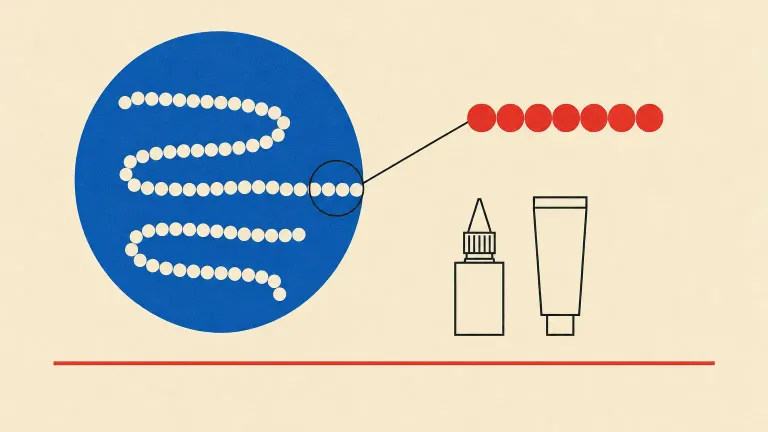
MOTS-c is a 16-amino-acid peptide encoded in mitochondrial DNA, discovered at the University of Southern California in 2015. In mice it appears to act mainly on skeletal muscle and switches on AMPK, an energy-sensing pathway.[2] For how it fits with similar molecules, see our guide to mitochondrial peptides research.
FDA’s 2026 review notes that the exact molecular target of MOTS-c is still unknown, which makes it hard to predict which organs a dose might affect.[1]
Why no human MOTS-c dose exists
A human dose is normally set in stages: animal toxicity studies, then a cautious first-in-human trial, then dose-finding studies. MOTS-c has not passed the first of these steps.
FDA’s evaluation for its July 2026 advisory meeting found:[1]
- No human data: no clinical studies, no pharmacokinetic data and no human exposure data by any route.
- No toxicity studies: no acute, repeat-dose or genetic toxicity studies in animals.
- No dose-response data: even the animal studies did not test how effects change across doses.
- Rapid breakdown: in a lab study, human blood quickly cut MOTS-c into shorter fragments, and FDA said it remains to be determined whether injected MOTS-c can reach active levels in people.
FDA’s guidance for first-in-human trials starts from the highest dose that caused no harm in animal toxicity studies, converts it by body surface area, and then divides it by a safety factor.[7] Without toxicity studies, that calculation cannot even begin.
MOTS-c doses used in mouse studies
These are the doses researchers gave mice. They are listed so you can see what the research actually tested, not as a guide for people.
| Study | Mouse dose | Schedule | Finding |
|---|---|---|---|
| Discovery study, high-fat diet[2][1] | 0.5 mg/kg/day | Daily, 8 weeks | About 20% lower weight than untreated mice |
| Insulin sensitivity[1] | 5 mg/kg/day | Daily | Better insulin-stimulated glucose uptake |
| Short-term obesity study[1] | 2.5 mg/kg twice daily | 3 days | Blood glucose fell by about half |
| After ovary removal[1] | 5 mg/kg/day | Daily, 12 weeks | Less weight gain and fat |
| Exercise, single dose[3][1] | 5 mg/kg | Once | Better treadmill performance at all ages |
| Exercise, older mice[1] | 15 mg/kg/day | Daily, 2 weeks | Changes in muscle glucose metabolism |
| Late-life treatment[3][1] | 15 mg/kg | 3 times a week | Better physical capacity |
Most of these doses were injected into the abdominal cavity (intraperitoneal), not under the skin.[1] That route is rarely used in people and absorbs differently. For why mouse results so often fail to carry over, see animal vs human peptide studies.
The CB4211 trial: an analog, not MOTS-c
CohBar, the company that licensed MOTS-c, developed a modified version called CB4211. Its phase 1a/1b trial is the closest thing to human MOTS-c dosing data.[5]
- Phase 1a: single and multiple rising doses in 65 healthy adults, used to pick a dose. The registry lists the doses only as “Dose 1” to “Dose 6”.[4][5]
- Phase 1b: 25 mg once daily under the skin for 4 weeks in 20 adults with obesity and fatty liver, against placebo.[4]
- Results: liver enzymes fell more than with placebo, but liver fat fell substantially in both groups. There were no serious adverse events; the only side effects in more than 10% of people were temporary, mostly mild to moderate injection-site reactions.[4]
- Outcome: in 2023, CohBar said the formulation was not suitable for further development and that its board might pursue dissolution.[6]
CB4211 is a different molecule, so its 25 mg dose says nothing reliable about MOTS-c itself. These results were also company-reported, not peer reviewed.
Where “5 mg” and “10 mg” MOTS-c doses come from
Searches for a MOTS-c dosage per day, per week, a dosage chart or a protocol PDF usually lead to numbers like 5 mg or 10 mg. The only regulatory trace of those figures is a compounding nomination that proposed 5 mg and 10 mg products for injection under the skin.[1]
- The nomination was withdrawn, and FDA reviewed MOTS-c on its own.[1]
- FDA said the nomination gave no information on how the product would be prepared or at what concentration.[1]
- Those figures are product sizes, not doses tested for safety or effect in anyone.
Side effects reported with MOTS-c
Because there are no human trials, side effects are unknown. FDA found no reports in its adverse event database through March 2025.[1] The U.S. Anti-Doping Agency says people who buy MOTS-c online report faster heart rate or palpitations, injection-site irritation, insomnia, immune reactions and fever.[10]
FDA’s main concern is immune reactions. Peptides injected under the skin can provoke antibodies, from harmless ones to severe reactions, and peptide clumping or impurities can make this worse.[1]
Regulatory status in 2026
- Not FDA-approved and not part of any approved drug.[1]
- Compounding: MOTS-c was previously in FDA’s category of substances with possible significant safety risks before the nomination was withdrawn.[8] FDA staff recommended against adding it to the 503A list.[1]
- July 2026 vote: FDA’s Pharmacy Compounding Advisory Committee voted 7 to 5, with 2 abstentions, to recommend it anyway. The vote is advisory, and FDA had not added MOTS-c to the list as of our last review.[9]
- Sport: MOTS-c is prohibited at all times, and USADA says an exemption is highly unlikely.[10] See peptides on the WADA prohibited list.
Products labeled “for research use only” are not made for people; see our guide to research-use-only peptides.
Questions to ask a clinician
- What human evidence supports using MOTS-c for my goal?
- How was this dose chosen, given that no human dose has been tested?
- Is there an FDA-approved treatment for my condition instead?
- Who makes the product, and how is its identity and sterility verified?
- What symptoms should make me stop?
MOTS-c is often paired with NAD+; for the evidence on that, see our guide to NAD+ injections. Talk to a licensed clinician before using any experimental peptide.