Quick answer: in ipamorelin vs tesamorelin, the two peptides raise growth hormone through different receptors and have very different evidence. Tesamorelin mimics GHRH and is FDA-approved as Egrifta for excess belly fat in adults with HIV, backed by phase 3 trials where deep belly fat fell 15.2% in 26 weeks.[1][7] Ipamorelin mimics ghrelin, has never been approved, and its only published efficacy trial, after bowel surgery, did not beat placebo.[4][5]
This guide compares how they work, how long they last, the evidence, side effects, dosing and legal status. For each drug in depth, see our ipamorelin profile, tesamorelin profile and the growth hormone peptides hub.
At a glance
| Ipamorelin | Tesamorelin | |
|---|---|---|
| Mimics | Ghrelin | GHRH |
| Size | 5 amino acids | 44 amino acids plus a fatty chain |
| Half-life | About 2 hours (IV) | About 8 to 11 minutes |
| FDA status | Never approved | Approved November 2010 |
| Approved use | None | Excess belly fat in adults with HIV and lipodystrophy |
| Largest published trial | 114 surgery patients | 412 adults with HIV |
| Human dose route | IV only | Under the skin of the abdomen |
Sources: ipamorelin studies,[2][3][4] tesamorelin labels and approval record.[1][15][6]
Two receptors, one goal
The pituitary gland releases growth hormone in response to two main signals, and each peptide copies one:
- Tesamorelin is the full human GHRH sequence with a short fatty chain attached to protect it. It acts on the GHRH receptor.[1]
- Ipamorelin activates the ghrelin (growth hormone secretagogue) receptor. When Novo Nordisk scientists described it in 1998, they called it the first selective secretagogue: in pigs, it released growth hormone about as strongly as the older peptide GHRP-6 without raising ACTH or cortisol, even at doses over 200 times higher than needed.[2]
That selectivity was shown in animals. A 2026 endocrine review adds that, in people, ipamorelin appears to spare the prolactin and cortisol rises seen with older ghrelin-type peptides.[14]
Both depend on a working pituitary. Tesamorelin’s label rules it out after pituitary surgery, head radiation or other damage to the hypothalamic-pituitary axis.[1]
How long each lasts
- Ipamorelin: in healthy men given IV infusions, its half-life was about 2 hours, and each dose caused a single growth hormone burst peaking at about 40 minutes.[3]
- Tesamorelin: the drug itself is gone within minutes, with a half-life of 8 minutes for Egrifta SV and 11 minutes for Egrifta WR.[15][1] Its effect lasts longer because it raises IGF-1, which rose 81% over 26 weeks of daily injections.[7]
Evidence compared
Tesamorelin:
- Phase 3 trial 1: in 412 adults with HIV, 2 mg daily cut deep (visceral) belly fat by 15.2% versus a 5.0% rise on placebo, and lowered triglycerides by 50 mg/dL.[7]
- Phase 3 trial 2: in 404 adults, visceral fat fell 10.9% versus 0.6%, reaching about 18% at 12 months. People switched to placebo quickly lost the improvement.[8]
- Fatty liver: in 61 adults with HIV, liver fat fell 37% relative to placebo over a year, and 35% reached normal liver fat versus 4%.[9]
Ipamorelin:
- Healthy volunteers: single IV infusions at five dose levels raised growth hormone in a dose-related way.[3]
- After bowel surgery: in 114 patients, 0.03 mg/kg IV twice daily did not significantly shorten the time to a tolerated meal (25.3 vs 32.6 hours).[4]
- Unpublished: a 320-patient dose-finding trial finished in 2014 without posting results.[11]
Belly fat: opposite signals
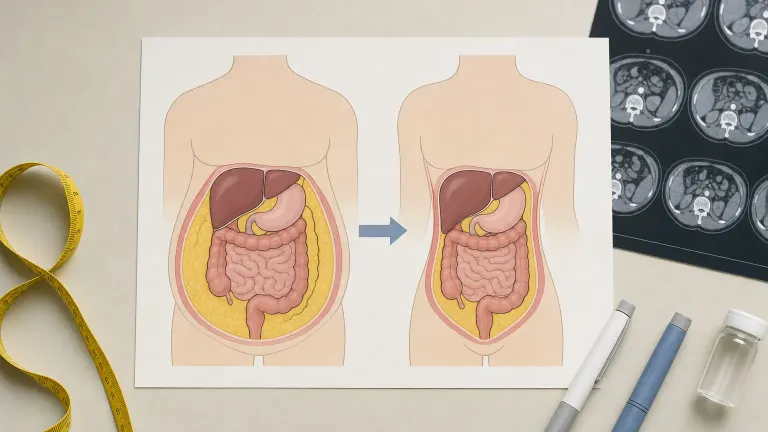
Tesamorelin specifically reduces deep belly fat; its label calls it weight-neutral and says it is not for weight loss.[1] Ipamorelin is often marketed for fat loss, but the animal evidence points the other way: in mice, two weeks of ipamorelin increased body weight, body fat and food intake, through a pathway that did not depend on growth hormone.[10] No human study has measured fat with ipamorelin. For tesamorelin’s full results, see tesamorelin results.
Who each was tested in
- Tesamorelin: adults with HIV on antiretroviral treatment who had excess belly fat; 86% of the first phase 3 trial’s 412 participants were men.[7] Across its trials, 740 people with HIV and lipodystrophy received the drug.[1]
- Ipamorelin: eight healthy men at each of five IV dose levels, and 114 adults in hospital after small or large bowel resection.[3][4]
Neither drug has been tested in healthy adults using it for fitness, recovery or anti-aging, which is how both are often promoted. Tesamorelin’s label also notes that it has not been studied in people over 65.[1]
What happens after stopping
With tesamorelin, the gains depend on staying on the drug. In the second phase 3 trial, people switched to placebo after 6 months quickly regained visceral fat, while those who continued kept their reduction.[8] Ipamorelin’s effect on growth hormone fades within hours of a dose, and no study has followed people after a course of treatment.[3]
Side effects compared
| Ipamorelin (IV, after surgery) | Tesamorelin (label, 26 weeks) | |
|---|---|---|
| Most notable | Low potassium 12.5% vs 3.4%; insomnia 10.7% vs 5.2% | Injection-site reactions 17% vs 6%; joint pain 13% vs 11% |
| Blood sugar | High blood sugar at discharge 14.3% vs 8.6% | HbA1c of 6.5% or higher in 5% vs 1% |
| Fluid-related | Not reported | Leg swelling 6% vs 2%; carpal tunnel symptoms |
| Hormone levels | Not reported | IGF-1 over 2 standard deviations above normal in 47% |
| Antibodies | Not reported | Anti-drug antibodies in about half, without loss of effect |
Sources: FDA’s ipamorelin review[5] and the tesamorelin label.[1]
Two ipamorelin patients died after complications of colon cancer surgery; FDA said it is unclear whether the drug played a role.[5] Tesamorelin’s label also warns about allergic reactions, a possible increased risk of tumors, and use in pregnancy or active cancer.[1] See our ipamorelin side effects guide for more.
Dosing compared
- Tesamorelin: 1.4 mg once daily for Egrifta SV or 1.28 mg once daily for Egrifta WR, which give similar exposure to the 2 mg dose used in the phase 3 trials. The two products are not interchangeable.[15][1]
- Ipamorelin: no label dose. Human studies used only IV doses; FDA found no human data for injection under the skin.[5]
Details are in our tesamorelin dosage and ipamorelin dosage guides.
Legal status
- Tesamorelin: prescription drug approved by FDA on November 10, 2010.[6]
- Ipamorelin: in October 2024, FDA’s compounding advisers voted 0 to 12, with one abstention, against adding it to the list traditional pharmacies may use.[12] FDA lists ipamorelin acetate as a significant safety risk for outsourcing facilities.[13]
Some people combine the two; see tesamorelin and ipamorelin for why that pairing is untested. For ipamorelin’s usual partner, see CJC-1295/ipamorelin vs tesamorelin.
Questions to ask a clinician
- Is my goal one that either drug has been tested or approved for?
- If tesamorelin, how will we track IGF-1, blood sugar and belly fat?
- If ipamorelin, what human evidence supports the dose and route?
- What should I expect when I stop?