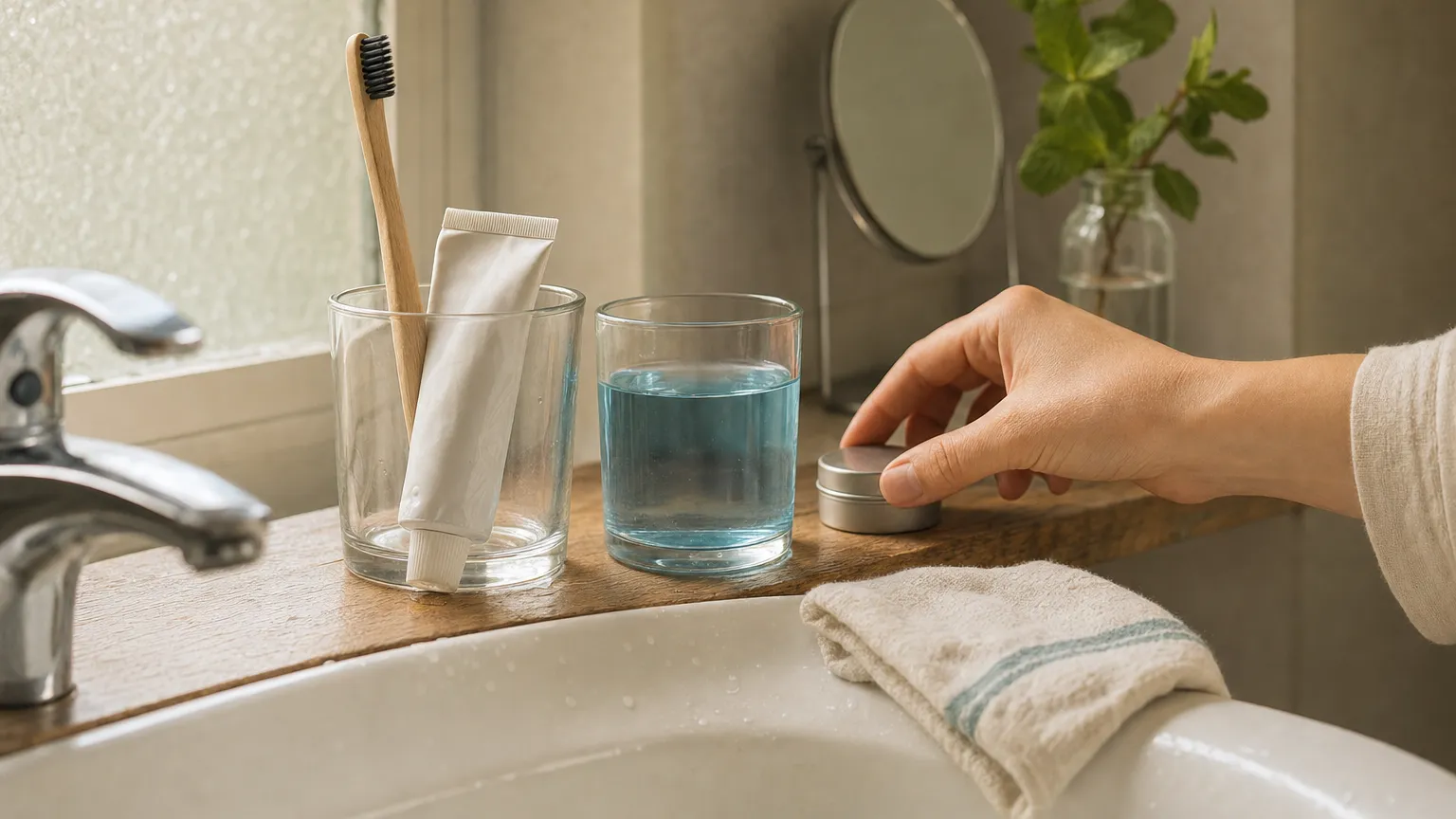
The best-studied peptides for oral health help with one narrow job: a self-assembling peptide called P11-4 may help early enamel lesions (white spots) remineralize, especially when used with fluoride.[3][4] Peptide mouthwashes aimed at plaque and gum disease are still experimental.[9][10] None replaces the basics: fluoride toothpaste, which a Cochrane review found prevents cavities compared with non-fluoride toothpaste, and regular dental care.[1]
This guide explains what each peptide does, how strong the evidence is, and what to ask your dentist. It is part of our peptide basics hub.
Evidence-graded table
| Peptide or treatment | Evidence level | What was shown | FDA status | Our profile |
|---|---|---|---|---|
| Fluoride toothpaste (not a peptide) | Standard of care | Prevents cavities vs non-fluoride toothpaste[1] | Standard care (OTC) | Not applicable |
| P-15 peptide bone graft | FDA-approved for this use (device) | Better bone fill than graft alone (73% vs 51%) in gum disease defects[12] | Device approval 1999 for periodontal bone defects[11] | Not applicable |
| Self-assembling peptide P11-4 | Human RCTs | Early lesions regressed more with P11-4 plus fluoride than fluoride alone[3] | Not an approved drug; US regulatory status unclear | Not applicable |
| Histatin-based rinse (P-113) | Small human studies | Less gum bleeding at one dose in experimental gingivitis[10] | Not approved | Not applicable |
| Targeted antimicrobial peptide (C16G2) | Small human studies | Fewer cavity-causing bacteria in a pilot[9] | Not approved | Not applicable |
Start with what works: fluoride and your dentist
Tooth decay starts when bacteria in plaque turn sugars into acid, which dissolves minerals from enamel. Early on, this shows up as a chalky white spot. If the process continues, the surface collapses into a cavity that needs a filling.
The proven steps are simple: brush twice a day with fluoride toothpaste, cut back on frequent sugary snacks and drinks, clean between teeth, and see a dentist regularly. A Cochrane review of 96 studies supports fluoride toothpaste over non-fluoride toothpaste for preventing cavities.[1] Dentists add fluoride varnish, sealants or prescription-strength toothpaste for people at higher risk.
P11-4: a peptide scaffold for early enamel lesions
P11-4 is an 11-amino-acid peptide designed in a lab. Applied to an early lesion, it seeps into the porous enamel and assembles into a fiber network that attracts calcium and phosphate from saliva, helping minerals rebuild from within.
- First safety study (2013): 15 adults with white spot lesions received one application. Lesions shrank by day 30, and only 2 of 11 adverse events were possibly related to treatment.[2]
- Children’s trial (2018): in a randomized single-blind study of children with active early lesions on newly erupted molars, P11-4 plus fluoride varnish beat fluoride varnish alone on every measure at 3 and 6 months, with no adverse events reported.[3]
- Braces (2026): in a triple-blind trial of 25 teenagers with fixed braces, a home P11-4 gel with fluoride for 18 months led to fewer new lesions (7.2% vs 14.5% of surfaces) than fluoride gel alone.[6]
Evidence reviews are mixed. A 2022 meta-analysis of 6 trials and 12 lab studies found P11-4 remineralized early lesions better than comparison treatments but called for long-term studies.[4] A 2023 meta-analysis, with half its trials at high risk of bias, concluded it was uncertain whether self-assembling peptides improve white spot lesions.[5] In a 2026 head-to-head trial, another biomimetic treatment outperformed P11-4 over 12 months.[7]
A US Army dental study of P11-4 with fluoride for early lesions between teeth began enrolling in 2026.[8]
Who might be offered P11-4?
Based on the trials so far, the people most likely to be offered a P11-4 treatment are those with early, non-cavitated lesions that a dentist wants to monitor rather than drill:
- children with active white spots on newly erupted back teeth;[3]
- teenagers wearing fixed braces, who are prone to white spots around the brackets;[6]
- adults with early lesions on smooth surfaces or between teeth.[2][8]
It is applied in the dental office (or, in some studies, as a home gel) after the tooth is cleaned. It does not whiten teeth, and a lesion still needs checkups to make sure it is not progressing.
Antimicrobial peptide rinses: still in the lab and early trials
Your body makes natural antimicrobial peptides, such as histatins in saliva and LL-37 in skin and immune cells. Researchers have tried to turn peptides like these into mouth rinses.
- Histatin-based P-113: in a phase 2 study of 294 healthy volunteers who stopped brushing for four weeks, the 0.01% rinse reduced gum bleeding compared with placebo; other measures showed only trends.[10]
- C16G2: a designed peptide that targets Streptococcus mutans, the main cavity-causing bacterium, while sparing most other mouth bacteria. In a small pilot, the rinse reduced S. mutans, acid production and enamel mineral loss.[9]
Neither has become a standard product. For background on these molecules, see our guides to antimicrobial peptides research and LL-37 vs defensins vs magainin.
An approved dental peptide: P-15 bone graft
The clearest regulatory success is surgical. In 1999, FDA approved a bone graft material that pairs bovine bone mineral with P-15, a synthetic peptide that mimics a cell-binding part of collagen, for filling bone defects caused by moderate or severe gum disease.[11] In a 33-patient trial, defects treated with the combination filled 72.9% on average versus 50.7% with the bone mineral alone.[12] It is used by periodontists during surgery, not at home.
Peptides in toothpaste and cosmetics
Some toothpastes and whitening products now advertise “peptides.” Ask what peptide, at what concentration, and what trial supports that specific product. Many cosmetic-style claims rest on lab data. Our guide to cosmetic peptides evidence explains how to judge such claims, and are peptides safe covers general safety.
Questions for your dentist
- Is this spot an early lesion that could remineralize, or a cavity?
- Would fluoride varnish, sealants or a peptide treatment help me?
- How often should I come back to check this lesion?
- Is my gum bleeding a sign of gum disease?