Matrixyl clinical studies are thinner than the ingredient’s popularity suggests: the best evidence is a single 2005 split-face trial in 93 women, in which a moisturizer with 3 ppm palmitoyl pentapeptide-4 reduced fine lines and wrinkles more than the same moisturizer without it over 12 weeks.[2] That trial was run by a skincare company, and most later studies are small, short, or test Matrixyl mixed with other actives.[6]
This page reviews each published human study, what it measured and where the gaps are. For the basics, see our peptide basics hub.
Bottom line
| Study | Design and size | Result |
|---|---|---|
| Pal-KTTKS moisturizer (2005) | Randomized, double-blind, split-face; 93 women, 12 weeks | Fewer wrinkles vs control side; well tolerated[2] |
| Multi-ingredient creams (2009) | Two randomized split-face studies; 42 and 35 women, 4 weeks | Smoother crow’s feet, but products contained several actives[3] |
| Pentapeptide-4 vs Argireline (2023) | Randomized, double-blind; 21 women, 8 weeks | Pentapeptide-4 appeared better, but the trial was very small[4] |
| Matrixyl 3000-type eye cream (2024) | 12-week clinical study | Better hydration and elasticity; several actives combined[5] |
What Matrixyl is
“Matrixyl” is a trade name for a family of cosmetic peptides:
- Matrixyl (original): palmitoyl pentapeptide-4, also called pal-KTTKS. It is a five-amino-acid fragment of type I collagen with a fatty acid attached to help it enter skin.
- Matrixyl 3000: two peptides, palmitoyl tripeptide-1 (pal-GHK) and palmitoyl tetrapeptide-7.[8]
- Newer versions use different peptides. We found no peer-reviewed human trials of them.
These are “signal peptides,” meant to tell skin cells to make more collagen.[9]
The key studies
The lab origin (1993). Researchers studying how collagen regulates itself found that the pentapeptide KTTKS was the smallest piece needed to strongly stimulate collagen and fibronectin production by fibroblasts in culture.[1] This is the scientific basis for Matrixyl.
93 women, 12 weeks (2005). White women aged 35 to 55 applied a moisturizer with 3 ppm pal-KTTKS to one side of the face and the same moisturizer without it to the other side. Both computer image analysis and expert graders found a significant reduction in wrinkles and fine lines on the peptide side, and participants also noticed improvement. The peptide was well tolerated.[2] The authors worked for a major consumer products company.
Multi-ingredient eye-area studies (2009). In two randomized, split-face studies with 42 and 35 women, several products containing niacinamide, pal-KTTKS, another peptide and carnosine improved the smoothness of crow’s feet after 4 weeks, measured by 3D skin imaging.[3] Because each product contained several actives, the peptide’s own effect can’t be separated.
Pentapeptide-4 vs Argireline (2023). In a small Indonesian double-blind trial, 21 women applied a palmitoyl pentapeptide-4 cream, an acetyl hexapeptide-3 (Argireline) cream or placebo around the eyes for 8 weeks. Pentapeptide-4 appeared to perform best, but the authors called it an initial study needing larger samples.[4] Our Matrixyl vs Argireline comparison covers that matchup in detail.
Eye cream with Matrixyl 3000 peptides (2024). A Chinese study tested an eye cream combining palmitoyl tripeptide-1, palmitoyl tetrapeptide-7, a yeast ferment and another active. After 12 weeks, skin hydration rose 28%, elasticity 19% and ultrasound collagen density 55%.[5] Again, the mix of ingredients means the peptides’ contribution is unknown.
Does Matrixyl get into the skin?
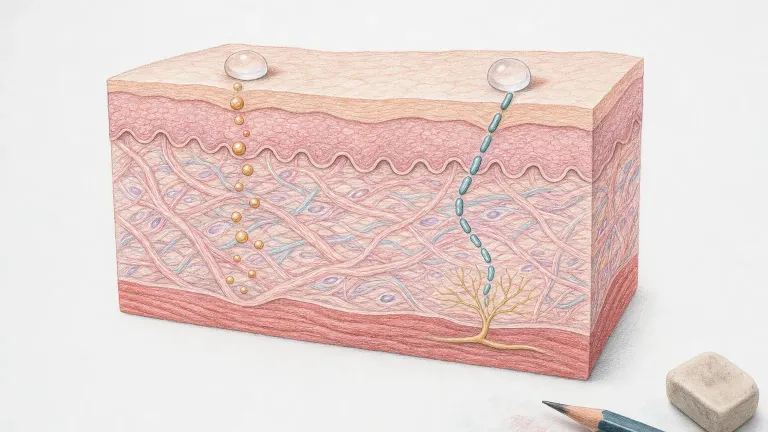
This is the central question. Skin’s outer layer blocks most molecules that are large or water-loving, and most peptides are both.
- A 2022 review concluded that most anti-wrinkle peptides are poor candidates for skin penetration and that enhancement methods are needed for them to reach the deeper skin where collagen is made.[7]
- A 2026 study in three volunteers used advanced mass spectrometry after applying a Matrixyl 3000 serum. Both peptides were detected throughout the outermost skin layer, but only on the surfaces of cells near the top, not inside them.[8]
Attaching a fatty acid (the “palmitoyl” part) helps, but how much reaches living skin cells in everyday use is still unclear.
Established vs preliminary
Established:
- KTTKS and its palmitoyl form stimulate collagen production in cell cultures.[1][6]
- Pal-KTTKS at low concentrations is well tolerated in a moisturizer.[2]
Preliminary:
- How large and lasting the wrinkle benefit is in real-world use.
- Whether Matrixyl 3000 works on its own in people.
- How Matrixyl compares with proven options such as retinoids and sunscreen.
Limitations
- Industry funding. The largest trial, and the 2009 studies, were run by skincare companies.[2][3]
- Short follow-up. Studies lasted 4 to 12 weeks.
- Mixed formulas. Many products and studies combine several actives.[3][5]
- Cosmetic rules. In the US, cosmetics don’t need to prove they work. A product claiming to change skin structure, such as regenerating cells, would be treated as a drug.[11]
Reading Matrixyl claims on product labels
Marketing for Matrixyl products often quotes large percentage improvements. A few things to check:
- Is the number from a lab dish? Collagen increases in cell cultures don’t tell you what happens on a face.[1]
- Who ran the test? Supplier or brand testing is usually not peer reviewed.
- Was there a control? Without a placebo or untreated side, improvements may come from moisturizing alone. In the 2005 trial, the comparison was the same moisturizer without the peptide, which is the right design.[2]
- How much is in the product? Labels rarely list concentration, so you can’t tell whether a product matches tested amounts.
Safety
Matrixyl peptides have a good safety record as cosmetic ingredients. A 2026 safety framework from industry scientists evaluated palmitoyl pentapeptide-4 among other cosmetic peptides using bioinformatic screening for toxicity and allergy risk.[10] As with any skincare product, stop if you get persistent redness or irritation.
What’s next
Research is shifting toward better delivery, such as encapsulation and microneedles, to get peptides deeper into skin.[7] What’s missing is independent, longer, placebo-controlled trials that test Matrixyl alone and against a retinoid.
Related reading
- GHK-Cu vs Matrixyl and the GHK-Cu profile
- Cosmetic peptides: what the evidence shows
- Peptide cream vs serum
- Copper peptides vs retinol
A dermatologist can help you put peptides in context with treatments that have stronger evidence, like daily sunscreen and retinoids.