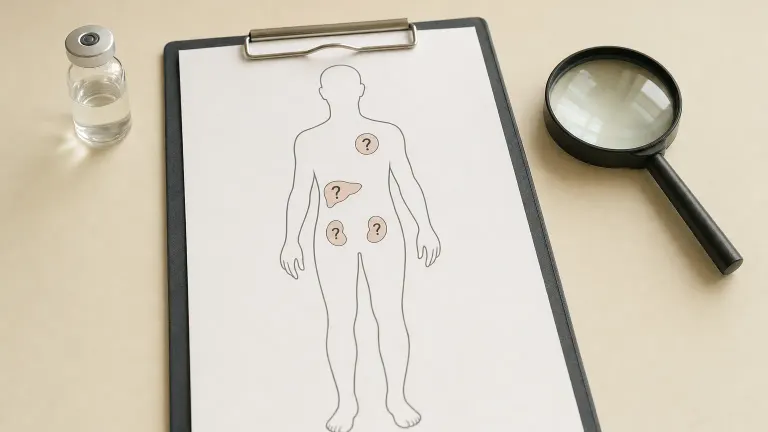
Quick answer: KPV side effects in people are unknown. FDA’s 2026 review found no clinical studies or human exposure data for KPV by any route, no animal toxicity studies and no adverse event reports, and concluded that its potential risks in humans are unknown.[1] The main concrete risks come from product quality: impurities, clumped peptide and mislabeled products.[1][7]
This page explains what is and is not known about KPV safety, why “no reports” does not mean “safe,” and who should be especially careful. For dosing, see our KPV dosage guide; for the peptide itself, the KPV profile; and for related compounds, the healing and gut peptides hub.
What FDA found when it reviewed KPV
FDA evaluated KPV for its compounding advisory committee in July 2026. On safety, its findings were:
| Question | FDA’s finding |
|---|---|
| Human clinical studies | None found, by any route |
| Human pharmacokinetics (absorption and clearance) | None found |
| Animal toxicity studies | None found |
| FDA adverse event reports (FAERS) | No reports |
| Food and supplement complaint system | No reports |
| Immune-reaction (immunogenicity) data | None found |
Source: FDA’s July 2026 presentation.[1]
FDA’s conclusion was that there is a lack of both clinical and animal safety information, that it is concerned about the lack of human data for KPV given by any route, and that the potential safety risks in humans are unknown.[1] On its list of bulk substances that may pose safety risks, FDA states it lacks important information about whether KPV would cause harm if given to people.[2]
Why nobody knows KPV’s side effects
Side effects are normally found in three steps: animal toxicity tests at rising doses, small human safety trials, and then larger trials with careful tracking. KPV has skipped all three.
The published research is about whether KPV reduces inflammation, mostly in mice with chemically induced colitis. Those studies were not designed to look for harm. The Emory team that published the best-known study gave mice KPV in their drinking water and measured colon inflammation, not toxicity.[4] Nanoparticle versions of KPV did not damage gut cells grown in the lab,[5][6] but that is a narrow test, not a safety study.
Possible risks, based on what is known
Without human data, the risks below are reasonable concerns rather than measured side effects.
- Immune reactions. Peptides can clump (aggregate) and carry impurities left over from manufacturing, both of which can trigger the immune system. FDA said it found no human data to assess this risk for KPV and listed it as a specific concern.[1]
- Impurities and identity. FDA found KPV sold under one name for different chemical forms, and that the certificates of analysis it reviewed lacked impurity, clumping and microbial testing. It judged both forms “not well-characterized.”[1]
- Contamination and dosing errors. A 2026 medical review of unregulated injectable peptides lists contamination, manufacturing impurities and inaccurate dosing among the main hazards.[7] A 2026 review of peptide use in sport, which names KPV among peptides promoted for anti-inflammatory effects, notes that such products are often mislabeled or contaminated.[8]
- Injection problems. KPV is sold as injections even though no study has tested injected KPV for gut inflammation.[1] Any non-sterile injectable carries a risk of infection.
Does KPV darken the skin?
KPV comes from alpha-MSH, the hormone that drives tanning. A 2008 research review described KPV as keeping alpha-MSH’s anti-inflammatory effect while lacking its pigment effect, which is one reason researchers became interested in it.[3] FDA likewise reported that KPV lacked the skin-darkening activity of alpha-MSH in lab studies and does not appear to act on the melanocortin receptors that cause it.[1]
That makes KPV different from tanning peptides such as Melanotan 2, which act directly on melanocortin receptors. Still, nobody has checked skin, moles or pigment in people who use KPV.
Side effects by route
| Route | What is known |
|---|---|
| Capsules (by mouth) | The route used in mouse studies; no human data[4][1] |
| Injection | Never tested for gut inflammation; immune-reaction and sterility concerns[1] |
| Cream or gel | KPV does not pass through skin well, which may limit whole-body effects, and its effect too[1] |
| Nasal spray | Offered online; no studies found[1] |
For a closer look at oral products, see our KPV capsules guide.
Who should be especially careful
- People with Crohn’s disease or ulcerative colitis. KPV has only been tested in mice. FDA noted that approved therapies with established benefit exist for many inflammatory diseases.[1] Stopping or delaying prescribed treatment can let inflammation flare.
- Pregnant or breastfeeding people. FDA found no human data and no animal toxicity studies of any kind, so there is nothing to go on.[1]
- People with a weakened immune system or on several medicines. Interactions have never been studied.
- People with cancer or a history of cancer. See our separate page on KPV and cancer for what the research does and does not show.
- Athletes. Check with your anti-doping organization before using any unapproved substance.
KPV in blends
KPV is also sold as part of the KLOW peptide blend, alongside BPC-157, TB-500 and GHK-Cu. Combining several unstudied or lightly studied peptides adds unknowns rather than removing them. For the other ingredients, see BPC-157 side effects and TB-500 side effects.
Legal status and what it means for safety
KPV is not FDA-approved.[1] FDA staff recommended in July 2026 against letting pharmacies compound with it, citing the lack of safety data, but the advisory committee voted in favor.[1][9] FDA had not acted on the vote as of our last review. Even if compounding is allowed later, that would not mean KPV has been shown to be safe or effective; it would mean licensed pharmacies could prepare it under compounding rules.
When to stop and get help
If you have used a KPV product and develop hives, swelling of the face or throat, trouble breathing, a hot or spreading area of redness at an injection site, fever, severe stomach pain or bloody stools, stop using it and seek medical care. Tell the clinician exactly what product you used. You can also report problems to FDA’s MedWatch program, which helps fill the data gap.
Questions to ask a clinician
- Is my condition well controlled with approved treatment, and what else could help?
- What warning signs should make me stop a supplement or peptide?
- Could this product affect my lab tests, other medicines or an upcoming procedure?
For better-studied options, see our guide to the best peptides for gut health.
This is general information, not medical advice.