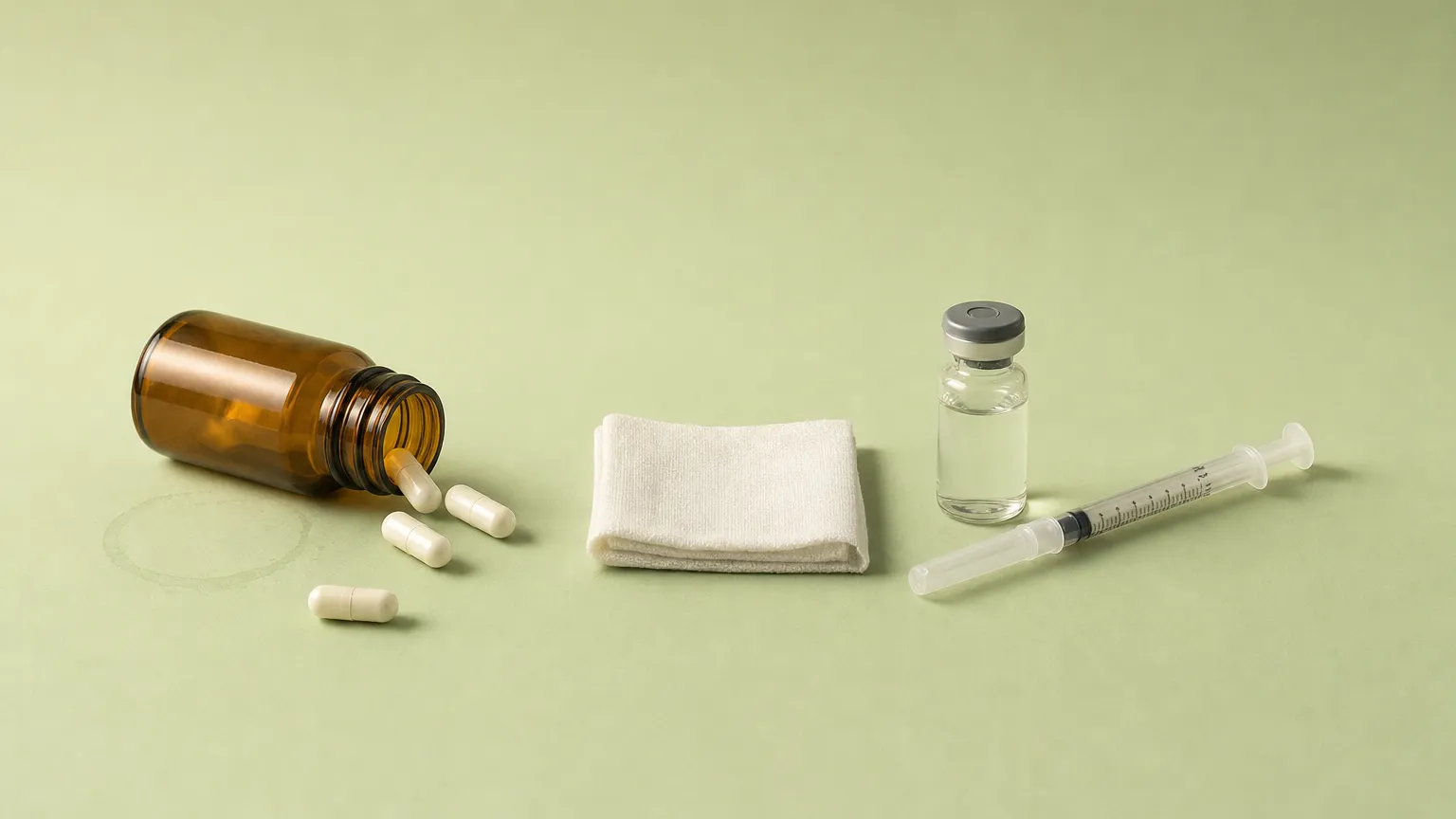
BPC-157 oral vs injectable is one of the most common questions about this unapproved peptide. The direct answer: neither route has been proven to work in people. BPC-157 is unusually stable in stomach acid and showed effects when given in drinking water to rats, but human oral absorption has never been measured, and the only oral human trial (42 volunteers, 2015) never published results.[1][3][6] The few human pilot studies all used injections or infusions.[1]
Oral vs injectable BPC-157 at a glance
| Oral (capsules, tablets, liquid) | Injectable (under the skin, into a joint or IV) | |
|---|---|---|
| Rationale | Resists breakdown in gastric juice[1] | Bypasses the gut |
| Animal evidence | Rat studies using drinking water, mostly from the original Zagreb group[3] | Most rat tendon and muscle studies[12] |
| Human data | One registered oral safety trial; no results posted[6] | Three small uncontrolled pilots[1] |
| Absorption in blood | Not measured in humans | Half-life under 30 minutes in rats and dogs[2] |
| Main added risks | Unknown dose actually absorbed | Infection, injection-site reactions[5] |
| Legal status | Not a legal supplement[11] | Not an approved drug[5] |
Why oral BPC-157 is even possible
Most peptides are digested in the stomach like any other protein, which is why drugs such as insulin are injected. BPC-157 is different: it was derived from a protein in human gastric juice, and a 2026 pharmaceutics review confirms it shows “unusual stability” there, with activity reported by oral, injected and topical routes in animals.[1]
The Croatian group that developed it has long described it as a natural protectant of the stomach lining.[4] In a 2021 rat study from that group, BPC-157 given either by abdominal injection or in drinking water helped heal a surgically damaged junction between thigh muscle and tendon.[3]
Stability in the stomach is not the same as absorption into the blood, though. No study has measured how much intact BPC-157 reaches the circulation after a person swallows it.[1]
What injected BPC-157 does in the body
The only formal pharmacokinetic study, in rats and dogs in China, tested IV and intramuscular injections, not oral doses:[2]
- Half-life: under 30 minutes.
- Intramuscular bioavailability: about 14% to 19% in rats and 45% to 51% in dogs.
- Breakdown: quickly cut into small peptide fragments and single amino acids, then excreted in urine and bile.
The 2026 review notes a puzzle: blood levels fall within minutes, but effects in animals last hours to days. That gap makes it hard to design any dose, oral or injected.[1]
Human evidence by route
Oral. In 2015, the company PharmaCotherapia registered a phase 1 trial of PCO-02, a 1 mg BPC-157 tablet, in 42 healthy volunteers in Tijuana, Mexico, to study safety and blood levels. Its status is listed as unknown and no results have been posted.[6]
Rectal. The ulcerative colitis trials run with Croatian drugmaker Pliva used enemas. FDA’s 2026 review says they did not clearly beat placebo and were never fully published.[5]
Injected. The three published pilots, which together include fewer than 30 people and no comparison groups, all used injections or infusions:[1]
- Knee joint injections: 14 of 16 patients reported less pain on a phone survey.[7]
- Bladder injection: 10 of 12 women with interstitial cystitis reported complete relief.[8]
- IV infusion: 2 adults had no measurable changes in safety tests.[9]
The next rigorous test is also injected: a University of Arkansas trial plans to randomize 30 people to daily under-the-skin BPC-157 or saline for 90 days after rotator cuff surgery, starting in January 2027.[10]
Gut vs injury: does the route match the goal?
Online advice often says to take BPC-157 by mouth for gut problems and inject it near an injury for joints or tendons. That logic follows the animal research, where oral dosing was often used for gut models and local or abdominal injections for musculoskeletal ones, but it has never been tested in a human study comparing routes.[1] “Inject near the injury” is also unproven: in rats, abdominal injections and drinking water both reached distant tendons.[3]
Side effects and safety by route
- Both routes: human safety is largely unknown. Cleveland Clinic notes BPC-157 has not been well studied in people, so its side effects are not known, and that a link to cancer growth is a theoretical concern.[13]
- Injections: FDA described reports of injection-site redness and swelling, and an ER visit for shortness of breath, with causes unclear.[5] A 2026 review warns that unregulated injectable peptides carry risks of contamination, infection and dosing errors.[14]
- Oral: fewer procedure risks, but the dose that actually reaches the body is unknown, and capsule products are just as unregulated.[11]
Legal status of capsules and injections
- Not a supplement: the Department of Defense’s Operation Supplement Safety says BPC-157 “is not a dietary ingredient” and is an unapproved drug, whether taken by mouth, by injection or as a nasal spray.[11]
- Not approved: FDA has not approved any BPC-157 product. Advisers reportedly voted in July 2026 to allow it in compounding, but the vote is not binding.[5] See our BPC-157 legal status guide.
- Sport: banned at all times by WADA, whatever the route.[15]
“Arginate” and “stable” salts
Some sellers market BPC-157 arginate or other salt forms as better absorbed by mouth. We found no published studies supporting that claim. FDA notes that BPC-157 has no official drug name and that different salts and forms are sold under the same name.[5]
Questions to ask a clinician
- What would we expect this to do that standard treatment for my condition does not?
- If I am considering any route, how would we check product quality and monitor for side effects?
- Am I drug-tested at work or in sport?
The verdict
Oral BPC-157 has a plausible biological rationale and some rat data, but zero published human evidence. Injected BPC-157 has slightly more human data, all of it uncontrolled, plus the added risks of injecting an unregulated product. Neither route is proven, and the difference between them is mostly a matter of unknowns. Compare it with other options in BPC-157 vs TB-500, BPC-157 vs GHK-Cu and the healing peptides hub.
This is general information, not medical advice.